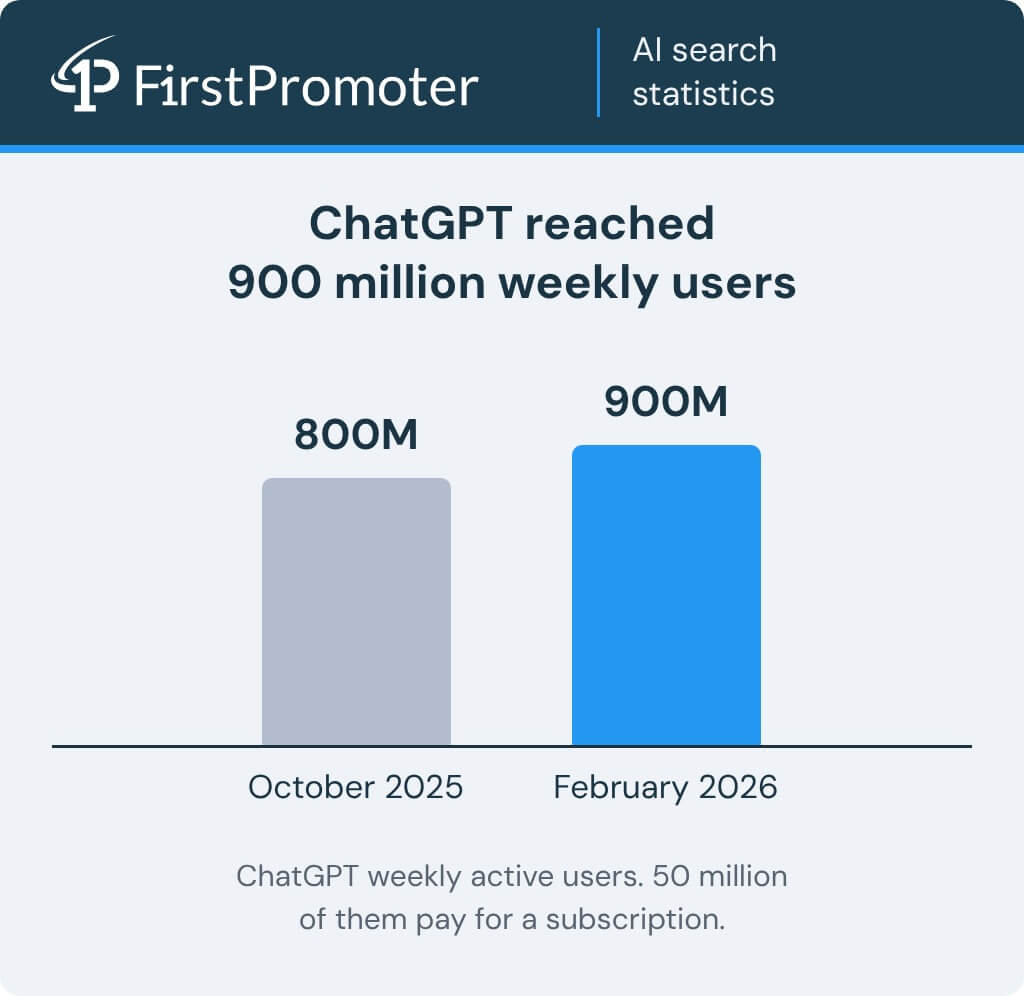
ChatGPT has 900 million weekly active users, yet AI platforms still send only 0.32% of all website traffic. On US retail sites, the visitors AI does send converted at a 60% higher rate than other traffic in July 2026.
Below are 62 AI search statistics on usage, market share, Google AI Overviews and AI Mode, zero-click search, AI referral traffic, LLM citations and AI product recommendations. The vast majority of the research was published in 2025 and 2026 and every figure links to its source. Several numbers that circulate on other statistics pages turned out to be outdated, misquoted or impossible to trace, so the sections below show where each one came from and what to cite instead.
Top AI search statistics in 2026
- ChatGPT has 900 million weekly active users and 50 million paying subscribers, up from 800 million in October 2025 (OpenAI,2026).
- 42% of US adults use AI chatbots to search for information (Pew Research Center, 2026).
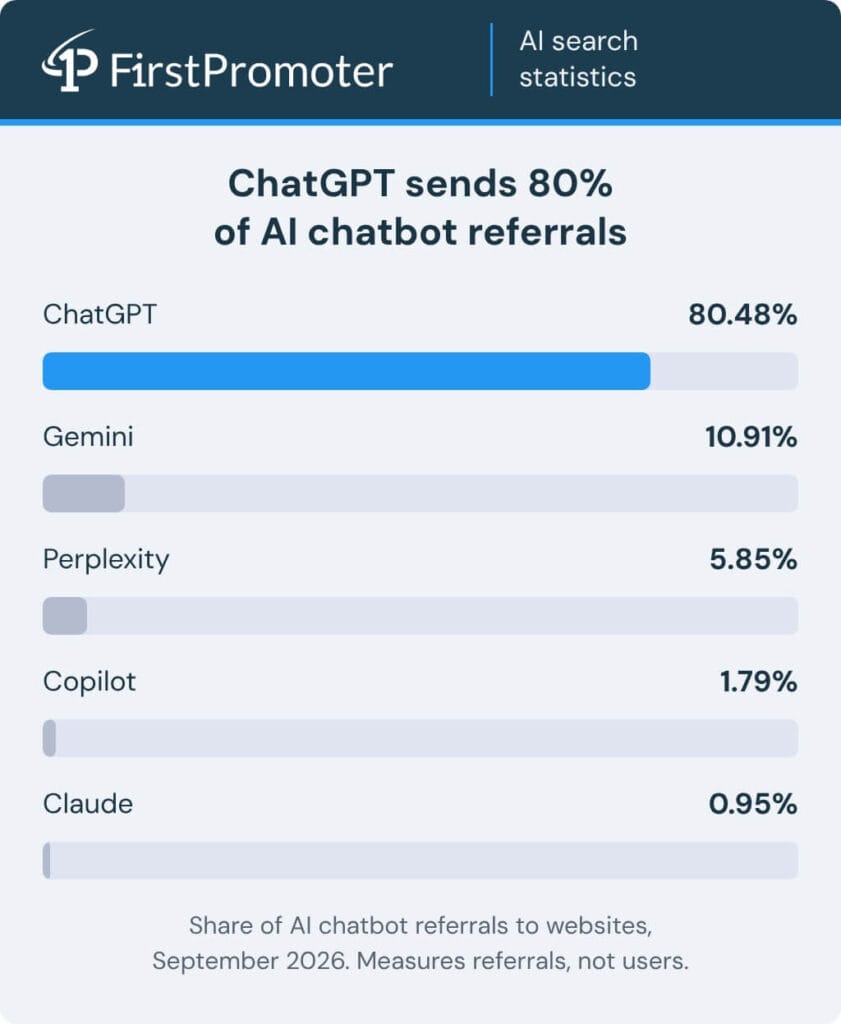
- ChatGPT sends 80.48% of AI chatbot referrals to websites. Gemini sends 10.91% and Perplexity 5.85%, measured in September 2026 (StatCounter, 2026).
- Google AI Overviews has more than 2.5 billion monthly active users. AI Mode passed 1 billion in about a year (Google, 2026).
- AI Overviews appear on 20.5% of Google search results pages (Ahrefs, 2025).
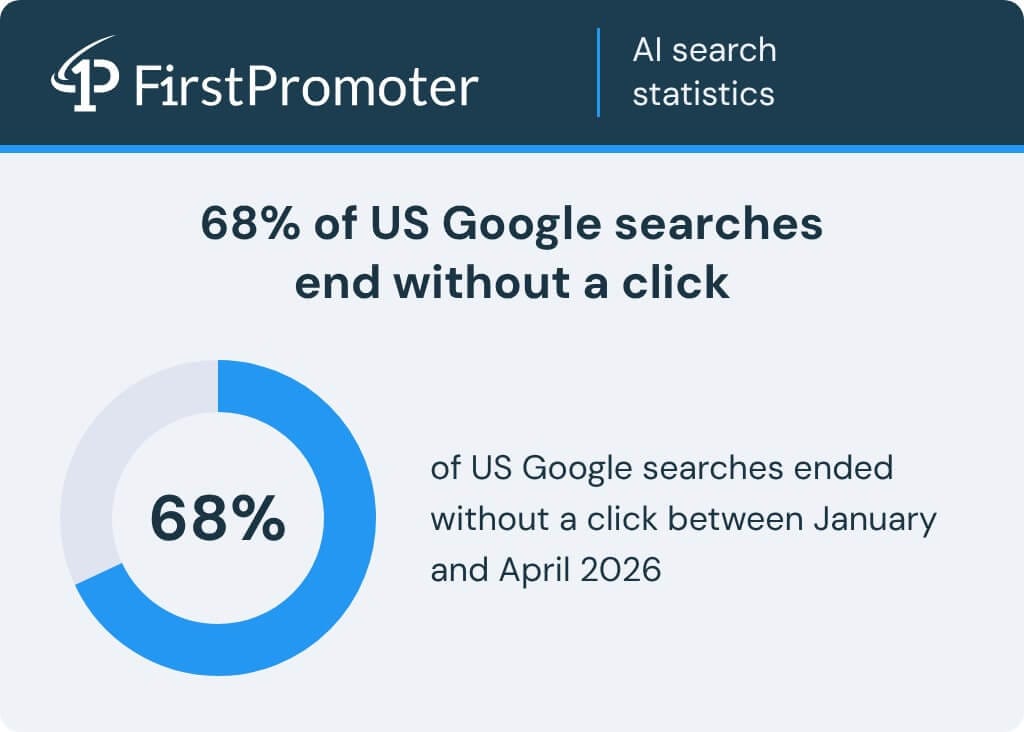
- 68% of US Google searches ended without a click between January and April 2026 (SparkToro, 2026).
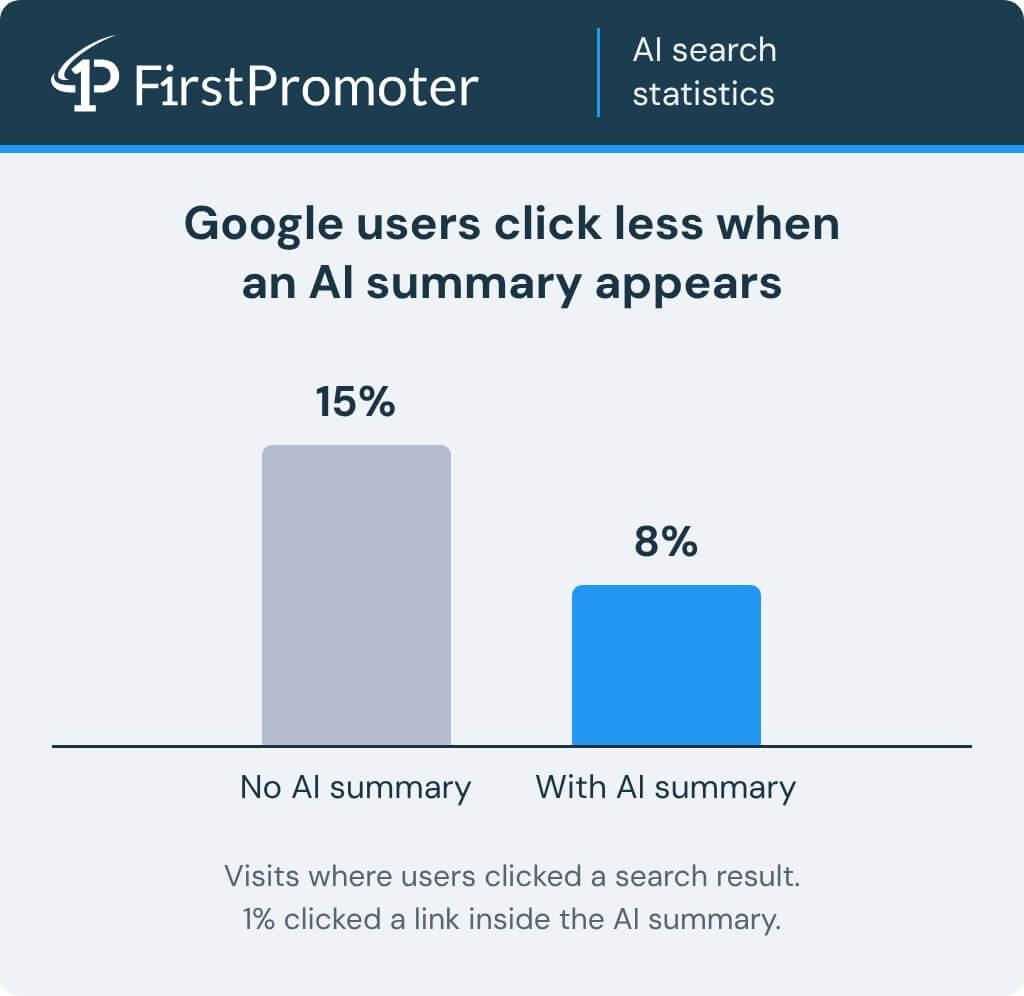
- Google users clicked a result on 8% of visits when an AI summary appeared and on 15% of visits without one. They clicked a link inside the summary 1% of the time (Pew Research Center, 2025).
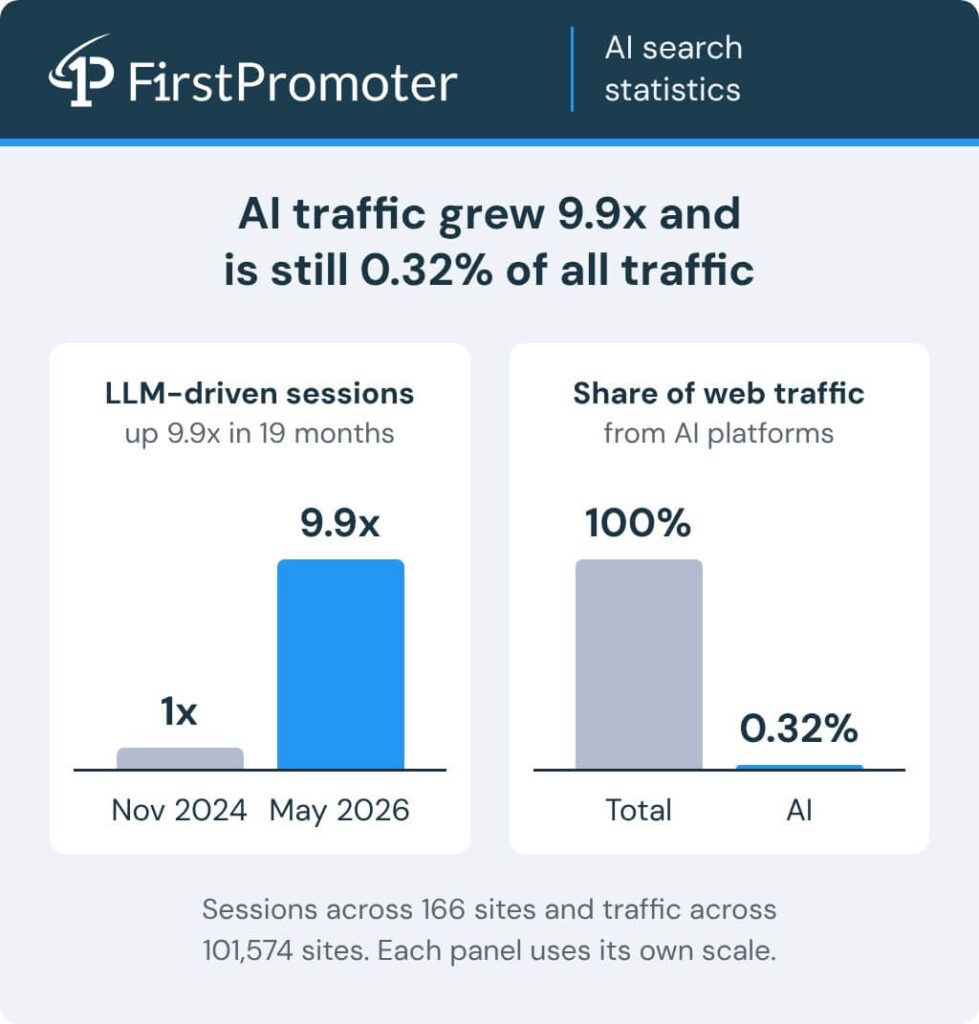
- LLM-driven sessions grew 9.9x in 19 months across 166 sites, and ChatGPT sent 92.4% of the LLM referrals that could be tracked (Previsible, 2026).
- AI-referred visitors to US retail sites converted at a 60% higher rate than non-AI traffic in July 2026 (Adobe Digital Insights, 2026).
- Branded web mentions predict AI Overview visibility with a 0.664 correlation. Backlinks reach 0.218, about a third of that (Ahrefs, 2025).
- “Best X” listicles make up 43.8% of the page types ChatGPT cites (Ahrefs, 2025).
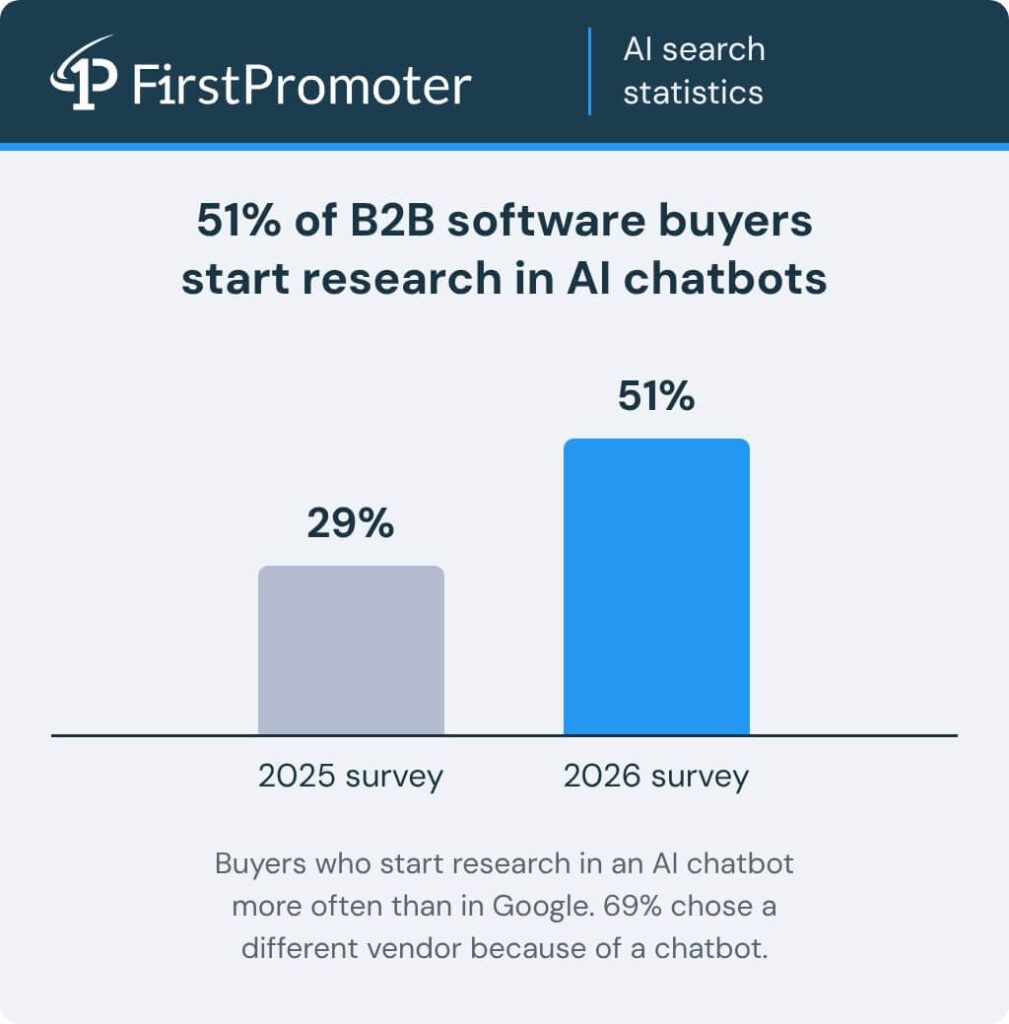
- 51% of B2B software buyers now start research in an AI chatbot more often than in Google, up from 29% a year earlier. 69% ended up with a different vendor than they planned because of a chatbot’s recommendation (G2, 2026).
- AI search visitors are projected to outnumber traditional search visitors by early 2028, and the average AI search visitor is worth 4.4x an organic visitor (Semrush, 2025).
How many people use AI search?
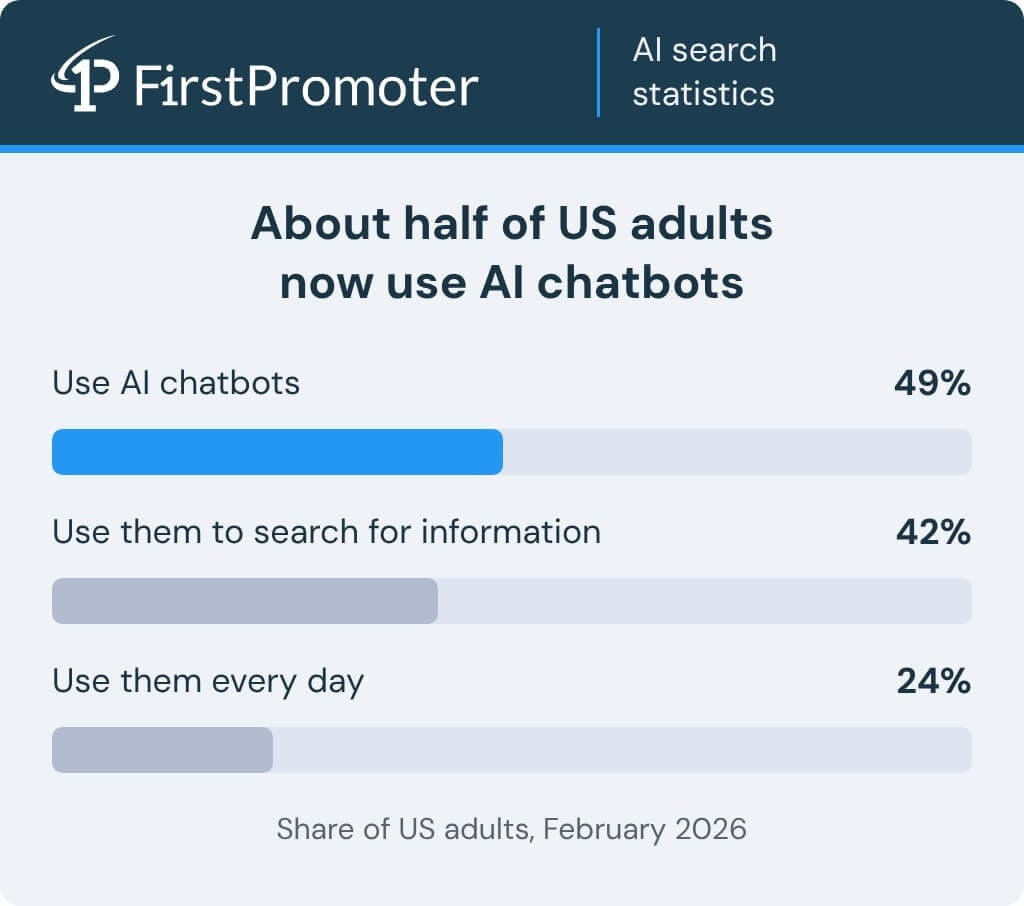
About half of US adults (49%) use AI chatbots, up from 33% in 2024, and 24% use one every day (Pew Research Center, 2026). Pew surveyed 5,119 adults in February 2026. The 2024 question was worded differently, so read the change as a direction of travel.
- 42% of US adults use AI chatbots to look up information (Pew Research Center, 2026).
- 44% of US adults have used ChatGPT, more than double the 18% Pew recorded in 2023 (Pew Research Center, 2026).
- ChatGPT has 900 million weekly active users, 50 million of them on paid plans (OpenAI).
- The Gemini app passed 1 billion monthly users in August 2026, up from 400 million in May 2025. The count covers the app only, without Gemini inside Google Search (Google, 2026).
- “Seeking information” rose from 14% to 24% of all ChatGPT messages between July 2024 and July 2025. The economists behind the study call ChatGPT “a very close substitute for web search” (OpenAI, Harvard and Duke economists via NBER, 2025).
- In July 2025, 700 million ChatGPT users sent 18 billion messages a week (OpenAI, Harvard and Duke economists via NBER, 2025).
- 64% of US adults use AI, and 25% use it daily, up from 19% a year earlier (Menlo Ventures, 2026).
- Weekly use of generative AI to get information rose from 11% to 24% in a year across six countries (Reuters Institute, 2025).
- Perplexity answered 780 million queries in May 2025, growing more than 20% month over month. The company hasn’t published a newer query count (Perplexity via TechCrunch, 2025).
AI search market share
Google holds 89.94% of the worldwide search engine market and Bing holds 5.29%, measured by page views in September 2026 (StatCounter, 2026). For AI chatbots, the leader’s share changes with the method. Referral data, web visits and surveys each give a different number, and every figure below names the one it uses.
- By referrals, ChatGPT holds 80.48% of the AI chatbot market, ahead of Gemini (10.91%), Perplexity (5.85%), Copilot (1.79%) and Claude (0.95%). StatCounter counts referrals to the sites it tracks, not users (StatCounter, 2026).
- By web visits, generative AI platforms averaged 9.5 billion visits a month from June 2025 to May 2026, up 70% year over year. ChatGPT’s share of those visits fell from about 76% to about 53%, while Gemini rose to about 27 to 28% (Similarweb, 2026).
- By survey, 44% of US adults have used ChatGPT, 24% Gemini, 17% Copilot, 14% Meta AI, 8% Grok and 6% Claude (Pew Research Center, 2026).
- Google says Search queries are at an all-time high, driven by AI Overviews and AI Mode, and that its AI features send “billions of clicks to websites every week.” Both claims come from Google itself (Alphabet, 2026).
Google AI Overviews and AI Mode statistics
Google AI Overviews has more than 2.5 billion monthly active users, and AI Mode passed 1 billion within about a year of launch (Google, 2026).
- AI Overviews appear on 20.5% of Google search results pages, and 99.9% of the keywords that trigger them are informational (Ahrefs, 2025).
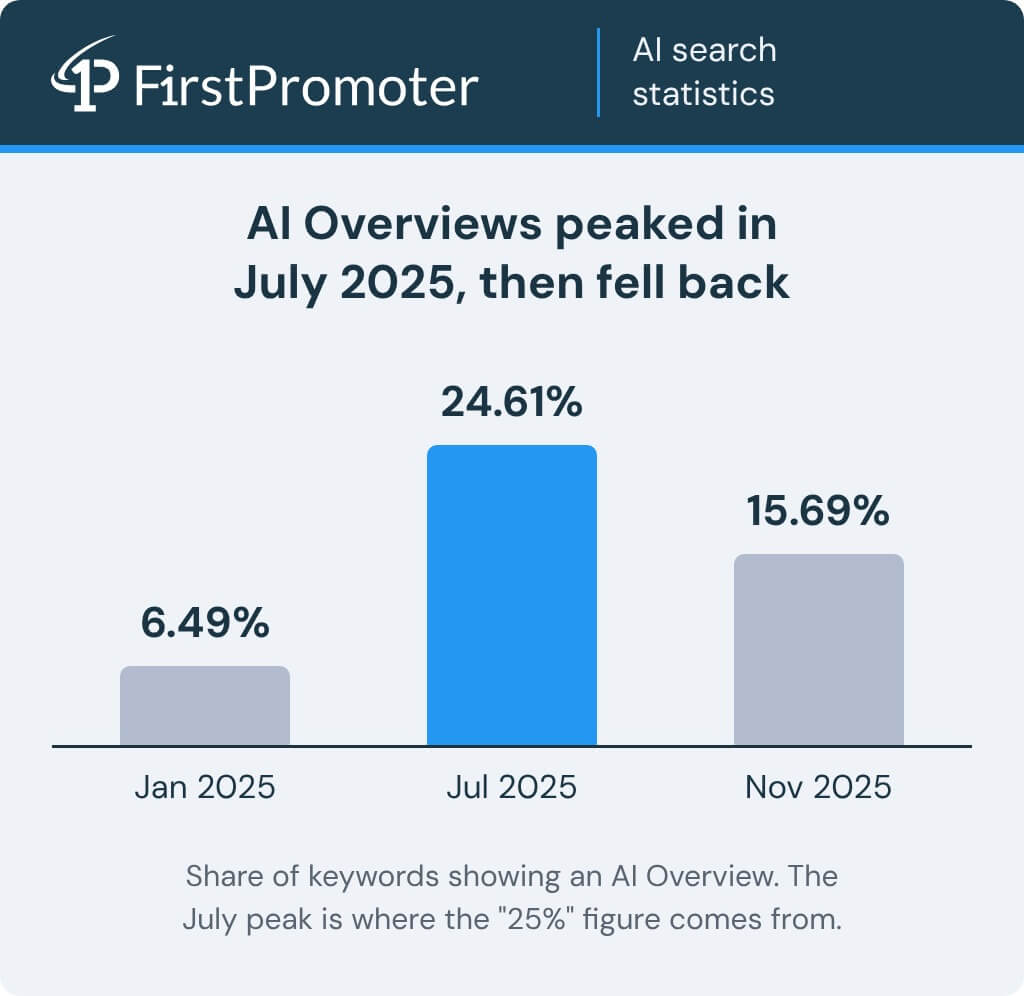
- AI Overviews showed up for 6.49% of keywords in January 2025, peaked at 24.61% in July 2025 and dropped to 15.69% by November 2025 (Semrush, 2025).
- AI Overviews appear on 82.91% of US desktop results for branded keywords as of September 2026, up from 61.3% in July (Ahrefs, 2026).
- Only 8% of one- or two-word searches produce an AI summary. The share rises to 53% for searches of 10 words or more and 60% for searches phrased as questions (Pew Research Center, 2025).
- 60% of US adults say they read the AI summaries at the top of search results (Pew Research Center, 2026).
- AI Mode queries are 3x as long as traditional searches, and nearly 1 in 6 is a voice or image query (Alphabet, 2026).
Myth vs data: how often AI Overviews appear
The most quoted AI Overview figure, 25% of Google searches, describes one month: July 2025, the peak in Semrush’s tracking. The two figures after it also come from real studies, but one is read backwards and Google has replaced the other with a higher count.
Myth: “AI Overviews appear in 25% of Google searches.”
What’s wrong: 24.61% was the July 2025 peak in Semrush’s tracking. By November 2025 the rate had dropped to 15.69%.
Use instead: AI Overviews appear on 20.5% of Google search results pages (Ahrefs, 2025), and on 82.91% of US desktop results for branded keywords (Ahrefs, 2026).
Myth: “99.9% of informational keywords trigger an AI Overview.”
What’s wrong: Ahrefs measured the opposite direction. Of the keywords that trigger an AI Overview, 99.9% are informational.
Use instead: AI Overviews appear on 20.5% of Google search results pages, and 99.9% of the keywords that trigger them are informational (Ahrefs, 2025).
Myth: “AI Overviews reach 2 billion monthly users.”
What’s wrong: Google gave that figure in July 2025 and raised it at I/O 2026.
Use instead: AI Overviews has more than 2.5 billion monthly active users, and AI Mode passed 1 billion (Google, 2026).
Zero-click search statistics
68% of US Google searches ended without a click between January and April 2026 (SparkToro, 2026). SparkToro switched data panels for this study, so the figure can’t be compared directly with its 2024 result.
- Searchers clicked a result on 8% of visits that showed an AI summary and on 15% of visits that didn’t. 1% clicked a link inside the summary (Pew Research Center, 2025).
- Searchers ended their browsing session on 26% of pages with an AI summary, against 16% of pages without one (Pew Research Center, 2025).
- When an AI Overview appears, the page ranking first gets a 58% lower click-through rate. A year earlier the drop was 34.5% (Ahrefs, 2026).
- Organic CTR on queries with an AI Overview fell from 1.76% to 0.61% between June 2024 and September 2025. Brands cited inside the AI Overview earned 35% more organic clicks and 91% more paid clicks (Seer Interactive study: AIO Impact on Google CTR, 2025).
- 92 to 94% of Google AI Mode searches ended without a click in AI Mode’s first weeks, across 69 million sessions. No newer AI Mode study has been published (Semrush, 2025).
- About 80% of consumers rely on zero-click results for at least 40% of their searches, which Bain estimates cuts organic web traffic by 15 to 25% (Bain & Company, Bain-Dynata Generative AI Consumer Survey, 2025).
- For the same set of keywords, zero-click rates fell slightly after AI Overviews appeared, from 33.75% to 31.53% (Semrush and Datos, 2025).
- Premium publishers saw a median 10% year-over-year drop in Google referrals in May and June 2025. For their non-news brands, the drop was 14% (Digital Content Next, 2025).
- Chegg’s non-subscriber traffic fell 49% year over year in January 2025. The company blamed Google AI Overviews (Chegg, 2025).
Old zero-click statistics to stop quoting
Both zero-click figures below are still quoted after their publishers replaced them: SparkToro with a 2026 study on a new data panel, and Seer Interactive with an update that covers 42 organizations instead of one client.
Myth: “About 60% of Google searches end without a click.”
What’s wrong: that is SparkToro’s 2024 result. SparkToro published a 2026 study with a new data panel.
Use instead: 68% of US Google searches ended without a click between January and April 2026 (SparkToro, 2026).
Myth: “Being cited in an AI Overview lifts CTR from 0.6% to 1.08%.”
What’s wrong: the figure came from one Seer Interactive client. Seer’s September 2025 update covers 42 organizations.
Use instead: brands cited inside an AI Overview earned 35% more organic clicks and 91% more paid clicks (Seer Interactive, 2025).
AI referral traffic and conversion statistics
LLM-driven sessions grew 9.9x in 19 months, from November 2024 to May 2026, across 166 sites. ChatGPT sent 92.4% of the LLM referrals that could be tracked (Previsible, 2026).
- Website traffic from AI search engines grew 16x from 2024 to 2026, and AI platforms still account for only 0.32% of all website traffic, across 101,574 sites (SE Ranking, 2026).
- Traffic from generative AI grew 796% from January 2024 to December 2025, and AI visitors converted about 1.2x as well as organic search visitors, across 2.3 billion sessions (WebFX, 2026).
- AI-referred visitors to US retail sites converted at a 60% higher rate than non-AI traffic in July 2026, up from 54% in May 2026 (Adobe Digital Insights, 2026). In March 2025, the same traffic converted 38% worse (Adobe, 2026).
- AI traffic to US retail sites grew 393% year over year in Q1 2026 (Adobe, 2026) and 62% year over year in July 2026 (Adobe Digital Insights, 2026).
- AI traffic to US retail sites rose 693.4% year over year during the 2025 holiday season (Adobe, 2026).
- AI search referrals make up 1.08% of website traffic across 10 industries. IT has the highest share at 2.80%, and ChatGPT drives 87.4% of the referrals (Conductor, 2026).
- At Ahrefs, AI search visitors were 0.5% of traffic and 12.1% of signups, which works out to roughly 23x the conversion rate of organic visitors. The data comes from one SaaS company (Ahrefs, 2025).
- AI-referred retail visitors spent 59% more time on site and viewed 22% more pages per visit than visitors from other channels in July 2026 (Adobe Digital Insights, 2026).
- In July 2025, OpenAI’s crawlers fetched 1,091 pages for every visit they referred. Anthropic’s fetched 38,065 and Perplexity’s 194.8. Referrals from native apps aren’t counted, so the ratios may run high (Cloudflare, 2025).
Myth vs data: AI traffic growth and conversion rates
The four AI traffic figures below earn competing statistics pages more links than any other numbers on them and each one falls apart at its source. The best known, 527% growth, covered January to May 2025 and picked up a year-over-year label as it was copied.
Myth: “AI search traffic grew 527% year over year.”
What’s wrong: Previsible’s 2025 figure measured growth from January to May 2025 across 19 sites. It was never a year-over-year number.
Use instead: LLM-driven sessions grew 9.9x in 19 months across 166 sites (Previsible, 2026), and AI search traffic grew 16x from 2024 to 2026 (SE Ranking, 2026).
Myth: “AI referral traffic is growing 165x faster than organic traffic.”
What’s wrong: WebFX retired the figure, so the page it’s credited to no longer states it.
Use instead: generative AI traffic grew 796% from January 2024 to December 2025 and converted about 1.2x as well as organic search (WebFX, 2026).
Myth: “AI search visitors convert at 14.2%, against 2.8% for Google” and “ChatGPT converts at 15.9%, against 1.76% for Google.”
What’s wrong: the first figure has four conflicting attributions and no study behind it. The second came from a single Seer Interactive client in June 2025.
Use instead: AI-referred visitors to US retail sites converted at a 60% higher rate than non-AI traffic in July 2026 (Adobe Digital Insights, 2026).
Myth: “AI visitors spend 68% more time on site.”
What’s wrong: the figure comes from SE Ranking data for January to April 2025, and Adobe has since published engagement data for July 2026.
Use instead: AI-referred retail visitors spent 59% more time on site and viewed 22% more pages per visit in July 2026 (Adobe Digital Insights, 2026).
LLM visibility, citations and GEO statistics
Branded web mentions are the strongest predictor of AI Overview visibility, with a 0.664 correlation across 75,000 brands. Backlinks correlate at 0.218, about a third as strongly (Ahrefs, 2025).
- “Best X” listicles make up 43.8% of the page types ChatGPT cites, and brands placed higher on third-party lists get mentioned more often (Ahrefs, 2025).
- Domains with profiles on review platforms such as Trustpilot, G2, Capterra and Yelp earn 4.6 to 6.3 ChatGPT citations. Domains without them earn 1.8, roughly 3x fewer (SE Ranking, 2025).
- About 12% of the URLs AI assistants cite also rank in Google’s top 10 for the same query (Ahrefs, 2025).
- Reddit (21.6%) and YouTube (20.8%) are Perplexity’s most-cited domains. In AI Overviews, YouTube (22.9%) and Reddit (18.5%) lead, measured as a share of top-50 citations in September 2026 (Ahrefs, 2026).
- The 10 most-cited domains in US AI search are Reddit, YouTube, LinkedIn, Wikipedia, Forbes, G2, Yelp, Facebook, Medium and TechRadar, based on 30 million sources in March 2026 (Peec AI, 2026).
- 37.9% of URLs cited in AI Overviews rank in Google’s top 10, and 31% don’t rank in the top 100 (Ahrefs, 2026).
- 44.2% of ChatGPT citations come from the first 30% of a page’s text. Citation odds drop sharply after that point (Search Engine Land, 2026).
- Generative engine optimization (GEO) raised a source’s visibility in AI answers by up to 40% in the 2023 lab benchmark study that coined the term (Aggarwal et al., 2023).
- 86% of SEO professionals say they have built AI into their SEO strategy. The survey is from 2023, and no newer equivalent has been published (seoClarity, 2023).
Listicles and creator videos are formats partners already publish. A SaaS affiliate program run on affiliate software pays the publishers of “best X” lists for the customers they send, and influencer marketing software tracks each creator’s referrals through their link or coupon code. For how many marketing teams already work on GEO, see our AI marketing statistics.
Myth vs data: where AI Overview citations come from
Ahrefs published both the old 76% figure and the study that replaced it, so pages still quoting 76% are citing Ahrefs against itself.
Myth: “76% of AI Overview citations come from Google’s top 10.”
What’s wrong: that was Ahrefs’ 2025 finding. Its 2026 study of 863,000 search results pages replaced it.
Use instead: 37.9% of URLs cited in AI Overviews rank in Google’s top 10, and 31% don’t rank in the top 100 (Ahrefs, 2026).
AI product recommendations: how buyers choose with AI search
51% of B2B software buyers now start research in an AI chatbot more often than in Google, up from 29% a year earlier, in a survey of 1,076 buyers (G2, 2026).
- 69% of B2B software buyers chose a different vendor than they planned because of an AI chatbot’s recommendation, and 1 in 3 bought from a vendor they had never heard of (G2, 2026).
- 45% of B2B buyers name citations from software review sites as the strongest trust signal in an AI answer. G2 runs a review site, so it has a stake in this result (G2, 2026).
- AI chatbots (54%) and software review sites (43%) are the two sources that shape B2B software shortlists most (G2, 2026).
- 64% of B2B buyers get inaccurate AI answers often or very often, and they check those answers with peers (G2, 2026).
- 85% of B2B software buyers think more highly of a vendor that appears in an AI answer (G2, 2026).
- 94% of B2B buyers use AI in their buying process, up from 89% a year earlier. Twice as many name generative AI or conversational search as a meaningful source as name any other source (Forrester, 2026).
- The vendor that won the deal was on the buyer’s day-one shortlist 95% of the time, and buyers made 79% of first contacts (6sense, 2025).
- 58% of consumers prefer product recommendations from generative AI to results from traditional search engines (Capgemini Research Institute, 2025).
When buyers doubt an AI answer, they ask people they trust. A referral program turns those recommendations from existing customers into a tracked channel, with rewards tied to the referred customer’s payments.
AI search trends and forecasts
AI search visitors are projected to outnumber traditional search visitors by early 2028, and the average AI search visitor is worth 4.4x an organic visitor, according to a model-based forecast (Semrush, 2025).
- 20% of people trust answers from AI chatbots, while 37% trust news overall, in a survey of 97,520 people across 48 markets (Reuters Institute, 2026).
- In 2024, Gartner predicted that traditional search engine volume would drop 25% by 2026 because of AI chatbots (Gartner, 2024). In 2026, Google reports record query volume (Alphabet, 2026).
- 25% of US adults use AI daily, up from 19% a year earlier (Menlo Ventures, 2026).
- The Gemini app grew from 400 million to 1 billion monthly users between May 2025 and August 2026 (Google, 2026).
Why do partners matter for SaaS companies when buyers search with AI?
AI answers draw on pages a brand doesn’t control, and buyers who doubt an answer ask people they trust. Partners cover both: affiliates and creators publish the lists, reviews and videos AI cites, and existing customers recommend you when a peer asks. In a subscription business, a customer a partner brings in keeps paying after the first invoice, so the commission has to follow the subscription.
FirstPromoter tracks referral links, coupon codes and direct URLs on one partner record. It reads billing events from Stripe, Chargebee, Paddle, Recurly or Braintree, and commissions follow every renewal, upgrade, downgrade and refund. For benchmarks on the wider partner channel, see our affiliate marketing statistics for 2026. Connect your billing provider and try FirstPromoter free for 14 days, no card needed.
In this article
Newsletter