The right ReferralCandy alternative depends on what you sell. Shopify and WooCommerce stores value tools that plug into carts and order data, while subscription software businesses need ones that track trials, upgrades and recurring revenue. This list is split that way so you can skip to the section that applies to your business model.
Rated as one of the best referral marketing software solutions in 2026, ReferralCandy is an established refer-a-friend tool built for online stores and plenty of merchants happily run it. Whether you’re weighing costs, need deeper customization or are building referrals into your SaaS product, these are the nine options worth comparing in 2026.
Key Takeaways
- ReferralCandy charges a monthly fee as well as a success fee on referred customers’ first orders, meaning cost rises with results.
- Ecommerce stores mostly want Shopify-native tools with features for running loyalty programs.
- SaaS and subscription businesses need rewards tied to billing events and renewals.
- Before you switch to a ReferralCandy alternative, calculate how much it would cost using your own referral revenue.
- Migrating from ReferralCandy to another tool means exporting advocates and reissuing links or codes.
Why teams look for a ReferralCandy alternative
From the start, businesses should understand that ReferralCandy’s setup is built around carts and orders. If you’re selling services or subscription software billed outside a store checkout, you’ll have a hard time fitting your process into a tool designed first for ecommerce brands.
ReferralCandy pricing also weighs heavily and its fee structure can stop making sense. It charges a success fee (a percentage of referred purchases’ subtotal) on a new customer’s first three orders. While the percentage drops on higher plans, Scale’s $249 monthly fee is more than six times Basic’s $39. All in all, it works when volume is modest. Once your referrals scale, you’re paying a growing cut of your revenue.
G2 reviews highlight limited branding control as another pressure point and one that teams with a strong brand identity tend to notice. Email editing and widget customization are less user-friendly, while brand-specific layouts and advanced visual edits can be limited without CSS or HTML skills, according to Capterra feedback. If your referral emails and widgets can’t be made to look and sound like the rest of your customer experience, the program can feel like an afterthought.
Lastly, reporting is another switching trigger, based on Software Advice feedback. Some reviewers find the reporting hard to reconcile with store data. This makes it harder to defend the cost of the software.
ReferralCandy alternatives at a glance
The table below compares all nine options side by side, covering good-fit scenarios and pricing.
| Tool | Good fit for | Connects to | Pricing model | Free plan | Trial |
|---|---|---|---|---|---|
| ReferralCandy | Ecommerce brands | Stripe, PayPal (via Shopify/WooCommerce) | Success fee | No | 7 days |
| FirstPromoter | SaaS and subscription businesses | Stripe, Paddle, Chargebee, Recurly, Braintree | Flat | No | 14 days (no credit card required) |
| GrowSurf | Early-stage SaaS teams | Chargebee, PayPal, Recurly, Stripe | Flat | No | Yes |
| Referral Factory | B2B and service businesses | Stripe, PayPal | Flat | No | 15 days |
| Viral Loops | Growth campaigns | Stripe | Flat | No | 14 days |
| Smile.io | Loyalty programs | Shopify, BigCommerce, Wix | Flat | Yes | No |
| UpPromote | Shopify stores | Shopify | Success fee | Yes | Yes |
| Refersion | Ecommerce brands | Shopify, WooCommerce, BigCommerce, Adobe Commerce, Salesforce | Success fee | Free marketplace listing only | No |
| Friendbuy | Mid-market and larger DTC brands | Shopify, Shopify Plus, Adobe Commerce, Salesforce | Custom | No | No |
| Mention Me | Enterprise retail brands | Shopify, Adobe Commerce, SAP Commerce Cloud | Custom | No | No |
ReferralCandy alternatives for SaaS and subscription businesses
ReferralCandy is built around one-time, Shopify-style purchases where a friend clicks a link, checks out and a reward fires on the order. SaaS and subscription businesses work differently.
Rewards should trigger on a paid conversion or renewal confirmed by your billing system, not a cart event, so you don’t pay for trials that churn. The referral links should live inside the product, where engaged users already are.
The following four ReferralCandy competitors fit this model better than a cart-based tool.
1. FirstPromoter
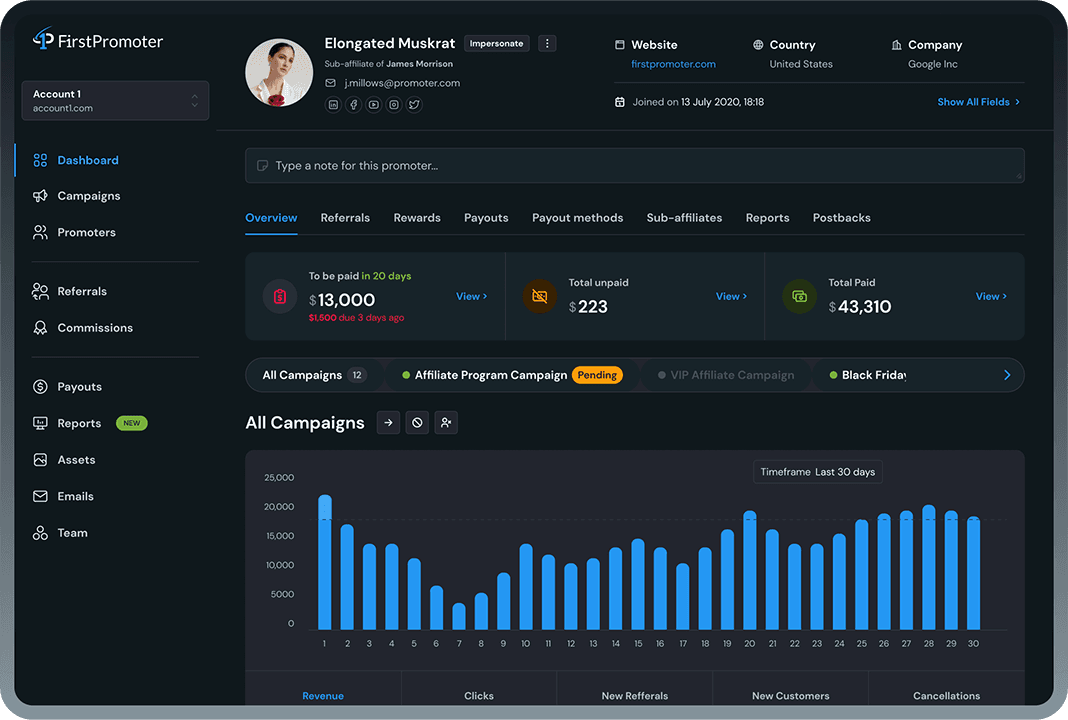
FirstPromoter is a good fit for SaaS and subscription businesses that bill through Stripe, Paddle, Chargebee, Recurly or Braintree and want customer referrals and affiliates in one place. If you run a Shopify store, the next group is where to look. FirstPromoter isn’t a Shopify app and has no native Shopify or WooCommerce integration. It also has no loyalty points program and store credit or free-month rewards are granted by your own app through a webhook rather than turnkey.
Setup is easy and you can go live the same day. You connect the billing provider via the Integrations area in your FirstPromoter account and if your billing provider isn’t listed as a native option, you can use the API to track sales.
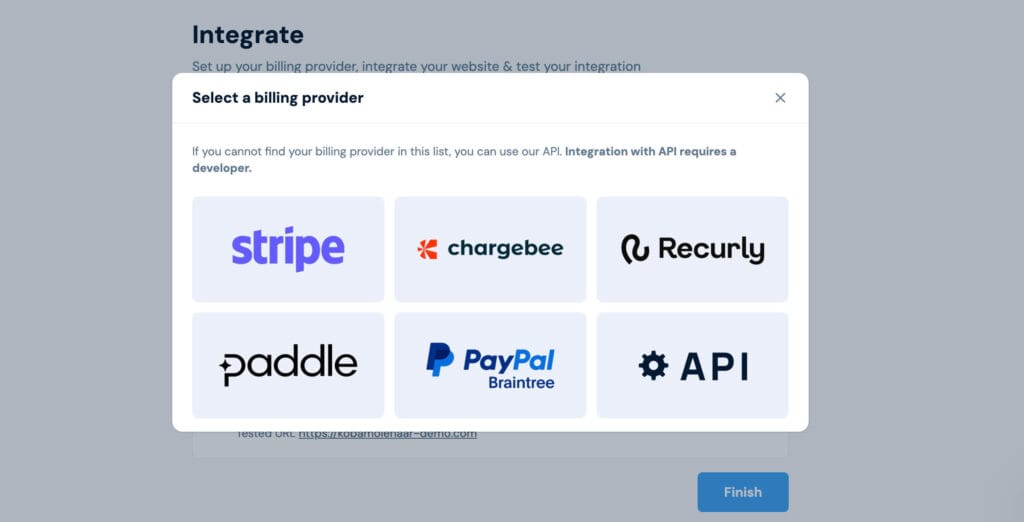
Once connected, FirstPromoter can track events like sales, refunds, upgrades and cancellations automatically.
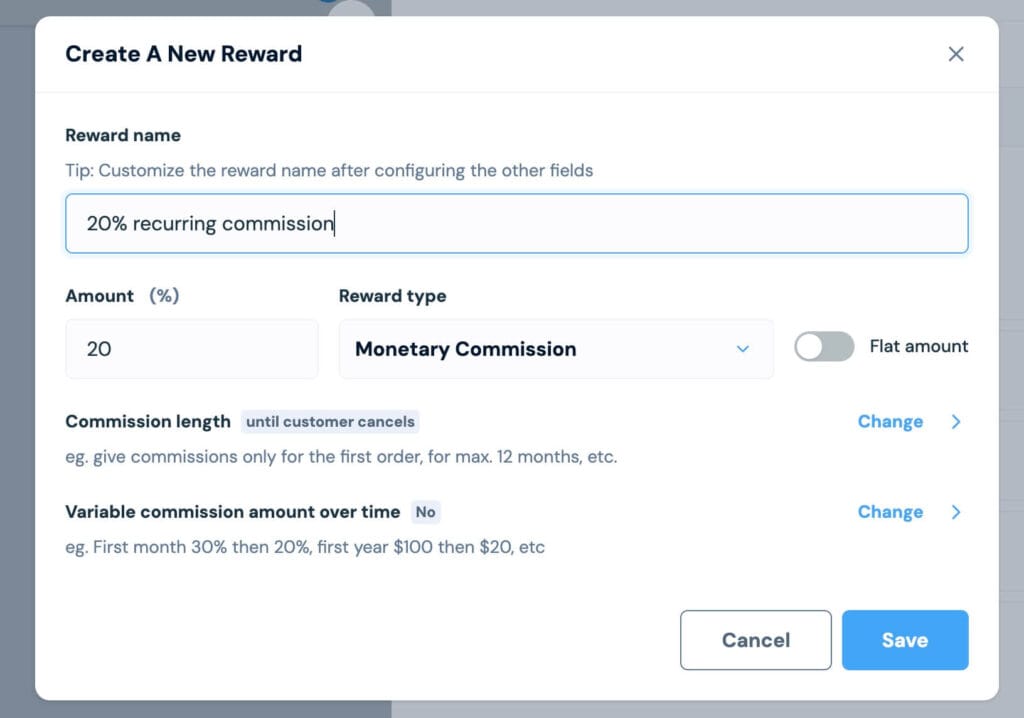
Next, you can set a dual-sided reward so that the referred customer and promoter get a reward. You set each party separately in the campaign, customizing details like whether the discount should be a flat amount or percentage and for how long it lasts. For example, new customers can be rewarded once, while promoters’ commission can be one-time or recurring on renewals.
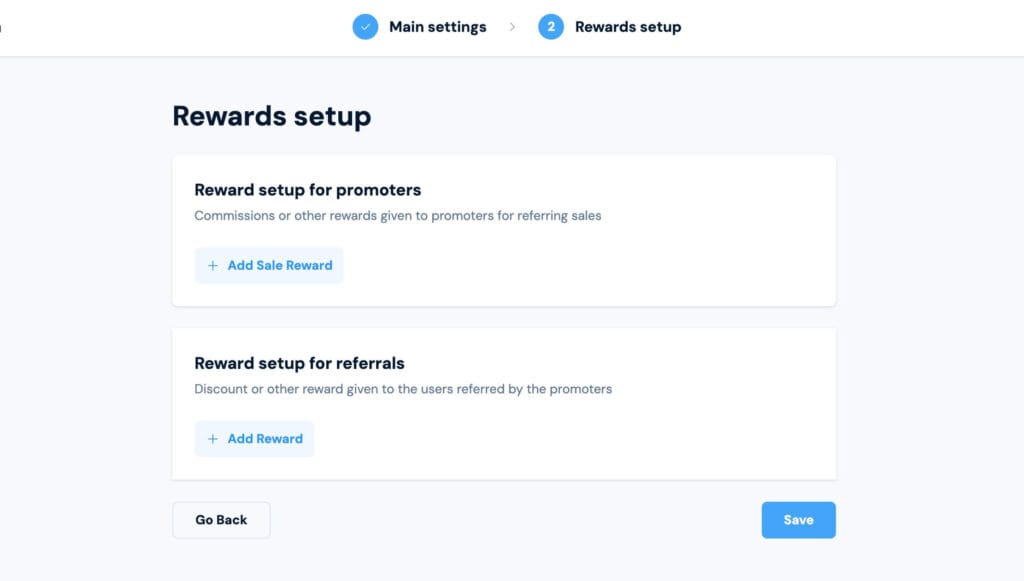
Each side can have its own trigger, allowing for rewards to be triggered at different times and tied to billing events so that trials that churn never earn a reward. For example, the promoter can earn a commission on every payment, while the friend gets a once-off $20 discount.
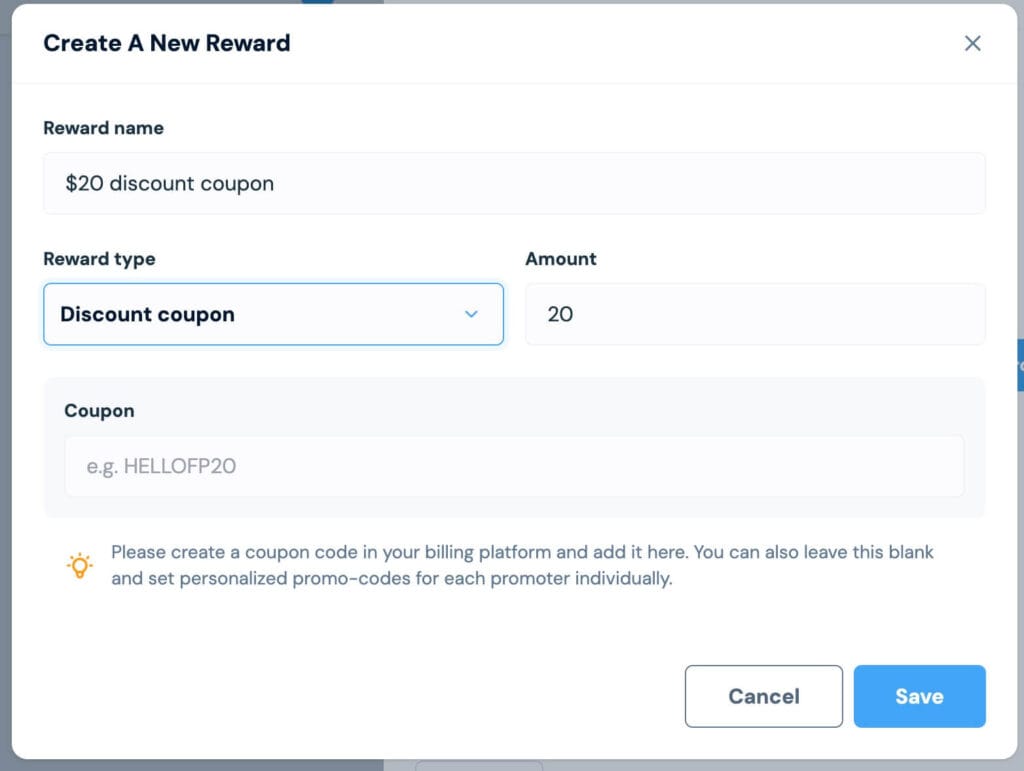
On Stripe, FirstPromoter creates the friend’s promotion and coupon codes automatically, while with the Chargebee or Paddle integration, the codes are created in the billing tool by hand. The billing provider applies the discount at checkout.
You can embed the referral portal inside your app, so customers find their link without leaving the product.
If you’re using PayPal or Stripe Payouts, you can send payouts in one click via the dashboard.
Wise and bank transfers use CSV. You export the payout file, pay it in Wise or your bank, then mark the payouts as paid in FirstPromoter.
Alternatively, if you prefer, you can still do payouts manually one by one outside FirstPromoter and then mark these as paid inside FirstPromoter.
As of November 2026, FirstPromoter offers three flat monthly plans: Starter ($49 per month), Business ($99 per month) and Enterprise ($149+ per month).
2. GrowSurf
GrowSurf is a good fit for early-stage SaaS teams with developer time. You embed its referral widget in your sign-up or user flow, allowing you to have a program up and running quickly.
Because it’s developer-oriented, you can use its API and webhooks to wire referral tracking and rewards into your own product logic. It also lets you style the referral experience to match your branding.
This widget and API reward teams with engineers to spare and non-technical teams may find it more hands-on than a plug-and-play tool. This is reflected in G2 feedback, with users mentioning its support documentation can be improved.
It offers two pricing options for its referral programs: Startup, starting at $179 per month and Business, starting at $449 per month. This pricing scales around the number of participants you add.
For affiliate programs, its pricing is success-based and you’re charged 3% of the referral revenue you earn.
For both referral and affiliate programs, custom pricing is available. All pricing details are correct as of November 2026.
3. Referral Factory
Referral Factory is a good fit for B2B and service businesses that want a template-driven referral program with CRM connections. Its template builder means that you get an on-brand program live without engineering. Using its drag-and-drop builder, you can change the layout of your referral campaign while its campaign editor tool gives you control over branding elements.
Tracking is centered on leads and references, rather than on subscription billing. Integrations with popular tools like HubSpot, Salesforce and Zapier allow for a referred lead to move through your existing sales pipeline. This makes it especially suitable for businesses with long sales cycles where a “conversion” is often a booked call and not necessarily a card payment.
However, Capterra feedback reports an initial learning curve and room for more design templates. In particular, reviewers would like better guidance, e.g. clearer explanations or tooltips, on how to use more advanced settings.
Its pricing model caters to smaller teams, mid-sized businesses and larger organizations. As of November 2026, its Basic plan costs $200 per month, Pro plan $400 per month and Enterprise plan $1,000 per month. It also runs a startup program that gives qualifying startups and small businesses a 50% discount.
4. Viral Loops
Viral Loops is a campaign tool first. You choose a ready-made template from its library with several campaign-specific templates for events like launches and waitlists instead of designing a program from scratch. Alternatively, you can describe your goal and its AI will suggest the best template or combine specific elements from various templates.
It works especially well for pre-launch waitlists, giveaways and milestone referral campaigns, making it better for growth campaigns than always-on customer referral or affiliate programs. For example, startups in the prelaunch phase can use Viral Loops to configure and publish a waitlist without any coding and get more sign-ups.
Support is an area of weakness, as revealed by Trustpilot feedback. Reviewers have mentioned that support can be slow and sporadic.
Viral Loops pricing model includes four plans: Start-up ($49 per month), Plus ($139 per month), Growing ($229 per month) and Power ($399 per month) (as of November 2026). A custom plan for enterprise clients is also available.
ReferralCandy alternatives for ecommerce stores
Store owners usually look beyond ReferralCandy for a few practical reasons. They want a Shopify-native app that installs cleanly and fits their theme, with referrals and loyalty managed in one place instead of two separate tools.
Flexible rewards matter too, especially store credit and discount codes that bring customers back. The same flexibility should apply to pricing. While store owners appreciate a variety of plans, pricing should stay predictable and not climb with every dollar of referred revenue.
These ReferralCandy alternatives cover those needs.
5. Smile.io
Smile.io is a loyalty platform first, with referrals as one module alongside points and VIP tiers. This suits Shopify stores that want one tool to run loyalty and referral programs. One advocate can earn points, refer friends and move up the tier ladder. However, as referrals are secondary, you get less depth than a dedicated referral tool.
Setup is straightforward. You can install it from the Shopify, BigCommerce or Wix app store and configure points, tiers and referrals.
Its pricing offers small stores an easier entry point. There’s a free tier to support small merchants, while its Essential plan at $15 per month is still at the lower end of the spectrum.
However, the price jumps sharply as you scale. After its Essential plan, the Standard plan costs $79 per month, followed by the Growth ($199 per month) and Smile Plus ($999 per month). Enterprise retailers with over $40M in annual revenue qualify for custom pricing. All pricing is listed as of November 2026.
6. UpPromote
UpPromote is a Shopify-native app and leans heavily toward affiliates. Its marketplace facilitates affiliate recruitment, while its flexible commission structures that include condition-based commissions help motivate affiliates.
Separate dashboards keep your affiliate and customer referrals distinct, allowing it to work as a partner-program tool as much as a referral one. This makes it a good fit for Shopify stores that want affiliate and influencer management alongside referrals.
Reviewers have mentioned in Capterra feedback that setup can be confusing and the onboarding experience, especially in terms of explaining more advanced features, can be better. Then, when you’re up and running, its user interface can make it difficult to navigate to some features.
As for its pricing, it offers four revenue-based plan tiers: Free, Growth ($29.99 per month), Professional ($89.99 per month) and Enterprise ($199.99 per month). These three paid plans include a percentage fee (ranging between 1% and 2%). Pricing is correct as of November 2026.
7. Refersion
Refersion is a good fit for ecommerce brands running affiliate and influencer programs at volume. It’s built for brands managing many partners with unlimited affiliates, multiple payout options, multi-currency support and connects to Shopify, BigCommerce, WooCommerce and more.
Its focus is on offering brands a complete affiliate program platform with strong tracking and program management. It’s affiliate-first rather than refer-a-friend. Affiliate programs appear in the Refersion Marketplace, helping you to build brand visibility among affiliates who are already looking for brands to promote.
Marketplace listing is free. To manage these affiliates, you’ll need to sign up for one of its three paid plans: Launch ($39 per month and 3% of affiliate-driven sales), Growth ($199 per month and 2% of affiliate-driven sales) or Scale (custom pricing for brands generating more than $1 million GMV annually).
Pricing is one of the areas where it falls short. Not only is the jump between the two plans steep, but Trustpilot feedback points to trouble canceling plans.
8. Friendbuy
Mid-market and larger DTC brands that want a managed refer-a-friend program will find Friendbuy a suitable ReferralCandy alternative. It takes a white-glove, sales-led onboarding approach and integrates with popular tools like Shopify, Klaviyo and Stripe. Where ReferralCandy’s testing is limited to rewards, friend offers and welcome emails’ copy, according to Friendbuy’s own comparison, Friendbuy lets you test this along with placements, creative and messaging.
For example, with its Klaviyo integration, you can add referral links, coupon status and referred revenue to customer profiles and use this data to personalize follow-up communication. That said, some G2 feedback has flagged integration issues.
Friendbuy offers custom pricing. Shopify brands can build their plans by choosing the monthly order volume and selecting the products and optional add-ons they want to add to their plan, while brands using other commerce platforms qualify for complete custom pricing.
9. Mention Me
Aimed at large brands, Mention Me is positioned for brands prioritizing performance, personalization and long-term customer value. It’s especially a good fit for enterprise retail brands that want referral testing and offline referrals. It offers A/B testing of offers designed to help you identify the referral offer that performs best.
One key difference between Mention Me and ReferralCandy is that it offers you more ways to capture referrals. For example, with its Name Share feature, customers can refer using their name. This way, you don’t just have to rely on links but can capture offline recommendations too.
Some aspects of the process can be challenging, though. Based on G2 feedback, the process can be time-consuming because the interface can be unintuitive at times.
Unlike the majority of the other ReferralCandy alternatives on this list, Mention Me offers only custom pricing. Its pricing is based on your revenue and you’ll only be charged for the referrals you drove.
What switching actually costs: success fee vs flat fee
The cheaper option depends on volume, as these calculations below show.
Using each vendor’s published pricing as of November 2026, this is how the cost switches as you jump from $2,000 monthly referred revenue to $20,000.
If you’re still earning only $2,000, ReferralCandy states that the Grow plan which costs $79 per month will cost you the least. Then, you need to factor in the 3.5% success fee for the purchase subtotal for every new customer’s first three paid orders, which will add up to an extra $70. This leaves you with a monthly bill of $149.
On the other hand, if you use a flat-fee tool like GrowSurf or Referral Factory, starting out will cost you $179 to $200 per month.
However, if your monthly referred revenue jumps to $20,000, ReferralCandy recommends the Scale plan. While your success fee will drop to 1.5%, the volume means the cost jumps to $300 (if all this revenue was generated by new customers). Add to that the monthly fee of $249 you still need to pay and you’re looking at $549 per month.
On the other hand, with GrowSurf you can upgrade to its Business plan for $449 per month or Referral Factory’s Pro plan for $400 per month and still save $100-$150 per month.
The costs for ReferralCandy and GrowSurf (the Startup plan) cross at about $2,860 a month in referred revenue, while for Scale and Business plans it’s more or less $13,300.
In both these scenarios, the percentage-fee model can be more affordable. For example, if you’re using UpPromote, at $2,000 revenue, you can expect to pay about $70 (the sum of the monthly cost of its Growth plan, which is $29.99, and the 2% percentage fee). Once you reach the $20,000 threshold, the monthly cost of its Professional plan ($89.99) and the 1.5% fee add up to about $390.
Then, consider the cost of the reward itself and, in the case of SaaS brands, for how long a recurring commission runs. A 10% reward on $20,000 of referred revenue is $2,000 a month. It’s over three times the highest bill above. While ReferralCandy doesn’t take a fee on the reward you pay out to your advocate, you still need to fund it.
“In B2B with long sales cycles, a referred customer can take 12 months to close. In those cases, it’s better to switch to cost-per-lead rewards and pay for qualified referrals instead of closed sales. When customer lifetime value is very high, set a cap on how much commission one referred customer can generate. In B2C, a percentage reward rarely works, because customers find it hard to understand. Rewarding them with value from your product works better than cash. Receiving a cash payout takes effort on the customer’s side, and most would rather get credits they can use straight away.”
Tautvydas Vasiliauskas, Head of Marketing at FirstPromoter
How to move off ReferralCandy without losing referrals
When you’re ready to move from ReferralCandy, treat it as a short migration project that you tackle step by step as follows:
Export your promoters and referral history: Pull the full list of promoters, along with their referral links and codes, the orders each one generated and rewards already earned or still owed. This document will be your source of truth to which you can refer if anything goes wrong.
Decide how existing links and codes will be honoured: Decide whether old links will redirect to the new program, keep working in parallel or be recreated as matching codes in the new tool.
Run both programs side by side for a short window: Two to four weeks is usually enough to catch referrals still in the pipeline. Keep the old program live for tracking only and avoid rewarding anyone who appears in both twice.
Share the new link with promoters: Send an email with the new link or code. Mention what has changed in the rewards and how long the old link will keep working.
Reconcile pending rewards before switching off the old one: Check that every approved reward has been paid or carried over. For example, FirstPromoter can import historical Stripe payments to credit past referrals.
Choosing the right alternative (and when to stay on ReferralCandy)
When evaluating ReferralCandy competitors, start with your business model, then your revenue volume.
Choosing an ecommerce tool for a subscription product (or vice versa) is a common mistake. If you sell subscription software, try FirstPromoter, which is built for recurring revenue, where rewards can be tied to retention and renewals rather than a single order. If you run an ecommerce store, stay with ecommerce-native tools.
ReferralCandy is still a good fit if you’re a small Shopify store, expect low referral volume and want everything on one plan. However, first model it at your order volume and average order value. Choosing a tool on its headline price alone is a mistake as a low monthly fee can hide a success fee on every referred sale.
FAQ
What is the best alternative to ReferralCandy?
There’s no single winner, because the right tool depends on how you sell. For SaaS and B2B, FirstPromoter and Referral Factory are built for software products. For Shopify and DTC stores that want loyalty and referrals together, Smile.io is a common pick, while Refersion works for creator and influencer-led growth.
What is the cheapest ReferralCandy alternative?
Viral Loops and FirstPromoter are the cheaper options for SaaS, with pricing starting at $49 per month. For ecommerce stores, Smile.io and UpPromote are the cheapest alternatives and both offer free plans. UpPromote’s free plan is for up to $3,000 referral revenue per month, while Smile.io limits it to 200 monthly orders.
Does ReferralCandy charge a success fee?
Yes. ReferralCandy uses a hybrid model that combines a flat monthly fee with a commission on referral-generated revenue. As of November 2026, the success fee runs from 10.5% on Basic to 0.25% on Enterprise and applies to a new customer’s first three paid orders.
Which ReferralCandy alternative works for SaaS businesses?
GrowSurf, Viral Loops and FirstPromoter are frequent recommendations. ReferralCandy is built around one-off ecommerce purchases so SaaS teams need tools that handle sign-ups, trials and recurring subscriptions.
Are there free ReferralCandy alternatives?
Yes. UpPromote and Smile.io offer free plans.
Can I switch from ReferralCandy without losing referral data?
Yes, but only if you export your data first. Download your advocate list, referral history and pending rewards before you delete your ReferralCandy account because referral data is deleted when you delete the account and won’t be recoverable.

In this article
Newsletter