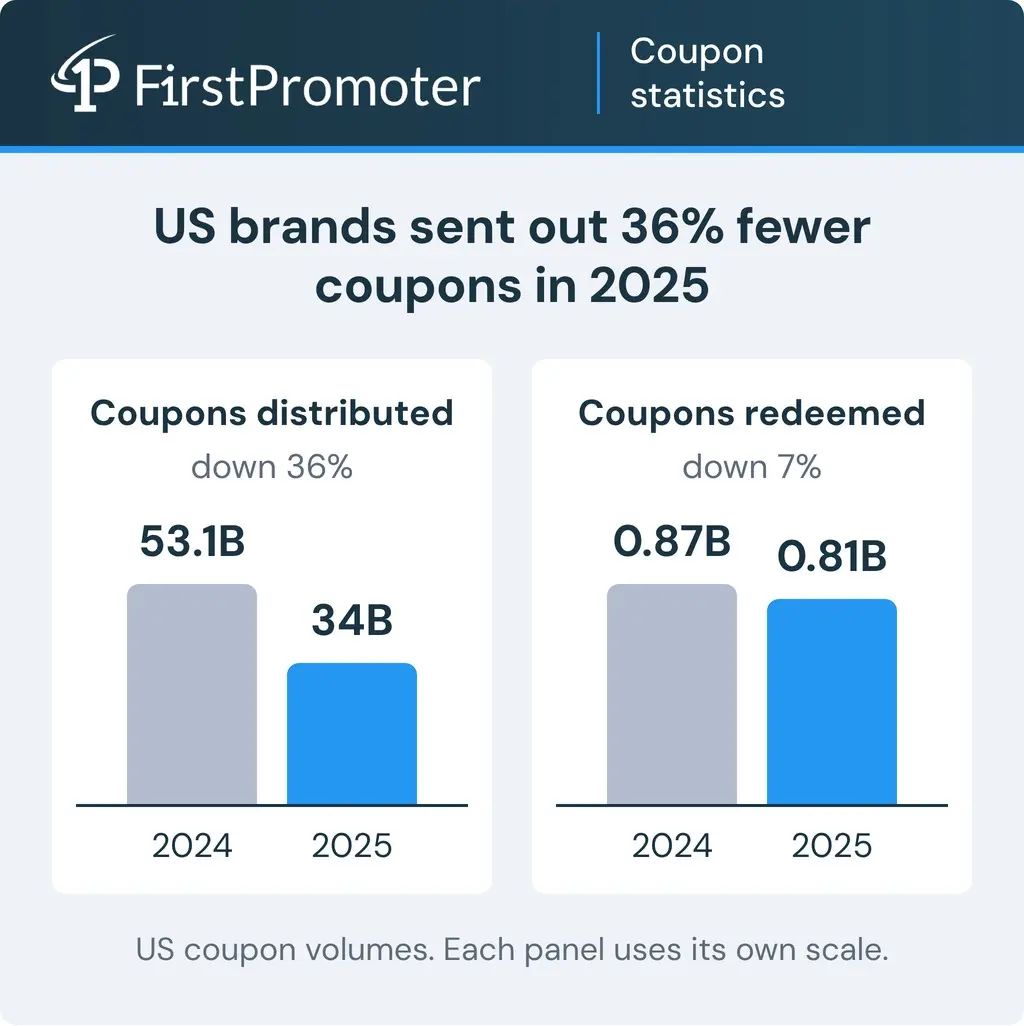
US brands sent out about 36% fewer coupons in 2025 than in 2024, while redemptions slipped only from 0.87 billion to 0.81 billion, so more of the coupons that did go out got used. Shoppers haven’t stopped looking for deals either: 91% of US adults say they regularly look for coupons or discount codes.
Below are 56 coupon statistics on usage, digital coupons, redemption rates, promo codes, affiliate and influencer codes, and coupon fraud. Most of the research was published in 2025 and 2026, and every figure links to its source.
Top coupon statistics in 2026
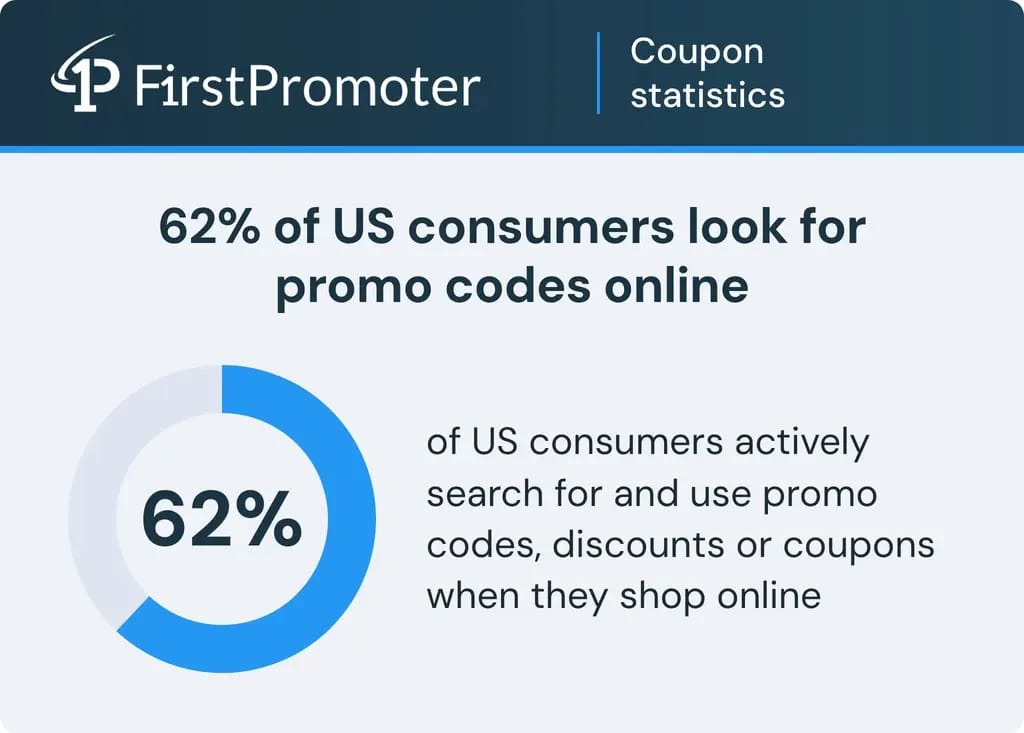
- 62% of US consumers actively search for and use promo codes, discounts or coupons when they shop online (SimplyCodes, 2024).
- 91% of US adults regularly seek coupons or discount codes, online or in store (Savings.com, 2025).
- US coupon redemptions fell to 0.81 billion in 2025, from 0.87 billion in 2024 (Inmar Intelligence, 2026).
- US CPG coupon distribution dropped to 34 billion in 2025, from 53.1 billion in 2024, a fall of about 36% (Inmar Intelligence, 2026).
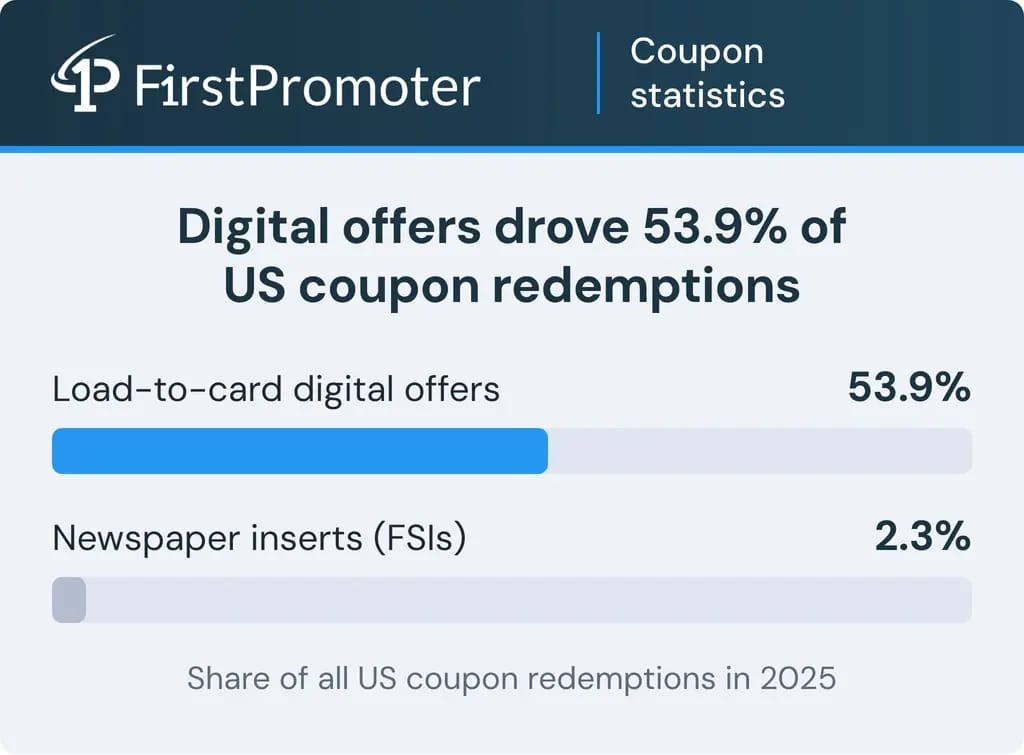
- Load-to-card digital offers made up 53.9% of all US coupon redemptions in 2025. Newspaper inserts (FSIs) made up 2.3% (Inmar Intelligence, 2026).
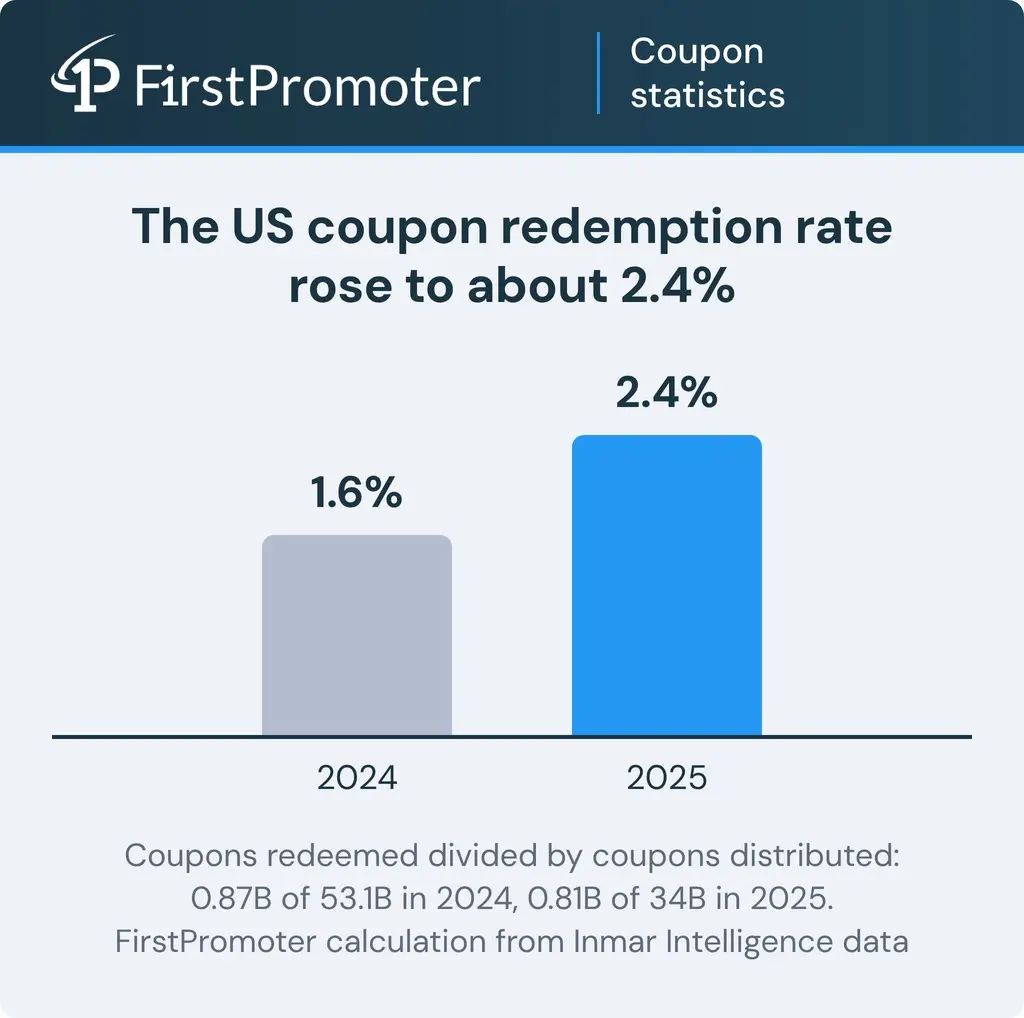
- The implied US coupon redemption rate rose from about 1.6% in 2024 to about 2.4% in 2025, because distribution fell much faster than redemptions (FirstPromoter calculation from Inmar Intelligence data, 2026).
- More than 70% of shoppers say digital coupons influence both what they buy and where they shop (Inmar Intelligence, 2026).
- Discounts motivate up to 72% of shoppers in the US, Canada, the UK and Australia (Omnisend, 2025).
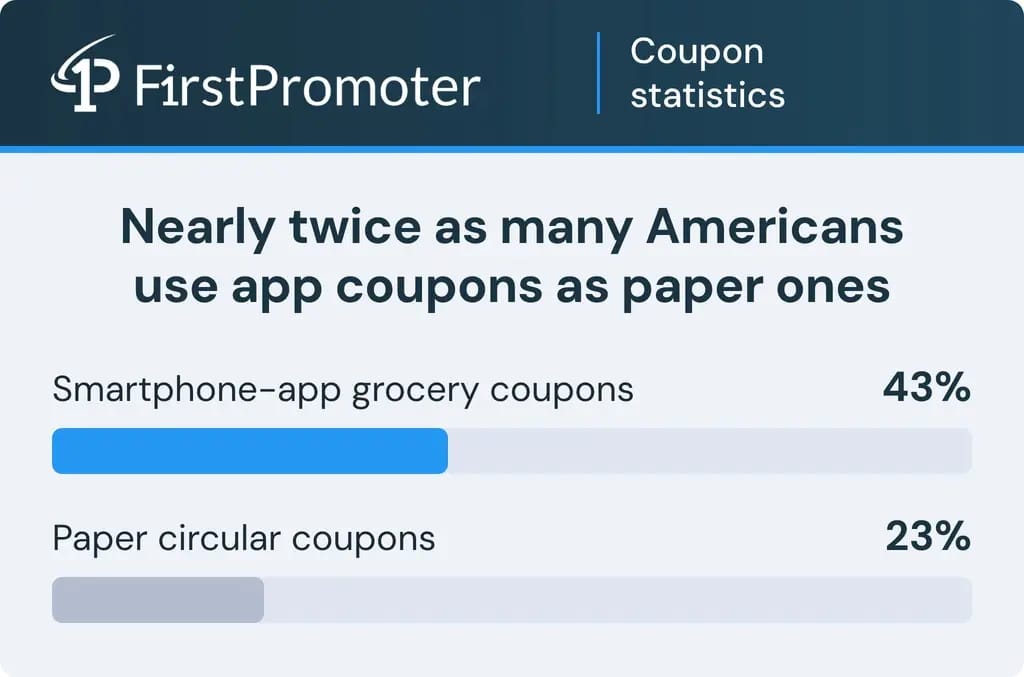
- Nearly twice as many Americans use smartphone-app grocery coupons (43%) as clip coupons from paper circulars (23%) (The Harris Poll for UNFI, 2024).
- 45.9% of brands track influencer campaigns with promo or discount codes, the most common method. Affiliate links come second at 26.0% and native shop features third at 25.0% (Influencer Marketing Hub, 2026).
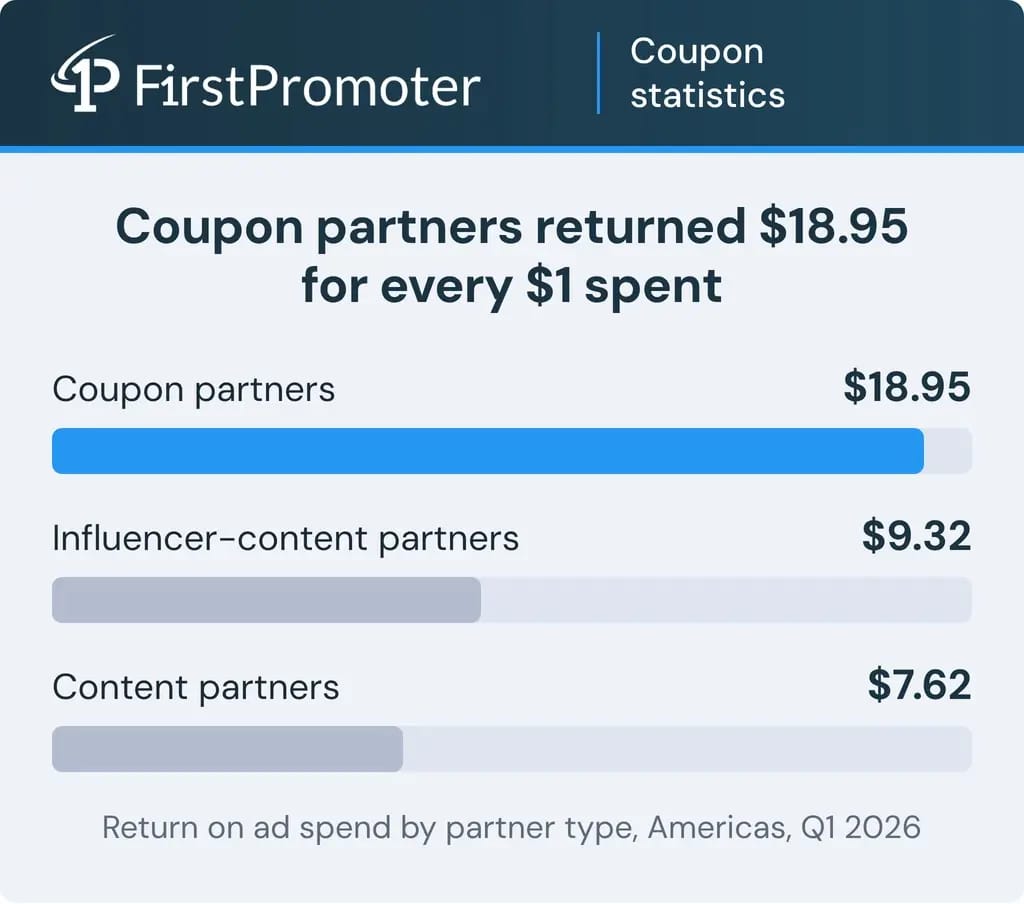
- Coupon partners returned $18.95 in revenue for every dollar spent in the Americas in Q1 2026. Content partners returned $7.62 and influencer-content partners $9.32 (Partnerize, 2026).
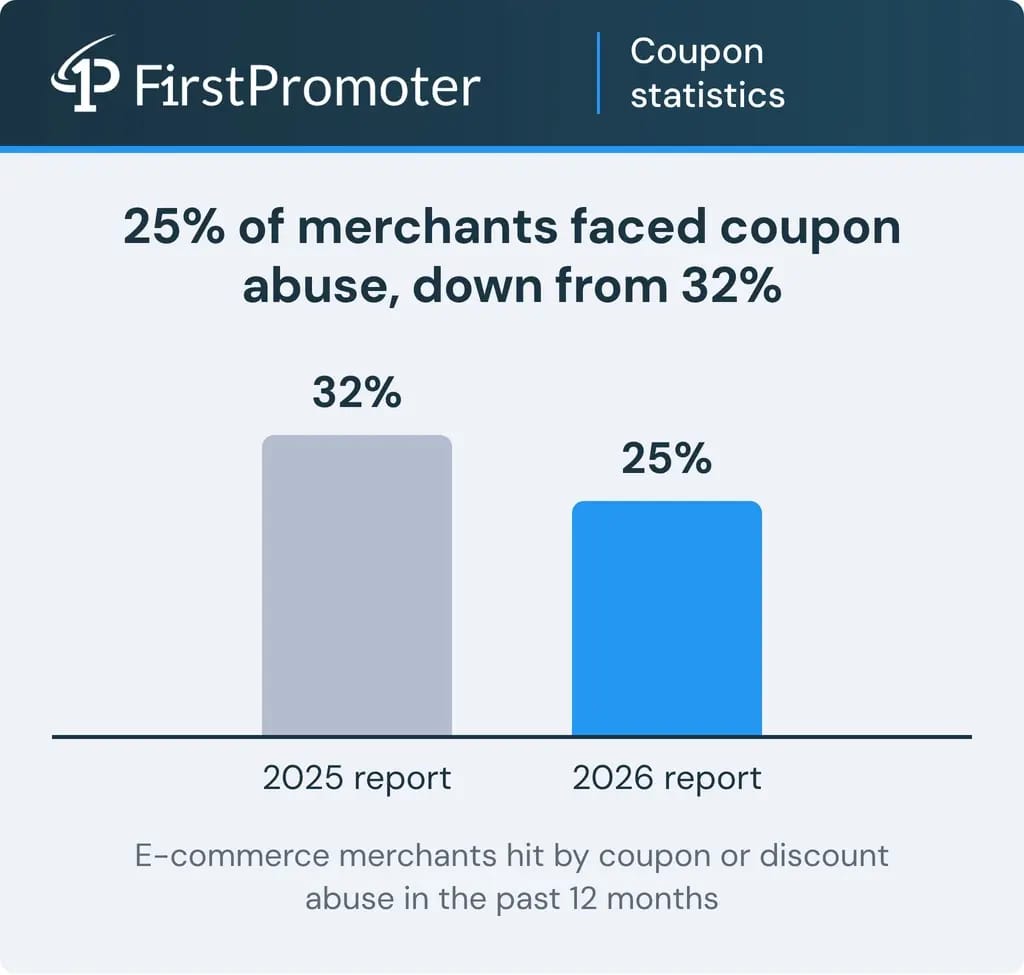
- 25% of e-commerce merchants dealt with coupon or discount abuse in the past 12 months, down from 32% a year earlier (Visa Acceptance Solutions and Merchant Risk Council, 2026).
- Promo and loyalty abuse is projected to grow from 31% to 42% of total fraud within two years (Liminal, 2025).
What percentage of people use coupons? Is couponing still a thing?
91% of US adults say they regularly look for coupons or discount codes, online or in store, in a September 2025 survey of 1,011 adults sampled to match the US population (Savings.com, 2025). The survey asked about looking for coupons. It doesn’t say how many of them were redeemed.
- 43% of US adults use smartphone-app grocery coupons, and 23% still clip coupons from paper circulars (The Harris Poll for UNFI, 2024).
- 37% of shoppers are using coupons and discount codes to manage their spending (Bazaarvoice, 8,000+ shoppers in six countries, 2025).
- 53% of Cyber Weekend 2025 shoppers whose buying was hit by rising prices now seek out promotions and coupons (Numerator, 2025).
- When tariffs pushed prices up, the most common reaction among US consumers was to look for sales or coupons, at 41% (Numerator, 2025).
- In the UK, 90% of 18 to 25-year-olds are more likely to try a product if they have a coupon for it. Across all UK adults the share is 76%, up from 60% in 2022 (savi, 2024).
The Krazy Coupon Lady surveys its own app users every year, so the next three figures describe people who already coupon more than average:
- Just over 70% of the app users surveyed used a coupon in the past 60 days, up 14% on 2025.
- 84% of couponing app users use digital coupons. Only 28% use printable or paper coupons, down from 41% a year earlier.
- App users who don’t coupon give two main reasons: the products they buy rarely have coupons (42%), and couponing is too complicated (31%).
Old coupon usage statistics to stop quoting
The coupon usage figures quoted most often online, 90%, 93% and 96%, come from studies published between 2016 and 2020. We traced each one back to its original study. Two of them measured something other than coupon use, and the pages behind the 90% figure no longer load. Each entry below shows the claim as it’s usually quoted, what the study actually measured, and a current figure to cite instead.
Myth: “90% of consumers use coupons” and “96% of consumers use coupons.”
What’s wrong: both trace back to Valassis and PRRI studies from around 2017, and the original pages no longer load. The 96% figures described specific groups, such as Baby Boomers and dads, and never all consumers.
Use instead: 91% of US adults regularly seek coupons or discount codes, online or in store (Savings.com, 2025).
Myth: “93% of shoppers use coupons.”
What’s wrong: the 2020 Criteo figure asked whether discounts matter to shoppers. It didn’t ask whether they use coupons.
Use instead: discounts motivate up to 72% of shoppers in the US, Canada, the UK and Australia (Omnisend, 2025).
Digital coupon statistics
Digital coupons now account for most US coupon redemptions. Load-to-card offers made up 53.9% of all redemptions in 2025, against 2.3% for newspaper inserts (Inmar Intelligence, 2026).
- More than 70% of shoppers say digital coupons shape what they buy and where they shop (Inmar Intelligence, 2026).
- Digital coupons grew 40% over two years, and digital temporary price reductions grew 60% (Numerator, 2025).
- Inmar’s digital incentives network reaches 200 million+ shoppers at 40,000+ North American retail locations, and the company projected $12 billion+ in consumer savings for 2025 (Inmar Intelligence, 2025).
- 32% of shoppers have joined a loyalty program to get better deals (Bazaarvoice, 2025).
- Retailer loyalty programs and apps are a saving tool for 79% of couponing Krazy Coupon Lady app users, up from 69% in 2024 (The Krazy Coupon Lady, 2025).
- Amazon has become the place where the most Krazy Coupon Lady app users redeem coupons (79%, up from 59%), ahead of drugstores (71%) and Walmart (68%) (The Krazy Coupon Lady, 2026).
Coupon redemption rate statistics
The implied US coupon redemption rate was about 2.4% in 2025, up from about 1.6% in 2024. We calculated it from Inmar’s volumes: 0.81 billion redemptions out of 34 billion coupons distributed in 2025, and 0.87 billion out of 53.1 billion in 2024 (FirstPromoter calculation from Inmar Intelligence data, 2026). The rate covers all US CPG coupons, paper and digital.
- Inmar describes the drop in distribution as a move from mass reach to precise targeting.
- A targeted Sprouts snack coupon campaign reached a 15.9% redemption rate, nearly double the category average. It’s a single campaign, so don’t read it as a benchmark.
- The load-to-card (53.9%) and newspaper insert (2.3%) figures in the digital section are shares of all redemptions. They aren’t redemption rates.
Myth vs data: coupon redemption rates
Two redemption figures still appear on coupon statistics pages: a 7% redemption rate for digital coupons and 10.4% growth in redemptions. We couldn’t find any study behind the first one, and the second describes 2022 to 2023, before the trend reversed. Here is what the current data shows.
Myth: “Digital coupons have a 7% redemption rate.”
What’s wrong: no original study for the figure can be found.
Use instead: the implied redemption rate for all US CPG coupons was about 2.4% in 2025 (FirstPromoter calculation from Inmar Intelligence data, 2026).
Myth: “Coupon redemptions grew 10.4%.”
What’s wrong: that growth was measured between 2022 and 2023, and the trend has since turned.
Use instead: US redemptions fell from 0.87 billion in 2024 to 0.81 billion in 2025 (Inmar Intelligence, 2026).
Coupon code and promo code statistics
62% of US consumers actively search for and use promo codes, discounts or coupons when they shop online (SimplyCodes, 2024). SimplyCodes’ own write-up of the June 2024 survey of 1,194 people puts it as more than 3 in 5 Americans (SimplyCodes, 2024).
- 73% of couponing Krazy Coupon Lady app users use online promo codes. 46% use rebate or cash-back apps, down from 58% (The Krazy Coupon Lady, 2026).
- 83% of e-commerce sites don’t apply eligible discounts automatically, even though users find auto-applied discounts convenient and trustworthy (Baymard Institute, 2026).
- A visible promo code field sends shoppers off the site to hunt for codes, Baymard found in usability testing. It recommends hiding the field behind a link (Baymard Institute, 2026).
- The global average cart abandonment rate is 70.22%, averaged across 50 studies. Coupons don’t appear in Baymard’s list of reasons shoppers abandon (Baymard Institute, 2025).
- PayPal Honey’s Chrome extension lists 13 million users as of October 2026 (Chrome Web Store, 2026).
- Honey had about 20 million Chrome users before the December 2024 exposé and about 12 million by the end of 2025 (9to5Google, 2025).
- Since June 2025, a Chrome extension may insert an affiliate link or code only when the user takes an action and gets a direct benefit. A coupon extension that finds no discount can’t add an affiliate link (Google Chrome for Developers, 2025).
- 63% of consumers in Ireland don’t trust that Black Friday discounts are genuine (CCPC Ireland, 2025).
Coupon marketing statistics: impact on sales and loyalty
Discounts motivate up to 72% of shoppers, according to an August 2025 survey of 4,000 consumers in the US, Canada, the UK and Australia (Omnisend, 2025).
- 58% of US shoppers try a new brand when they get a good coupon, up from 49% in 2023 (Savings.com, 2025).
- 61% of shoppers say promotions influence them before they’ve picked a brand (Inmar Intelligence, 2026).
- 74% of shoppers would take a smaller discount on something they buy regularly over a bigger discount on something they buy less often (Inmar Intelligence, 2026).
- 65% of shoppers plan their shopping lists around deals, and 83% want more personalized offers based on what they buy (Inmar Intelligence, 2025).
- 45% of shoppers are likely to switch brands for a better deal, and 38% would switch retailers (Numerator, 2025).
- 48% of shoppers would add another product to their cart to qualify for free shipping. For faster shipping, the share is 21% (Bazaarvoice, 2025).
- Percentage-off is the favorite discount type of couponing Krazy Coupon Lady app users (75%), just ahead of buy-one-get-one (74%). Dollar-off trails at 59% (The Krazy Coupon Lady, 2025).
- 31.3% of UK grocery spending went on promotions in the four weeks to 19 April 2026. The share has risen year on year every month since July 2023, and it covers all promotions, coupons included (Worldpanel by Numerator, 2026).
Influencer and affiliate coupon code statistics
Promo and discount codes are the most common way brands measure influencer campaigns: 45.9% use them, compared with 26.0% for affiliate links and 25.0% for native shop features (Influencer Marketing Hub, 2026).
- Coupon partners in the Americas returned $18.95 ROAS in Q1 2026, against $7.62 for content partners and $9.32 for influencer-content partners (Partnerize, 2026).
- Brands paid coupon partners an effective CPA of 5.28% of revenue in the same quarter. Content partners cost 13.12% (Partnerize, 2026).
- New-to-file customers brought in 50.72% of coupon-partner revenue, slightly more than for content partners (49.54%) and influencer-content partners (44.22%) (Partnerize, 2026).
- 42% of US consumers are more likely to complete a purchase when a creator offers a promo code, and 57% use creators’ exclusive discounts and affiliate codes (GRIN survey, 2025).
- In the first half of 2025, 7 of the top 10 affiliate publisher types used more coupons, and 50.1% of affiliate sales from email publishers included a coupon (EMARKETER using Awin data, 2025).
- US affiliate marketing spend reached $13.62 billion in 2024, up 49.8% on 2021. It drove $113 billion in e-commerce sales, 9.4% of all US e-commerce (Performance Marketing Association, 2025).
- UK brands spent £1.8 billion on affiliate and partner marketing in 2025, up 7.3% (APMA, 2026). Voucher partners delivered a 24x ROI (APMA, 2026, via InPublishing).
- Rakuten Advertising removed PayPal Honey from its network “effective immediately” on 12 January 2026 (Hello Partner, 2026).
- Awin said its investigation “confirmed breaches of our publisher policies” by Honey, and it suspended Honey’s payments and its access to new programs (Awin Group, 2026).
- A class action brought by creators alleges that Honey replaced creators’ affiliate cookies with its own. The court denied PayPal’s motion to dismiss on 22 June 2026. PayPal says the code involved touched under 0.1% of traffic (Cohen Milstein, 2026; PayPal via Hello Partner, 2026).
The Honey case is a dispute over who gets credit for a sale. A code that belongs to one partner settles that at checkout, even when no cookie was set. With FirstPromoter’s coupon tracking, referral links, coupon codes and direct URLs all feed the same commission record, and a customer who first arrived through a partner’s link stays credited to that partner. On Stripe, FirstPromoter creates partner promotion codes and keeps them in sync. On Paddle and Chargebee, you create the codes in your billing tool and FirstPromoter tracks them. Creator programs can pair each creator’s code with a referral link through FirstPromoter’s influencer marketing software.
Coupon fraud and promo abuse statistics
25% of e-commerce merchants dealt with coupon or discount abuse in the past 12 months, down from 32% a year earlier, in a survey of 1,278 merchants in 37 countries (Visa Acceptance Solutions and Merchant Risk Council, 2026).
- In the 2025 edition of the report, coupon and discount abuse hit 32% of merchants. That matched identity theft and was more than loyalty fraud or account takeover (Visa Acceptance Solutions and Merchant Risk Council, 2025).
- 98% of merchants faced at least one type of fraud attack in the past year. The average merchant saw 3.8 attack types, down from 4.2 (Visa Acceptance Solutions and Merchant Risk Council, 2026).
- Promo and loyalty abuse is projected to rise from 31% to 42% of all fraud within two years (Liminal, 2025).
- Only 20% of organizations enforce promo code restrictions automatically. 67% blame easy account creation for abuse, and 63% blame minimal checks at redemption (Liminal, 2025).
- 96% of loyalty and referral abuse cases still need a manual review (Liminal, 2025).
- 58% of US shoppers who abuse store policies, or are curious about it, have used several email addresses to reuse coupons or discounts. In the UK the figure is 48% (Riskified, 2024).
Partner codes end up on coupon sites, and some partners use their own codes. FirstPromoter checks every referral for self-referrals, ad traffic and blocked promoters before a commission fires, and flags a self-referral when the partner’s email or sign-in IP matches the customer’s. Our guide to affiliate fraud covers the other patterns worth watching.
How do coupon codes work in a subscription partner program?
A coupon is redeemed once, at checkout. A subscription customer who used a partner’s code keeps paying after that, and the renewals, upgrades, downgrades and refunds that follow change what the partner should earn. A commission fixed on the first invoice drifts away from the customer’s real value.
FirstPromoter reads those billing events from Stripe, Chargebee, Paddle, Recurly or Braintree and updates the commission on every code-attributed customer to match. A 100%-off trial code still records the referral and skips the commission on the $0 invoice. For benchmarks on the wider partner channel, see our affiliate marketing statistics for 2026. Connect your billing provider and try FirstPromoter free for 14 days, no card needed.

In this article
Newsletter