Affiliate marketing statistics do a specific job. On the brand side they are benchmarks: whether your affiliate share of revenue, ROI and partner mix look normal or lagging, and ammunition for the budget conversation if you are still making the case for a program. On the affiliate side, the earnings and traffic numbers show what the field actually pays beyond course-seller screenshots.
The catch is that the numbers everyone repeats are older and thinner than they look. The industry’s favorite adoption stat is ten years old, and the survey behind its favorite earnings figure went offline. Every figure below is verified at its primary source, and the full source list sits at the end.
Key Takeaways
- US affiliate marketing spend reached $13.62 billion in 2024, up 49.8% from $9.1 billion in 2021.
- US affiliate spend is forecast to hit $13.81 billion in 2026, growing 11.3% in a year when US retail e-commerce grows 6.7%.
- Affiliate marketing drove $113 billion in US e-commerce sales in 2024, or 9.4% of all US e-commerce.
- The global affiliate marketing industry is most commonly valued at over $17 billion.
- 74% of brands generate 11-30% of their total revenue from affiliate marketing.
- Affiliate marketing returns $11 to $21 for every $1 spent, depending on vertical.
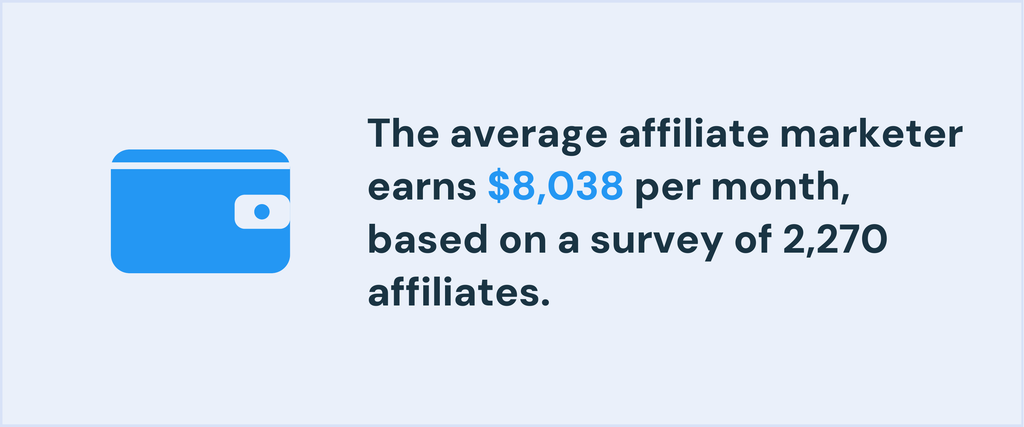
- The average affiliate marketer earns $8,038 per month, according to the last large survey of 2,270 affiliates.
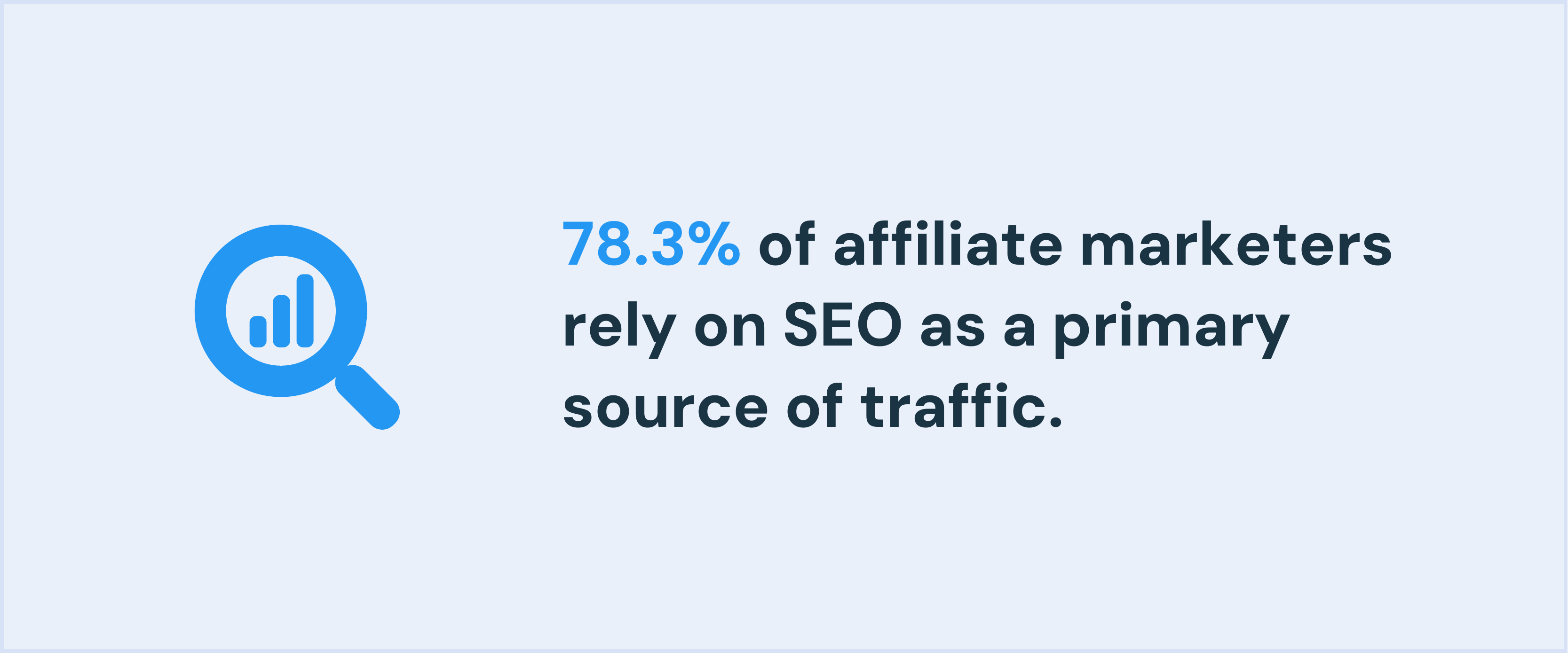
- 78.3% of affiliate marketers use SEO as a primary traffic source.
- 97% of brands already use AI somewhere in their partnership programs.
- Around 60% of performance marketers now prioritize content partnerships specifically to influence AI search results and LLM answers.
Affiliate marketing market size
US affiliate marketing spend reached $13.62 billion in 2024, up from $9.1 billion in 2021. Different research bodies measure the market differently: the broadest industry study produced that $13.62 billion figure, while a narrower forecast series estimates $12.42 billion for 2025 and $13.81 billion for 2026. The same forecast puts affiliate-influenced US e-commerce sales at $241.03 billion in 2026.
Global figures are messier. The most-cited valuation puts the worldwide industry at over $17 billion, though that number circulates with rotating attributions rather than a single study behind it. Named vendor estimates for 2024-2026 cluster between $18.5 and $24 billion, with North America taking about 36%, and the growth forecasts behind them run anywhere from 5.9% to 15.9% a year depending on who is selling the report. Treat any single global number as an estimate, ours included.
Affiliate marketing growth statistics
US affiliate spend grew 49.8% between 2021 and 2024, a 14.42% compound annual rate and roughly twice the pace of the broader e-commerce market over the same period. The trajectory holds into next year: 2026 spend is forecast to rise 11.3% while US retail e-commerce grows 6.7%, so the channel keeps growing faster than the market it sells into.
How many brands use affiliate marketing
Over 80% of brands run an affiliate program. The number gets repeated everywhere, and it comes from a single study published in February 2016, whose own forecasts ran out in 2021. We looked for something newer across every major network and industry body and came back empty-handed. So a ten-year-old study is still the best answer anyone has.
Recent measurements point the same direction. 74% of brands attribute 11-30% of their total revenue to affiliate marketing, the channel drives an estimated 15-20% of sales for companies that run programs, and the share of businesses running programs on multiple affiliate platforms grew from under 9% to nearly 20%.
Affiliate marketing ROI statistics
Affiliate marketing returned between $11 and $21 for every $1 spent in 2024, depending on vertical. Department stores lead at $21:1, followed by office supplies at $20:1, travel and auto parts at $19:1 and general retail at $11:1.The $6.50 and $15 per $1 figures quoted on many statistics roundups have no traceable study behind them. The measured range above is the one that holds up.
Attribution is the caveat behind every ROI number. Around 80% of programs still use last-click attribution, while 94% of brands report experimenting with alternative models.
Affiliate marketing success rate
No measured affiliate marketing success rate exists. Success has no standard definition in this industry, and the 10-20% and 5% figures that circulate have no study behind them.
What the survey data does show is how outcomes separate. Affiliates with 3+ years of experience earned 9.45x more than beginners, and those with 3-5 years earned 4.46x more, so time in the field is the strongest measured predictor. Persistence is part of the pattern too: 31.3% of six-figure earners said they considered giving up at some point.
How much affiliate marketers earn
The average affiliate marketer earned $8,038 per month, about $96,456 per year, per the largest recent survey of working affiliates, which polled 2,270 of them in November 2024. Treat it as directional: the survey page is now offline, the sample was self-selected and the figure is an average, which a handful of big earners can drag upward. The rest of it fills in the picture:
- The average affiliate website generated $149.76 in revenue per 1,000 visitors.
- The most profitable niches of 19 tested were education/e-learning, travel and beauty/skincare. 11 of the 19 averaged over $4,000 per month.
- The average affiliate site drew 56,673 visitors per month, and traffic grew about 53.5% with each additional year of experience.
How many affiliate marketers are there
No credible count of affiliate marketers exists. The 2 to 3 million figures repeated online trace to no census, registry or study, so any global headcount is a guess.
What can be measured is who they are. In the largest recent survey, 77.1% of affiliates were solopreneurs, the average team size was 2.3 people and 94.5% of teams had five or fewer. The field is overwhelmingly individuals and very small teams, not agencies.
How affiliates drive traffic
78.3% of affiliates use SEO as a primary traffic source, ahead of organic social at 35.5%, email at 22.8% and paid channels at 20.2%. From the same survey:
- 45.3% said getting traffic is their biggest challenge; 19.5% said converting it.
- Affiliates using email marketing earned 66.4% more than those who did not.
- 79.3% were already using AI-driven content creation.
- Only 25.1% reported being negatively affected by recent search algorithm updates.
- Amazon Associates remained the most-used network, at 58.5%.
Eimantas Aukštikalnis, SEO Manager at FirstPromoter: Brands won’t win those lost clicks back from Google because AI Overviews and AI Mode are here to stay. G2’s 2026 survey found 51% of B2B software buyers now start their research in an AI chatbot more often than Google, up from 29% a year earlier. LLMs aren’t replacing SEO, they’re adding a surface to it, and the first job is simply making sure you show up in popular AI chatbots and the information there is correct.
Affiliate marketing by industry and partner type
Retail’s share of US affiliate spend fell from 76% in 2021 to 63% in 2024, while financial services grew from 12% to 15%, travel from 5% to 9% and telecom from 3% to 7%.
Cashback and loyalty publishers took 35% of affiliate ad spend in 2024, with content publishers at 16%. Discount and coupon publishers accounted for 42.4% of US affiliate revenues in the first half of 2025. Email and newsletter partner adoption reached 59%, up 19% year over year, and brand-to-brand partnerships hit 54% adoption with partnership-driven sales up 93%. Adoption of media-house partners fell 17% and loyalty and reward partners 16% over the same period.
Affiliate marketing trends in 2026
97% of brands and 96% of creators already use AI somewhere in their partnership programs. The search side is changing what partnerships are for: around 60% of performance marketers now prioritize content partnerships specifically to influence what AI search engines and LLMs say about them.
Urszula Kamburov-Niepewna, Content Marketing Manager at FirstPromoter: The practical change is in the brief. AI answers are built on agreement between websites, so a partnership is no longer judged by the backlink alone. We ask partner writers to include things an AI can quote: the brand name next to the category, one clear number, a plain description of what the product does. The mention is the asset, even without a link. Ten partner articles repeating the same true claim will do more for AI visibility than one great post on your own blog.
Creator share of Awin network revenue rose from 15.9% to 19.5% in a year, and 59% of brands plan to put at least a quarter of their affiliate budget into creator partnerships. Repetition compounds: by the eighth YouTube creator integration, affiliate link click-through reaches 1.8x the level of the first.
Affiliate is also spreading beyond acquisition: 52% of senior marketers now use partnerships to support personalization, up 26% year over year, and 50% use them for customer experience, up 17%.
Interesting affiliate marketing facts
- Department store affiliate programs return $21 for every $1 spent, the highest measured ROI of any vertical.
- Affiliates who use email earn 66.4% more than those who do not.
- Only 25.1% of affiliates say recent search algorithm updates hurt their traffic.
- Google accounts for up to 76.6% of detected affiliate fraud cases.
- 58.5% of affiliates still run on Amazon Associates, making it the most-used network by a wide margin.
- 6 in 10 performance marketers now build content partnerships to shape what AI search engines say about them.
Affiliate marketing fraud statistics
No independent, industry-wide measurement of affiliate fraud exists. The confident percentages floating around the web either come from fraud vendors measuring their own customers’ traffic or trace back to curation pages citing nothing. When an affiliate fraud rate shows up without a named dataset behind it, someone made it up.
The detection data that does name its dataset shows where the problem concentrates. Google accounts for up to 76.6% of detected affiliate fraud cases, and ad hijacking clusters in the markets with the heaviest affiliate investment, led by Canada, the US, the UK and Germany. The tactics behind those detections, from brand bidding to cookie stuffing, are covered in the article to affiliate fraud we wrote with adment.
The wider digital advertising numbers frame the scale. The global invalid-traffic rate was 20.64% in 2025, measured across 105.7 billion impressions, and an estimated 22% of online ad spend was lost to fraud in 2023, around $84 billion, projected to pass $170 billion by 2028. Affiliate programs live inside that ecosystem.
Publisher sentiment
Publishers themselves are split. 69% say they are worried about what Google algorithm changes and AI are doing to their traffic. At the same time, 54% remain confident in the channel’s future and 52% plan to test new promotion methods.
What these numbers mean for subscription businesses
The big industry datasets are retail-heavy and SaaS behaves differently. Recurring billing changes the math: one referred customer keeps generating commissionable revenue every month, which is why recurring commission structures dominate subscription programs and why attribution accuracy matters more than raw click volume. It is also why affiliate tracking software built for subscriptions is its own category. For benchmarks built on subscription programs specifically, see our analysis of affiliate program management, built on data from 31 million referrals.
If you run a subscription business, the same standard applies to your own program: every commission should trace back to a real billing event. FirstPromoter connects to Stripe, Chargebee, Paddle, Recurly or Braintree and tracks referrals against actual subscription revenue, so your program reporting meets that bar from the first referral. Start a free trial and you can be live within a day, with 14 days free and no credit card required.
Sources
All figures were verified in September 2026.
- The US spend series, 14.42% CAGR, $113 billion and 9.4% of US e-commerce, ROI by vertical, vertical spend shares, the 15-20% of sales estimate and publisher sentiment come from the Performance Marketing Association Industry Study 2025, conducted by London Research on data from eight affiliate networks and platforms.
- Multi-platform adoption (9% to 20%), 80% last-click attribution and the 60% content-partnerships-for-AI figure come from the PMA 2026 US Brand Survey.
- The 2025-2026 spend forecast, $241.03 billion influenced sales, the cashback (35%) and content (16%) spend shares, the 42.4% coupon share, creator revenue share and the creator-integration click-through data come from EMARKETER’s affiliate marketing forecast and FAQ (September 2025 forecast, based partly on Awin and Agentio data).
- The 74% revenue figure, 97% brand and 96% creator AI adoption, 59% creator budget plans and 94% attribution experiments come from impact.com’s State of Affiliate Marketing 2025, a survey of 1,500+ marketers
- Partner-type adoption shifts (email and newsletter, brand-to-brand, media houses, loyalty) and the personalization and customer-experience figures come from the Awin x Forrester survey of around 700 senior marketers.
- The over-80%-of-brands figure comes from a Forrester Consulting study commissioned by Rakuten Marketing, published February 2016. The original paper is no longer online; contemporaneous coverage documents its findings.
- All affiliate earnings, traffic-source, niche and team-size figures come from Authority Hacker’s survey of 2,270 affiliate marketers, published November 2024.
- The 20.64% invalid-traffic rate on 105.7 billion impressions comes from the Fraudlogix State of Ad Fraud 2026 report.
- The 22% of ad spend, $84 billion 2023 loss and $172 billion 2028 projection come from a Juniper Research ad fraud study, September 2023.
- The Google share of detected affiliate fraud cases and the country hijacking detections come from adment.ai internal Q1 2026 data, based on millions of scanned ads, first published in FirstPromoter’s affiliate fraud guide.
- The $17 billion global valuation is the industry’s most-cited figure; it circulates with rotating attributions (Authority Hacker, Statista and others) and no single primary study. The vendor range comes from named estimates for 2024-2026, including Cognitive Market Research ($18.5 billion, 2024) and Grand View Research ($22.6 billion in 2025, 5.9% CAGR), with higher-CAGR vendor forecasts at the other end.

In this article
Newsletter