Advice on affiliate program management usually arrives from the outside: recruit more partners, keep them engaged, watch for fraud. All of it reasonable, and all of it unprioritized, because generic advice can’t tell you where the work actually is.
We pulled the numbers from the FirstPromoter database to find out. 31.4 million referrals, 12.4 million promoters and 9.9 million sale commissions across 3,425 subscription programs.
The picture differs from the standard advice on four points: activation is rarer and faster than operators expect, revenue concentrates in a small group of partners, commission records keep changing after creation and the daily fraud workload consists mostly of ad-traffic review rather than self-referral hunting.
Here’s each of those, with what to do about it in your own affiliate program.
Affiliate program management by the numbers
- 15% of approved affiliates in the median program ever produce a referral. 6.4% produce a paying customer.
- Among affiliates who do refer, half make their first referral within 7 days of joining. An affiliate who stays quiet for two months probably won’t convert without a nudge.
- 58.5% of referred revenue in the median program comes from the top 10% of revenue-generating affiliates.
- 2.55% of gross commission value gets clawed back after refunds and cancellations.
- 4% of referrals get flagged for review, and 96% of those flags are paid-ad traffic. Referrals tripping the classic self-referral checks account for around 0.15%.
About this data
All statistics in this article are FirstPromoter’s own, calculated from our production database in July 2026. The base is 3,425 subscription programs with at least 20 approved promoters, covering 31.4 million referrals, 12.4 million promoters and 9.9 million sale commissions. Most of the underlying records come from the last five years, the majority from the last two, and revenue concentration figures use the trailing 12 months.
Program-level statistics report the median program rather than pooled totals, so large affiliate programs don’t distort the results. Time to first referral is measured among promoters who referred at least once.
Most affiliate partners never activate, and that’s normal
Approve 100 partners and, in the median program, 15 will ever send a referral. Six or seven will bring a paying customer. That’s the baseline. The middle half of affiliate marketing programs land between 6% and 28% on referrals and even at the top of that range most of the roster stays inactive.
The window is short:
- Half of the promoters who ever refer make their first referral within 7 days of joining
- A quarter make it within the first 8 hours
- By day 49, three quarters of everyone who will ever refer already has
An affiliate who hasn’t referred in the first two months probably won’t start without a push.
Front-load everything
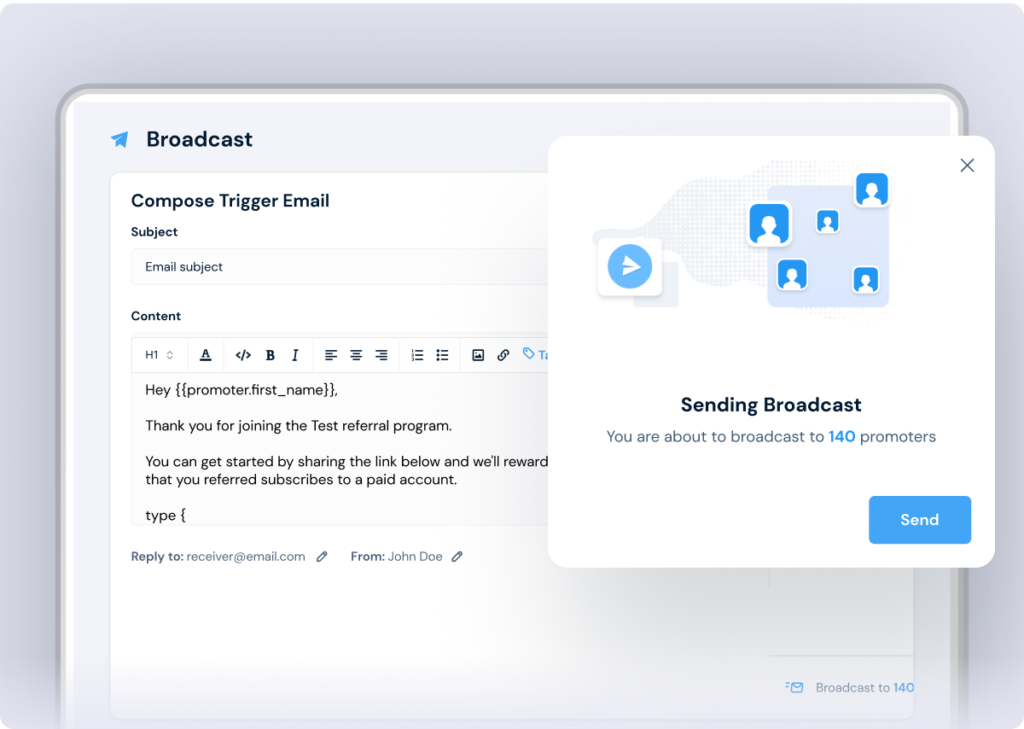
In FirstPromoter, trigger-based email sequences run this automatically: a welcome series when a partner joins, next steps at the first conversion, a re-engagement message when someone goes quiet. The partner portal carries their links and ready creatives from the assets library, plus a custom content panel with your positioning and current promos.
The goal is to compress the distance between approval and first referral, because the data says that distance decides whether a partner ever becomes real.
How neuroflash adds 30+ promoters a month on automated onboarding
Our case study with neuroflash, an AI content suite, shows this system in practice. They onboard every new affiliate with a three-email automated sequence covering where to find links, signups and commissions. Applications are filtered with signup questions about audience size and affiliate experience.
As they describe it, the ongoing work after setup comes down to reviewing applications once or twice a week, a monthly look at the data and emails around campaigns and releases. The results: 30+ new promoters a month, with around 15% of new customers now arriving through an affiliate. Setting up the same sequence in FirstPromoter takes an afternoon, and it runs for every partner you approve from then on.
Takeaway: onboarding has roughly two months to turn an approved partner into an active one and the first week decides most of it.
A small group of partners is the affiliate program
In the median program, the top 10% of revenue-generating promoters drive 58.5% of referred revenue. The middle half of programs sits between 46% and 72%. Measured across the whole platform, concentration is steeper still: the top 10% account for 86.2% of trailing-12-month referred revenue.
The management consequence: the arithmetic favors developing proven partners over recruiting average ones, so most of the judgment work in affiliate program management should point there. Spot rising partners early, give them better terms and keep them from drifting to a competitor’s program.
Let campaign structure promote them
In FirstPromoter, target rewards fire a one-off bonus when a partner crosses a revenue or customer milestone, and level-up campaigns move a proven affiliate into a higher-commission campaign at a threshold you define.
Campaigns also let you segment deliberately: Passion.io runs separate commission tiers for partners driving cold traffic and partners with warm audiences, and moves affiliates between campaigns as their role changes. Their program has grown past $2M in added revenue across 3,000+ promoters.
Takeaway: the top tenth is the program. Find them early and make their promotion automatic.
Refunds and cancellations claw back 1 in 40 commission dollars
Across 9.9 million sale commissions, 2.55% of gross commission value was clawed back through refund and cancellation adjustments. The median program adjusts 1.81% of its commissions and a further 1.58% get denied after review. Put differently: for every $40 of commissions created, about $1 later comes back out.
9 corrections a month, forever
The percentages look small until you multiply them by how subscription billing works. Every referred customer generates a billing event each cycle and every recurring commission rides on one.
A program with 500 referred customers on monthly plans creates 500 commission records a month. At the median adjustment rate, around 9 of them will change after the fact. Every month, indefinitely. Each one is a record someone has to correct and the number the affiliate sees has to change with it or you get disputes.
The fix is structural
This is the strongest argument for calculating commissions from billing events rather than signups or clicks: when the refund happens in Stripe, Chargebee, Paddle, Recurly or Braintree, the commission adjusts itself and the audit trail shows why. When commissions live in a spreadsheet or a click-based tool, that 1.81% becomes a manual reconciliation line every payout cycle, forever.
It’s a common reason companies switch tools. Brilliant Directories moved to FirstPromoter after their previous platform, built around one-time purchases, struggled with subscriptions and trials. During our case study interview, they shared that within the first few months they saw more consistent affiliate signups and a clear lift in affiliate-driven trials and new customers.
So if your billing already runs on Stripe, Chargebee, Paddle, Recurly or Braintree, this is the part FirstPromoter removes outright: connect the billing provider and adjustments become a log you review instead of a spreadsheet you maintain. A free trial is enough to see it against your own billing data.
Takeaway: pick the system that does the correcting for you. The refund rate never goes to zero.
Most fraud flags come from paid ads
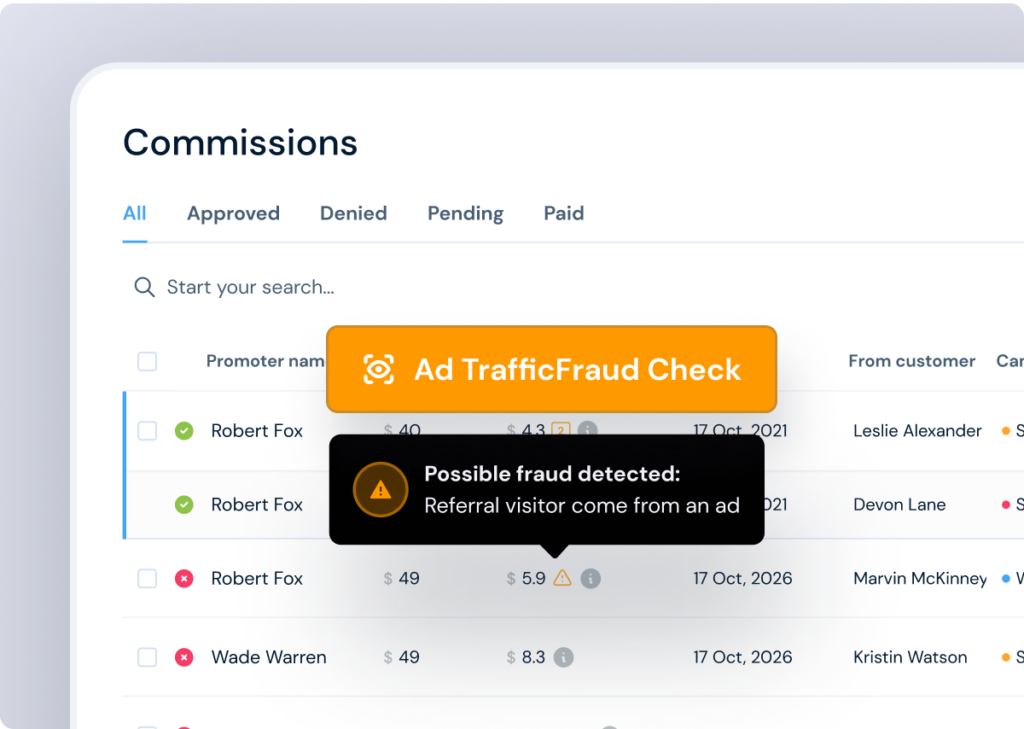
FirstPromoter’s fraud checks have flagged over 1.2 million referrals to date. 96% of those flags come from one check: the referral arrived from paid-ad traffic.
The classic self-referral checks (same IP or same email as the promoter) have caught around 47,000 referrals, about 0.15% of the total. Detection has limits and a determined self-referrer with a separate email won’t trip those checks, but the review volume an operator actually handles is overwhelmingly ad traffic. The scare story and the day-to-day workload are two different problems.
Ad traffic is a policy decision
Most of the day-to-day work is ad compliance: decide whether partners may run paid ads, then enforce it. In FirstPromoter that’s a per-campaign setting: track ad traffic normally, hold those commissions as pending for review or block ad-driven conversions entirely.
Self-referrals and suspicious leads still get flagged automatically before a commission fires and held in a review queue with the reason recorded. They’re just a much smaller pile than the advice suggests.
Two controls keep review time proportional to risk: require manual approval for any commission above a value you set and require a minimum number of paying customers before an affiliate qualifies for payout, which filters out anyone gaming small commissions.
The reviews end in real outcomes: 1.18% of all referrals, over 370,000, finished in a denied state. Passion.io caught attempted fraud this way, through FirstPromoter’s referred-customer detail view, showing emails, join dates and attempted purchases per referral.
Takeaway: write your paid-ads policy first. It decides 96% of your fraud review volume.
Run payouts like a utility
If the top 10% of your partners generate most of your revenue, losing one of them hurts more than any commission rate can fix. And those are exactly the partners with options: professional affiliates compare programs on payment reliability before they compare rates. A payout that arrives late or wrong tells your best partner to go test a competitor’s program.
So make payouts boring: set a minimum payout threshold so you’re not processing $4 payments.
Then match the payout path to your volume: one-click PayPal payouts for individual partners, mass PayPal payouts for the whole roster in one operation and a Wise-formatted CSV you download from FirstPromoter and upload to Wise for bank transfers.
On the Enterprise plan, managed autopayouts through Dots handle disbursement end to end: you submit payouts and pay a single invoice and partners pick bank transfer, PayPal, Payoneer or another supported method. A separate 2FA step for payment authorization keeps payouts from being one compromised login away.
Spreadsheets, affiliate marketing software or an agency
JustCall built their program to $2.4M in ARR with 1,000 affiliate partners over 3 years, and their takeaway on tooling is the honest one: a Google Sheet is a good start that fails as you scale. The reconciliation numbers above explain why and they compound with every referred customer.
Software plus an owner
Software covers the mechanical layer: tracking, commission calculation from billing events, fraud flags, partner portals and payout files. What it doesn’t cover is ownership. CustomGPT’s program ran steadily for a year, then took off after they hired a dedicated affiliate manager in early 2024, and has grown past $1M in affiliate revenue. The inflection point was a person whose job it is to run the program.
Outsourced program management (OPM) agencies take that ownership on for a retainer: recruiting affiliates, negotiating terms and handling day-to-day communication.
When an affiliate management agency makes sense
Hire one when the affiliate channel is a priority and nobody internal can own it, or when you’re entering markets where you have no partner relationships.
It still needs tracking software underneath it. And the activation and concentration data above is the argument for where your own hours go if you stay in-house: the mechanical layer is bought cheaply, the judgment layer (finding and developing the 10% who become the program) is where a human earns their time.
The job, measured
Affiliate program management rewards systems over heroics: commissions that correct themselves when billing changes, sequences that reach partners inside the window that matters and review queues that surface the 4% of referrals worth a human look.
FirstPromoter is that mechanical layer for 3,000+ subscription businesses. Connect your billing provider, launch your program and spend your own hours on the small group of partners the data says will become the program.
Affiliate program management FAQ
How many affiliates actually produce revenue?
In the median program on FirstPromoter, 15% of approved affiliates ever produce a referral and 6.4% bring at least one paying customer. Revenue concentrates further from there: the top 10% of revenue-generating affiliates drive 58.5% of referred revenue in the median program. Plan capacity around developing the few, and treat a mostly inactive roster as normal.
How do you keep affiliates active after they join?
Move fast, because half of affiliates who ever refer do it within 7 days of joining, and someone quiet for two months rarely restarts on their own. Automate the first-week touchpoints: a welcome sequence with links and assets, a milestone message at the first conversion and a re-engagement email after a defined quiet period. Pair that with escalating terms for proven partners so promoting you keeps paying off.
What’s the difference between an affiliate network and affiliate management software?
An affiliate network is a marketplace: it sits between you and a pool of affiliates, handles tracking and payments and charges a percentage of what moves through it. Affiliate management software runs your own affiliate program instead: your partners, your terms and your data, for a subscription price. Networks suit ecommerce brands recruiting from a shared pool. Subscription businesses usually run their own program, because their best partners tend to be existing users and niche creators rather than network affiliates.
Should you hire an affiliate management agency?
Outsource when the affiliate channel matters and nobody internal can own it or when you’re entering markets where you have no partner relationships. An OPM agency operates on top of your tracking software rather than replacing it, and the retainer usually costs multiples of the software. Most subscription businesses run the program in-house on dedicated software with a clear internal owner instead.

In this article
Newsletter