Search for influencer marketing software and you’ll find the same handful of tools again and again: a database of creators, filters for niche and audience size and a way to launch a campaign. That’s useful if your problem is finding people to work with. It says nothing about what happens to a creator’s compensation once the customer they referred becomes a subscriber.
Subscription businesses run into that gap fast. A creator’s coupon code doesn’t just drive a sale, but also drives a signup that renews, upgrades, downgrades or cancels over months. A lot of influencer marketing platforms stop tracking the moment the code is redeemed and never look at the subscription again, which means a business can end up paying full commission on a customer who cancelled in week two.
This article compares five influencer marketing platforms for subscription and SaaS businesses, focused on which ones can actually follow a subscriber’s billing history instead of stopping at the first conversion.
Quick answer: which is the best influencer marketing software for subscription businesses?
If you’re running a subscription or SaaS business, FirstPromoter is the top pick because it ties creator compensation to real billing events instead of clicks, reach or one-time orders. Commissions adjust automatically when a referred customer upgrades, downgrades or cancels, so payouts stay tied to revenue actually collected. Start a 14-day free trial and connect your billing provider before you commit to anything.
| Tool | Pricing | Core features |
|---|---|---|
| FirstPromoter | Starts at $49/month | Billing-event attribution across five providers, vanity links, coupon codes, direct URL tracking, dual-sided rewards |
| GRIN | Not published. Third-party estimates start around $25,000/year | Discovery-to-payment workflow, Shopify-native integration, creator database |
| Aspire | Not published. Third-party estimates start around $1,000/month | Creator marketplace, campaign workflow, reach and promo-code reporting |
| CreatorIQ | Not published. Third-party estimates start around $30,000/year | Creator discovery (20M+ profiles), earned media value tracking, brand safety and compliance workflows |
| Upfluence | Not published. Third-party estimates start around $478/month | Customer-to-creator discovery, ecommerce integrations, built-in creator payments |
Best influencer marketing software shortlist
Most digital marketing articles covering this topic rank tools on the same criteria: database size, discovery filters and influencer campaigns workflow. Those questions matter if the goal is finding creators, but they don’t answer what happens to a creator’s earnings after the sale. Which is the part that actually breaks for a subscription business.
We looked at how each platform attributes and adjusts compensation, what billing or ecommerce systems it connects to and how pricing is structured. Here’s what we found.
1. FirstPromoter
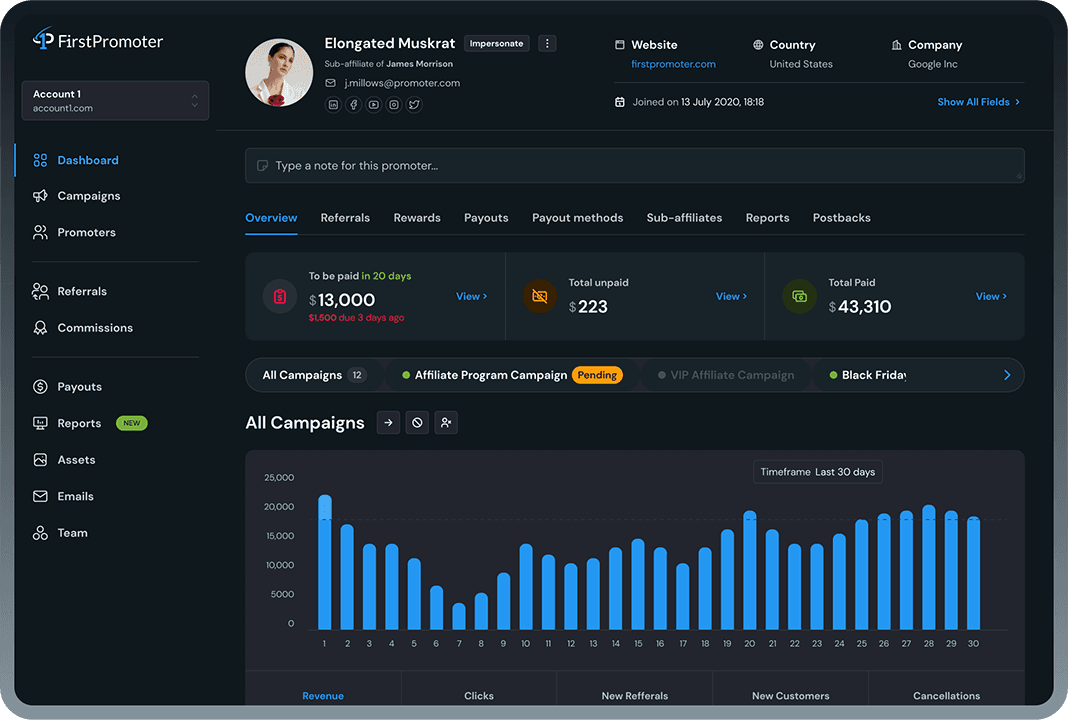
FirstPromoter is built around a different question than the other tools on this list: not how many creators you can find, but what happens to a creator’s payout once the person they referred becomes a paying, recurring customer. It provides the tracking and payout infrastructure for influencer marketing software without a creator discovery layer attached.
Commissions attach to the billing event, not the click or the coupon redemption. If a referred customer upgrades, downgrades, refunds or cancels, the commission updates to match. FirstPromoter reads webhooks directly from Stripe, Paddle, Recurly, Braintree and Chargebee, so the adjustment happens without anyone checking a spreadsheet by hand. Reviewers on both G2 and Capterra confirm this in practice, citing accurate commission recalculation on plan changes and reliable Stripe sync as reasons they use the platform.
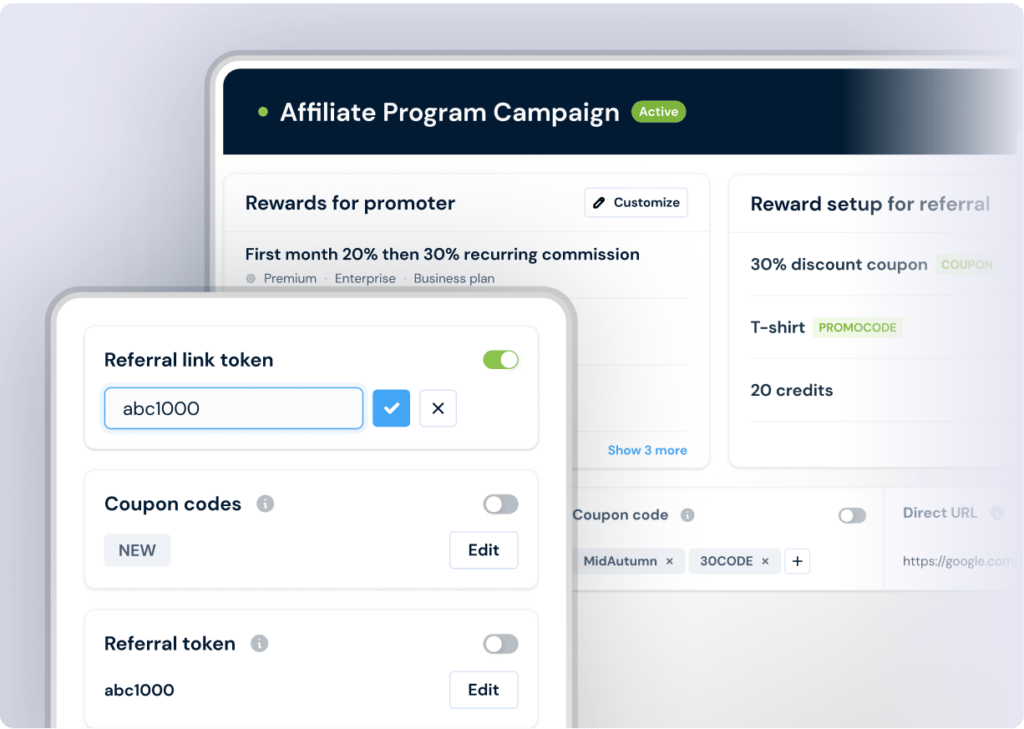
Attribution covers the ways creators actually promote on social platforms. Vanity links work for YouTube descriptions and blog placements, where clicks are reliable. Coupon codes cover TikTok and Instagram, where links in captions aren’t clickable and codes spoken on camera convert better. Campaign-specific landing pages add a third option: build a page for a creator’s audience, share the URL and attribution happens on arrival, with no tracking parameters visible in the link.
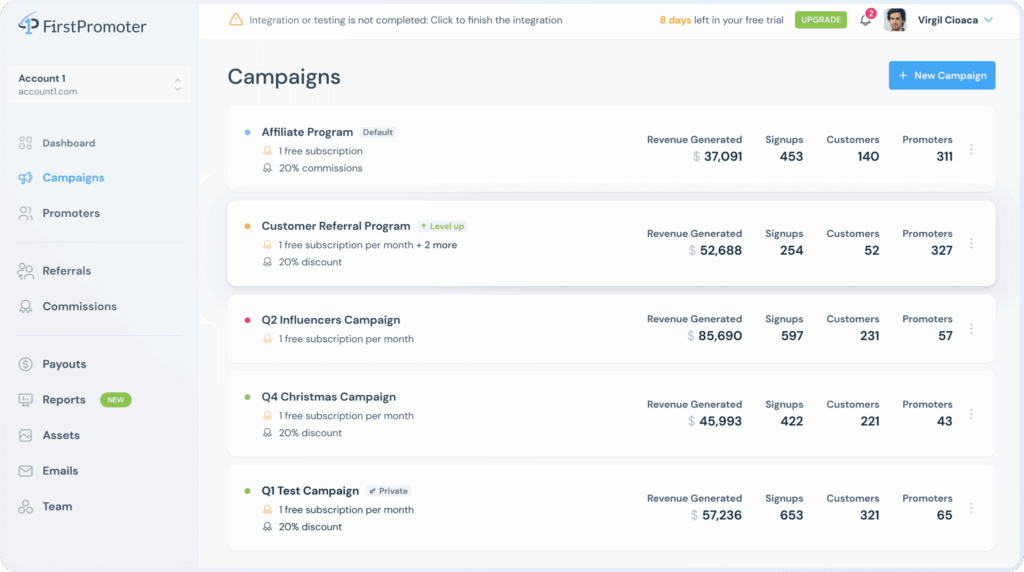
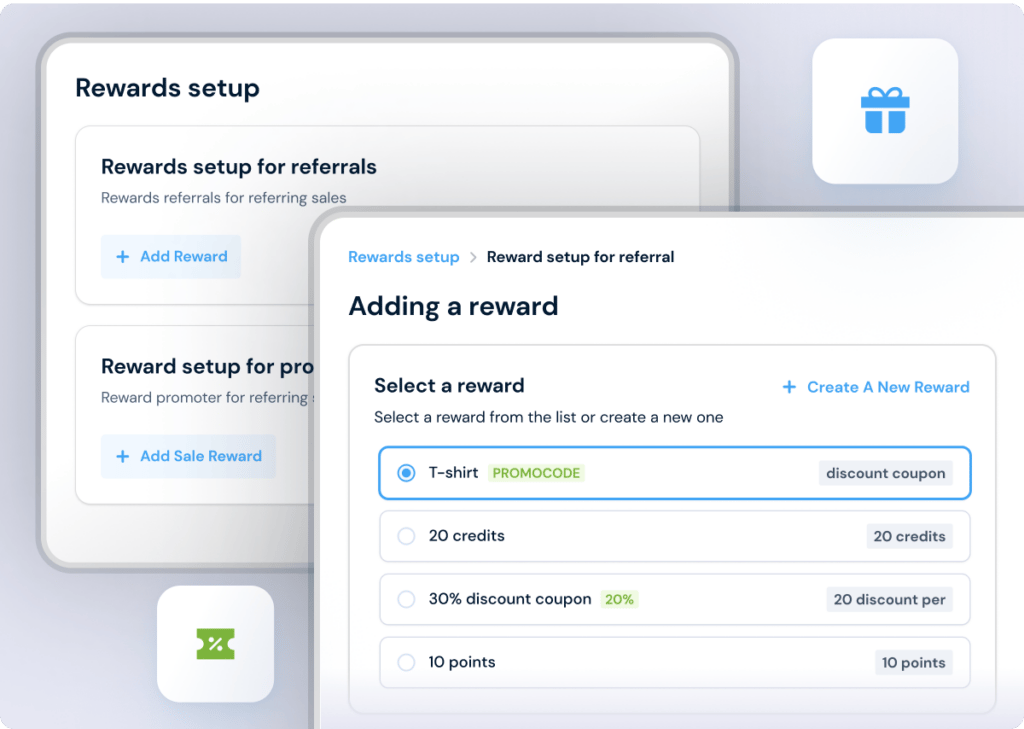
Deal structures match how influencer relationships actually work. Set a flat fee for a one-off post, a recurring commission for an ongoing ambassador relationship, a hybrid of both or free product access for smaller creators who aren’t paid in cash. Dual-sided rewards give a creator’s audience a discount at the same time the creator earns their own compensation, with each side configured independently. Level-up influencer marketing campaigns and target rewards move a creator into a higher-commission tier or fire a one-off bonus automatically at a defined milestone, without anyone restructuring the deal by hand.
What FirstPromoter doesn’t do is find creators, because there’s no marketplace and no influencer discovery database. Every creator is invited individually by the operator, and the relationship, negotiation and outreach stay manual. For a subscription business, that’s rarely the bottleneck. The harder problem is what happens after the deal is signed, and that’s the part built around billing data instead of a search filter.
Reporting runs 22 data points deep, broken down by campaign, creator and traffic source, at account and per-campaign level. Pricing is transparent: Starter at $49/month, Business at $99/month, Enterprise at $149+/month, with no transaction or payout fees. The platform currently tracks influencer, affiliate and referral programs for 3,000+ subscription businesses, moving more than $30M in revenue every month.
The best-fit buyer is an SMB-to-mid-market subscription business on Stripe, Paddle, Recurly, Braintree or Chargebee that already knows which creators it wants to work with and needs the tracking and payout side handled without giving up billing accuracy. Start a 14-day free trial and connect your billing provider before you commit to anything.
2. GRIN
GRIN was built for ecommerce in 2014. The platform covers the creator lifecycle, influencer discovery, outreach, product seeding, content and payments, in one dashboard connected natively to Shopify, with attribution tied to store orders rather than subscription billing.
The gap shows up the moment a business runs on recurring revenue instead of one-time orders. GRIN attributes creator activity to store transactions, not to a subscription’s lifecycle. There’s no mechanism for adjusting a creator’s payout when a customer they referred upgrades a plan, downgrades or cancels three months in. The integration answers whether an order happened, not whether the customer is still paying.
Pricing isn’t published. Third-party buyer data puts contracts in the $25,000 to $50,000-per-year range, on an annual commitment with no free trial. Reviewers on G2 and Capterra describe being locked into that annual term even when a demo suggested otherwise, with several specifically flagging the difficulty of exiting the contract.
GRIN isn’t built to answer what a creator’s compensation should look like once the customer they referred starts a recurring plan.
3. Aspire
Aspire pairs a creator marketplace with influencer campaigns management: brands post requirements, creators apply and the platform tracks the campaign through content review, product seeding and payment. Measurement centers on reach, engagement, impressions and promo-code redemptions, aimed at brands that want to show influencer marketing efforts moved awareness and short-term sales.
That measurement model stops at the point of sale. Aspire can report that a promo code was used. It has no connection to a billing provider, so it can’t report whether the customer who used that code is still subscribed a month later, or whether their plan changed. For a business selling a product once, that’s not a gap. For a business selling a subscription, a creator’s reported ROI and their actual, retained revenue can diverge without anyone noticing. G2’s aggregated review data flags a related pattern: users report that reporting gaps limit insight into which creators actually drive customer acquisition, as opposed to engagement.
Pricing isn’t published. Third-party estimates start around $1,000 per month on an annual commitment.
Aspire’s marketplace and campaign workflow are built around one-time purchases in categories like beauty, apparel or home goods, not around a subscription’s billing cycle.
4. CreatorIQ
CreatorIQ is built for the top of the market: AI-powered discovery across a large database of creator profiles and audience demographics, earned media value tracking following its acquisition of Tribe Dynamics, brand safety infrastructure and compliance workflows for global teams. Clients include Disney, Unilever and Ralph Lauren, and the platform is priced accordingly.
Contracts start around $30,000 a year, with a reported median closer to $39,000, on an annual-only basis with no monthly option. Implementation reportedly runs six to eight weeks. None of that budget or setup effort goes toward subscription billing. CreatorIQ measures brand safety, reach and earned media value. It has no native connection to a billing provider and no mechanism for adjusting commission when a subscriber’s plan changes. G2 reviewers separately describe the interface as slow and overwhelming once several influencer campaigns are running at once.
CreatorIQ’s entry pricing and multi-month implementation timeline put it out of reach for anything short of a large enterprise or agency with a dedicated creator marketing team and a seven-figure budget. For a growth-stage subscription business, both are hard to justify before a program has proven it works.
5. Upfluence
One feature in Upfluence is Live Capture, a snippet that scans a website’s visitors and existing customers for social reach and audience demographics, then flags the ones worth approaching. Paired with Shopify, WooCommerce and Amazon integrations, it’s designed to surface influencers who are already buying from the brand.
Creator payments run through Upfluence Pay, built on Stripe, and the connection is to Stripe as a payment processor, not to a subscription’s billing events. Upfluence can pay a creator once a transaction happens. It doesn’t track what happens to that transaction afterward: whether the customer renews, upgrades or cancels. Pricing is modular. Search and discovery, campaign workflow and payments are sold as separate components, and teams that start on the entry tier often find themselves needing a second or third module within the first year.
Pricing isn’t published. Third-party demo quotes put a typical entry setup around $1,276 a month for the core modules and one seat, on a required 12-month contract. Reviewers on G2 and Capterra report being told during the sales process that the term was shorter, then finding themselves held to the full 12 months.
How to evaluate and choose influencer marketing platform
Discovery and campaign workflow are close to standard on nearly every platform in this category. What separates them for a subscription business’s influencer marketing strategy is what happens after the campaign launches. Here’s what to check.
Revenue attribution: clicks, reach or actual billing events
One question matters more than any feature list: does the platform pay a creator based on what a customer actually paid, or based on a proxy for it, like a click, an impression or an order placed the same day? A referred customer who signs up and cancels within a week generated a click, and possibly a sale record, but no retained revenue. If the platform paid the creator the moment that click or order happened, the payout is already gone. FirstPromoter confirms a commission against the billing provider before paying, then adjusts it again if the customer refunds, downgrades or cancels later.
Recurring commission handling for subscription-based creator deals
Run this test on any platform you’re evaluating: set up a hypothetical creator deal, then ask what happens on day 35 if the referred customer upgrades their plan. Most tools built for ecommerce have no answer, because their attribution model assumes a single transaction, not a subscription that changes shape over months.
Louis Anghel, Head of Customer Success at FirstPromoter: “The mistake I see most often is treating the commission rate like a one-time decision. Businesses set 20% on the plan the customer signs up for, launch the campaign, and never define what happens after. Then the customer upgrades from a $29 plan to a $199 one, and nobody knows whether the influencer gets commission on the new plan, on the difference or on the original amount forever. Same on downgrades: the customer moves to a cheaper plan, revenue drops, but the payout stays where it was.“
The fix happens before the campaign goes live, not after. Pick a rule for each scenario. Upgrades: commission follows the new plan. Downgrades: commission drops with the plan. Cancellations: commission stops. Add-ons: decide whether they count at all. None of this is glamorous. It’s the difference between a program that scales and one that quietly bleeds margin while your finance team tries to reconcile the mess.”
Creator discovery: do you need a database, or do you already know who to work with
Ask any vendor you’re evaluating: if you already know the ten creators you want to work with, what does the discovery layer add? The answer separates two kinds of tools. GRIN, Aspire, CreatorIQ and Upfluence lead with discovery: a searchable database, filters and outreach tools for creators not yet known to you. If your team already sources creators through its own network, an existing customer base or manual outreach, you’re paying for a layer you won’t use. FirstPromoter skips discovery entirely and starts from the assumption that you already know who you’re inviting.
Attribution methods built for social platforms
Attribution on social media is messier than a standard affiliate link, because platforms make link clicks unreliable in ways a blog post never has to deal with. On TikTok and Instagram, links in captions aren’t clickable and link-in-bio friction cuts conversion, so a coupon code spoken or shown on screen converts better than any link. YouTube and blog placements work the other way: links in a video description or an article get clicked normally. A platform that supports only one attribution method will underreport a creator’s real impact depending on where they post.
Pricing model and contract length
Four of the five influencer marketing tools in this guide don’t publish pricing, which means every quote becomes a negotiation. Before that call, know what you’re asking: is the price per seat, per creator managed or a flat platform fee? Is there a required annual commitment, or can you start month to month? Are creator payments a separate module with its own transaction fees? A platform with transparent, published pricing removes a step from procurement that the enterprise tools in this category treat as part of the sales process.
Use a practical feature checklist during evaluation
When you sit down for a demo, work through a quick yes or no list to confirm you’ve found the right influencer marketing platform:
- Does the platform connect natively to a billing provider, or only to an ecommerce store?
- Does a creator’s commission adjust automatically on a plan upgrade, downgrade or cancellation?
- Which attribution methods are supported: vanity links, coupon codes, direct URL tracking or all three?
- Is a creator discovery database needed, or are the right creators already known?
- Is pricing published, or does every quote require a sales call?
- Is there a required annual contract, or can a program start month to month?
- Does the platform charge a separate fee or module for paying creators?
- Can the same platform run affiliate and referral programs alongside influencer programs?
Which influencer marketing platform should you pick?
The right platform depends on what your program is actually selling. If you need a creator’s compensation to survive a renewal, an upgrade or a refund, none of the discovery-first platforms in this guide were built to handle that. FirstPromoter was.
GRIN, Aspire, CreatorIQ and Upfluence are all built around one-time ecommerce orders, reach and creator discovery, not around a subscription’s billing lifecycle. None of them adjust a creator’s payout when a customer upgrades, downgrades or cancels, because none of them read events from a billing provider.
If revenue is recurring and a creator’s payout needs to stay accurate through every renewal and cancellation, connect a billing provider and start a free trial before committing to a tool built around a different kind of sale.
FAQs
What is the best influencer marketing software for subscription businesses?
Subscription businesses need a platform that adjusts a creator’s commission when a customer renews, upgrades, downgrades or cancels, not one that stops tracking after the first sale. FirstPromoter does this by reading billing webhooks from Stripe, Paddle, Recurly, Braintree and Chargebee.
Is there free software for influencer campaigns?
Most platforms in this category don’t offer a free tier. FirstPromoter and similar tools offer a free trial instead, typically 14 days, making it possible to test tracking and payouts against real billing data before committing to a paid plan.
What’s the difference between influencer marketing platform and an influencer marketplace?
A marketplace helps a brand find and vet creators it doesn’t yet know, through a searchable database and filters. Influencer marketing platform in the tracking-and-payout sense assumes the brand already knows who it’s working with and focuses on attribution, commission logic and paying creators accurately. Some platforms do both. Others, like FirstPromoter, focus on the second half and leave influencer discovery to the operator. For a comparison of tools built around a similar tracking-first approach, see our best affiliate marketing software guide.
Can influencer marketing software track subscription renewals and refunds?
Only if it connects directly to a billing provider. Platforms built for ecommerce track store orders, not subscription lifecycles, so they have no way to know a customer renewed, downgraded or refunded after the first sale. FirstPromoter reads billing events directly and adjusts commissions when they change.
Is influencer marketing software different for B2B SaaS than for ecommerce brands?
Yes. Software supporting a B2B SaaS influencer marketing strategy needs to track recurring, billing-based revenue and adjust commissions across a customer lifecycle. Ecommerce-focused tools are built around one-time orders and store integrations, and using one for a subscription program produces commissions that don’t account for what happens after the first charge.
Can one platform manage affiliate, referral and influencer programs together?
Some platforms handle one program type well and treat the others as an afterthought. FirstPromoter runs all three, affiliates, referrals and influencers, on one attribution engine, so reporting stays unified instead of needing reconciliation across separate tools at the end of the month.

In this article
Newsletter