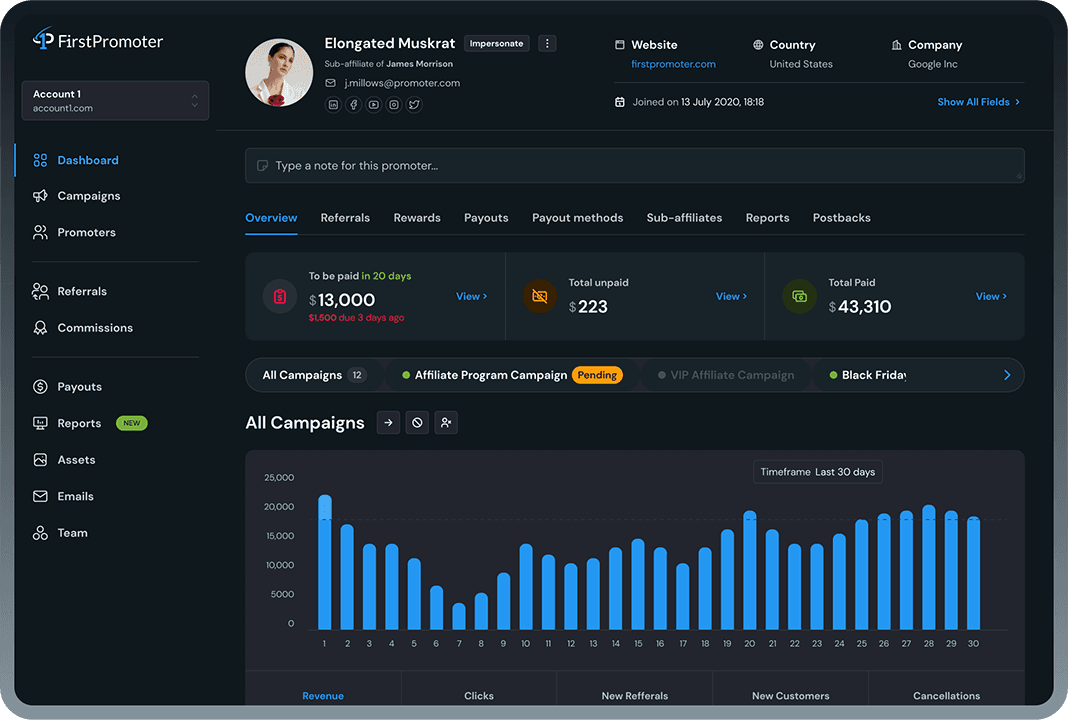
On paper, Tapfiliate’s entry plan looks affordable. But when you dig deeper, you realize this platform meters clicks and conversions, then adds overage fees once you pass your plan’s limits. As the program grows, your invoices climb, often from traffic that never converted into paying customers. Eventually, that spend starts eating into the margin the channel is supposed to add.
That weighs heaviest on lean SaaS and subscription teams. They need to track the revenue an affiliate actually generates, and pay in line with the revenue they keep, not the clicks they attract. When the meter sits on clicks instead of the billing event, your tool is charging for the wrong thing.
That’s the main reason teams are turning to Tapfiliate alternatives like FirstPromoter. FirstPromoter delivers transparent pricing with zero transaction fees on commission payouts. It also focuses on accurate billing-event tracking, so SaaS teams don’t lose money paying commissions on revenue they never received.
In this guide, we walk through the seven best platforms that compete with Tapfiliate, so you can pick the one suited to your business model.
Quick answer: what are the best Tapfiliate alternatives?
For SaaS and subscription businesses, FirstPromoter is the strongest Tapfiliate alternative. It ties affiliate commissions to real billing events, such as renewals, upgrades, downgrades, and cancellations. Pricing is transparent, and there are no transaction fees or commissions. You also get coupon tracking, branded partner portals, deep reporting, and automated payouts.
You can test the platform with a 14-day free trial.
| Tool | Pricing | Standout feature | SaaS fit |
|---|---|---|---|
| FirstPromoter | $49 / $99 / $149+ /mo · 0% transaction fees | Billing-event tracking across 5 providers (Stripe, Paddle, Recurly, Braintree, Chargebee) | Built for it |
| Rewardful | from $49/mo | Simple recurring Stripe affiliate tracking | For simple programs |
| Tolt | $69–199/mo (+2% on auto payouts) | Clean, modern, quick launch | For simple programs |
| LeadDyno | $49–$749/mo (flat) | Broad integrations, unlimited clicks/conversions | Check recurring support |
| Refersion | $39/mo + 3% of sales; $199/mo + 2%; custom | SKU-level ecommerce tracking | For ecommerce, not SaaS |
| Partnero | from ~$49–59/mo | Affiliate + referral + newsletter referrals, white-label | For smaller programs |
| Impact | From $30/mo (Essentials $500+, Pro $2,500+) + 2.5% txn fee | Multi-touch attribution at scale, large partner marketplace | Overkill for SMB SaaS |
Best Tapfiliate alternatives
Below are the seven platforms comparable to Tapfiliate, but the right one depends on what kind of program you run and how you make money. For a SaaS company, two criteria carry more weight than the rest: first, how accurately a tool attributes revenue; second, how deeply it connects to your billing system.
Each review below covers who the tool works for, where it gets limited, and how it handles subscription revenue specifically.
1. FirstPromoter
FirstPromoter is the strongest Tapfiliate alternative for SaaS because it doesn’t count clicks. It listens to your billing system instead, so that every commission ties back to a real charge.
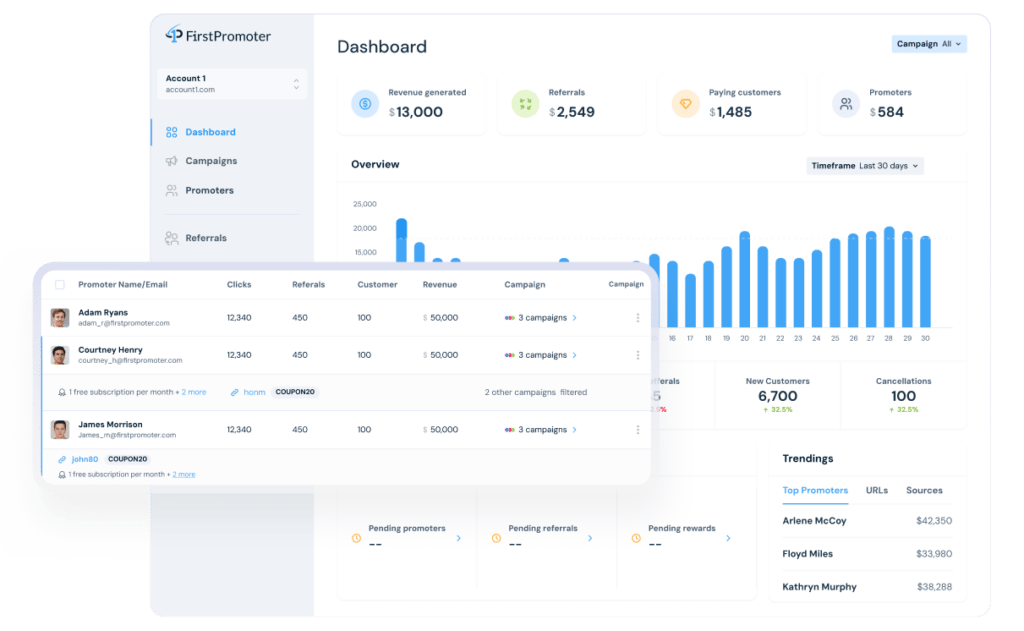
The platform works by connecting natively to five billing providers (Stripe, Paddle, Recurly, Braintree, and Chargebee) and reading their webhooks directly, so commissions adjust automatically when a billing event fires. Both the affiliate ledger and the billing record are pulled from the same source, so there’s no second system to reconcile.
Tapfiliate, on the other hand, tracks clicks and conversions first, then layers recurring and refund handling on top through a separate Stripe integration that a developer connects. Its Launch plan caps at 5,000 clicks and 500 conversions per month, with overages billed beyond that. Users have flagged the pricing as deceptive once those limits kick in (source: G2). At its core, it’s still a click tracker – it doesn’t track the full lifecycle of a referred customer the way a billing-native tool does.
Because it reads the billing events, FirstPromoter models commissions the way subscription pricing actually works: one-time, recurring and tiered rewards, plus different rates per plan or product. You can pay more for referrals to your Business plan than your Starter plan, or set up separate campaigns with different commission structures for different partner tiers. That logic lives in the platform.
It also creates and syncs Stripe coupon codes directly, with more than one code per affiliate. Tapfiliate handles one-time and recurring commissions too, but more specific structures (say, 50% on the first charge and 10% after) lean on its Extra Commissions feature plus logic you maintain in your own backend. Coupon tracking can depend on a Zapier workaround in setups outside Stripe – and SaaS teams have reported difficulty getting recurring Stripe webhook tracking to work correctly (source: Capterra).
“I was running an affiliate program for a subscription business that used an ecommerce tracking platform, one built for order checkout page tracking rather than billing. Every time a monthly charge processed, I had to manually adjust it on the affiliate platform. It took a couple of months of back and forth before switching to the right tool” – Tautvydas Vasiliauskas, 7+ years in affiliate program management, Head of Marketing at FirstPromoter.
The reporting reflects the same idea. FirstPromoter tracks 22 data points, with breakdowns by campaign, promoter, traffic source, and landing page, including earnings per click, churn, and the recurring revenue your affiliate channel is generating. That’s the difference between knowing a partner sent 10,000 clicks and knowing they sent 50 paying customers who stayed. Tapfiliate’s reporting is lighter, with fewer breakdowns of that kind.
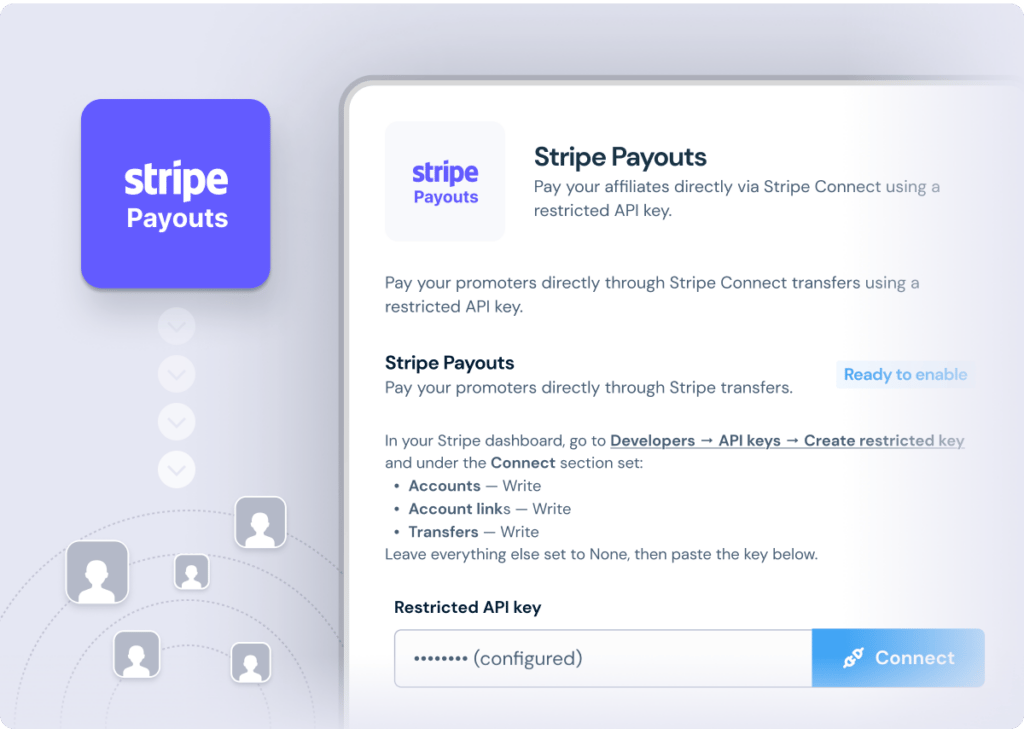
Payouts differ, too. FirstPromoter runs PayPal and Wise bulk payouts, with auto-managed payouts and EU invoicing, and takes zero transaction fees on commissions. Tapfiliate’s payouts route through PayPal or Trolley; the internal auto-managed payout is still listed as coming soon, so finance carries more of the work as the program grows.
A great example of FirstPromoter’s capabilities is the Submagic case study. It’s an AI video tool on a $12/month plan that generated €1,635,717 in affiliate revenue (€85,000+ per month across 9,000+ promoters), largely driven by creators promoting with coupon codes. It’s a useful reminder that recurring affiliate revenue is viable even on a low-priced product, as long as the attribution holds up.
FirstPromoter isn’t built for everything, and that’s deliberate. It doesn’t run an ecommerce storefront program (no native Shopify or WooCommerce, since it’s built for subscription billing). There’s no built-in marketplace for recruiting affiliates either. If you need any of those, another tool on this list fits better. But for a subscription business that wants commissions tied to real revenue and a program a small team can actually run, this is the one to start with.
See the full FirstPromoter vs Tapfiliate breakdown for a side-by-side.
2. Rewardful
Rewardful is often the first tool SaaS founders try. Setup is straightforward for Stripe-only programs, and it reads basic Stripe events, though the depth of that integration has limits that show up as the program grows.
It connects only to Stripe and Paddle Classic, so a business on Recurly, Braintree, Chargebee, or Paddle Billing won’t be a good fit. Reporting stays basic, commission customization is limited to fairly simple one-time and recurring rewards, and the Starter plan caps team members at two (Growth+ unlocks unlimited team members, but role separation is still light).
Its API is limited, and there are no postbacks (the server-to-server pings that let you feed conversions into other systems), which caps more advanced tracking setups. Managed Payouts exist but are still labeled Beta and may carry a fee.
The biggest difference between Rewardful and FirstPromoter is depth, not architecture. As a program matures into a real revenue channel, the limitations start to bite.
Teams on Stripe with simple commission needs and no plans to scale beyond it may find Rewardful sufficient in the short term.
See the full comparisons: Rewardful vs Tapfiliate and FirstPromoter vs Rewardful
3. Tolt
Tolt prioritises speed over depth. A basic program can go live quickly, which appeals to teams that want something running before they’ve fully scoped requirements. It connects to Stripe, Paddle, and Chargebee, and the setup process is straightforward for standard configurations. If your priority is shipping an affiliate program as soon as possible, Tolt makes that easy.
However, speed can’t compensate for depth. Tolt handles one-time, recurring, and custom rewards, but it has no multi-tier or multi-level structures, which rules out sub-affiliate programs and layered tiers.
Reporting is limited. Payouts on the Basic plan are manual; auto-managed payouts and invoicing only kick in on the Growth plan ($99/mo) and carry a 2% processing fee. Every team member shares the same permissions, with no role separation, and branding stops at a custom domain (no CSS or JS).
Like Rewardful, Tolt tracks charges, so it’s a sound fit for a subscription business early on. Some competitors even market against Tolt’s “billing-centric” design as a weakness, on the grounds that it doesn’t stretch to one-time ecommerce sales. For a SaaS reader, that focus is the benefit, not the flaw.
Tolt works for early-stage teams that want a simple, modern setup and don’t yet need detailed lifecycle reporting or complex commission logic.
See the full comparison: FirstPromoter vs Tolt
4. LeadDyno
LeadDyno’s selling point is reach. It connects to 25-plus tools, including Shopify, Stripe, BigCommerce, HubSpot, Chargebee and Wix, and runs on flat pricing without taking a cut of affiliate revenue.
That breadth comes with trade-offs. Payouts are PayPal-only (via PayPal Payouts automation), without Wise or bank rails, which becomes noticeable as the program scales. Reporting is basic; advanced fraud protection isn’t verified; role customization is limited; reviewers often say the interface feels dated; and the API is light on postbacks.
LeadDyno is the first tool here that leans toward counting clicks and conversions rather than billing charges. It’s designed to track across ecommerce, digital products, one-time sales, and subscriptions all at once. That’s why a subscription business should confirm exactly how it handles recurring commissions, refunds, and clawbacks before committing.
LeadDyno works for traditional or hybrid programs where ecommerce-style tracking and broad integrations matter more than subscription depth.
See the full comparison: Tapfiliate vs LeadDyno
5. Refersion
Refersion is an ecommerce-focused affiliate platform. It’s a strong starting point if you sell physical products through Shopify or BigCommerce.
The defining detail for a SaaS buyer is the pricing model. Refersion’s entry plan is $39/month plus 3% of affiliate-driven sales. The transaction fee drops to 2% on the Growth plan ($199/month), and only disappears on the custom Scale plan. Refersion bills on sales and orders, the ecommerce unit. A subscription business needs a tool for counting the recurring charge, not a slice of each order.
Reviewers point to high costs for standard features, limited reporting and filtering, and clunky manual PayPal payouts. While these still leave Refersion a strong contender for ecommerce, SaaS businesses should carefully evaluate their program’s needs before committing.
6. Partnero
Partnero connects to several billing providers, though subscription billing is one of two focuses rather than the entire product. It connects to Stripe, Paddle (Billing and Classic), and Chargebee, as well as Shopify and WooCommerce for hybrids. It handles subscription events such as upgrades, cancellations, and refunds, keeping the partner ledger aligned with billing. It runs affiliate, referral, and newsletter-referral programs, offers white-label portals, and starts at around $49–59/month.
Partnero spans both SaaS and ecommerce, so subscription billing is one of two focuses, rather than the entire product, as it is for a subscription-only tool. Its reporting is lighter than FirstPromoter’s, which means a growing program sees fewer breakdowns, showing which partners actually drive retained revenue.
Of all the tools on this list, Partnero is the closest architectural peer to FirstPromoter: both count the charge. The difference lies in depth, maturity, and the breadth of native billing support, not in the underlying model.
Smaller teams with simple needs and a hybrid SaaS/ecommerce setup may find it covers the basics without much configuration.
7. Impact
Impact focuses on enterprises that run large, multi-channel partner programs. On top of its affiliate platform, it also runs a marketplace of vetted partners for discovery and recruitment.
Pricing starts at $30/month for Starter, then jumps to $500/month for Essentials and $2,500/month for Pro, plus a 2.5% transaction fee on partner-driven revenue. It has the heaviest implementation and longest setup on this list, often needing dedicated staff to run.
Its multi-touch attribution, which credits several partners across a long, multi-step buyer journey, solves a problem that small- or mid-market subscription businesses don’t have yet. For a focused SaaS affiliate program where the conversion is simply the billing charge, that machinery is overhead you’re paying for and not using.
Impact’s attribution model is more advanced than a standard click tracker, which is part of why the cost and complexity are both significantly higher.
Impact is where you graduate to once a program justifies the complexity, not where you start. It works for enterprises managing sprawling partner ecosystems across many channels.
Why teams look for Tapfiliate alternatives
Tapfiliate is a capable affiliate tracker, though it’s more of a click-and-conversion engine for ecommerce and general use. The platform meters clicks and conversions, with overage fees when you exceed your plan’s allowance. A traffic spike (a viral review, a webinar, or a strong newsletter mention) can raise your bill even if those clicks never become paying subscribers. That’s the cost most teams complain about.
The operational gaps follow from the same issue. Coupon tracking can depend on a Zapier workaround in setups outside Stripe, rather than running natively across all billing connections. This can become a problem for SaaS and influencer programs that rely on coupon codes to attribute sales.
Commission customization is less flexible for plan- or product-specific reward logic. On the billing side, Tapfiliate connects natively to Stripe and Chargebee but not to Paddle, Braintree, or Recurly, so some subscription stacks don’t work.
Payouts route through PayPal or Trolley, and the internal auto-managed payout is still listed as coming soon, which adds finance admin as the program grows. Reporting is lighter and fraud controls fewer than a subscription-focused platform offers.
To be fair, Tapfiliate has real strengths. It offers flexible integrations, multi-language affiliate support, and a 0% transaction fee. However, subscription businesses can’t afford to use a tool that tracks clicks and bills them for the traffic.
What to Look for in a Tapfiliate Alternative
The only good platform is the one that fits your program type and revenue model. The criteria below are the ones a subscription business should weigh, roughly in order of importance.
Two of them, attribution quality and billing integration, carry the most weight because they decide whether your commissions match real revenue. The rest determine how much day-to-day work the program takes off your plate.
Match the platform to your partner program type
Affiliate, referral, and influencer programs don’t need the same software. An affiliate program rewards marketers and publishers with commission. A referral program turns your existing customers into promoters. An influencer program runs on creators with audiences. An ecommerce-built tool optimizes for store orders, coupon promotions, and creator sales tracking. A SaaS program needs revenue attribution, recurring payouts, and visibility into the customer lifecycle.
Many teams only realize they bought from the wrong category after they’ve paid for it.
That’s why purpose-built tools like FirstPromoter are clear about what they offer. It positions itself as a platform for SaaS and subscription businesses and delivers affiliate, referral, and influencer motions in a single system.
Check recurring commission support before anything else
This is the single capability that separates a general affiliate tool from a subscription-ready one. A recurring commission means the affiliate keeps earning each month as long as the referred customer stays subscribed, not just on the first payment. But a real subscription tool also has to adjust commissions when the subscription changes. That’s why it’s important to check whether the tool can track events such as downgrades, refunds, and cancellations.
Review tracking and attribution quality
A strong tool should track more than just clicks. Most businesses need to see which partners drive retained customers, not just traffic or free signups. A partner who sends 10,000 clicks that never convert is worth less than one who sends 50 subscribers who stay.
For this reason, FirstPromoter attributes through links, coupons, and direct tracking, and reports at the paying-customer and recurring-revenue level. A quick proxy when you evaluate any tool: if it bills you by clicks and conversions, its attention is on traffic; if it bills by revenue or affiliates, its attention is on revenue.
Compare billing and integration depth
Native billing integration lets your affiliate ledger and payment system agree automatically, reducing manual reconciliation and the payout errors that come with it. The more deeply a tool is wired into billing, the more it counts charges rather than clicks.
FirstPromoter integrates natively with five providers, Stripe, Paddle, Recurly, Braintree, and Chargebee, which is broader than most tools here (Rewardful covers two, Tolt three, and Refersion is ecommerce-first).
See how the Stripe affiliate tracking integration works as an example.
Evaluate partner portals and onboarding experience
A good portal lets affiliates serve themselves. Grab links and coupons, see their performance, and download assets, so your internal team isn’t acting as a help desk. The smoother that experience, the more active your good partners stay, and the less admin a lean team carries.
FirstPromoter offers branded portals with a custom domain and CSS/JS, an embeddable dashboard with auto-login on higher plans, and built-in email automation for onboarding sequences. That last point matters: most lightweight tools make you bolt on a separate email tool to do the same thing.
Look at payout workflows and finance controls
Payouts are where a growing program breaks if the tool is weak: manual PayPal exports, no clawback when a sale is refunded, and no tax forms. The right platform reduces manual checks rather than adding spreadsheet work.
The top provider on this list, FirstPromoter, offers PayPal and Wise bulk payouts, auto-managed payouts, EU invoicing, W-9 and W-8BEN tax form collection, and automatic commission adjustments for refunds and cancellations by reading billing events.
Several tools here are PayPal-only or lack an auto-managed option, which is fine at a small scale but painful beyond it. The refund-clawback point is the same billing-event idea showing up in finance: a tool that never saw the charge can’t reverse the commission when the commission is refunded.
Use a practical feature checklist during evaluation
Before any of the items below, ask the one question that sorts the field: Does the tool count clicks, or does it count the charge? Then work through these, framed as questions to put to each vendor:
- Does it pay recurring commissions and adjust them on upgrades, downgrades, and refunds?
- Does it natively integrate my billing provider (Stripe, Paddle, Recurly, Braintree, or Chargebee)?
- Can it attribute by link and by coupon, at the paying-customer level?
- Are payouts automated, and does it handle tax forms and invoicing?
- Can I brand the partner portal and let affiliates self-serve?
- What does reporting actually show? Clicks, or revenue, churn, and earnings per click?
- What fraud controls exist (self-referral, ad-fraud detection)?
Conclusion: Which Tapfiliate Alternative Should You Choose?
The right choice comes down to one test: for a subscription business, the tool worth picking is the one that counts the charge, not the click. FirstPromoter is a tool for SaaS and subscription companies. It ties commissions to real billing events throughout the subscription lifecycle, reports on paying customers rather than traffic, and keeps payouts clean, free of transaction fees.
Among the rest, Rewardful and Tolt fit simpler SaaS programs; Partnero suits smaller hybrid teams; Refersion and LeadDyno are built for ecommerce; and Impact is for enterprise partner operations. If you’re running on recurring revenue, sign up for FirstPromoter to see how the tracking compares to your billing data.
FAQs
What are the best Tapfiliate alternatives for SaaS companies?
For subscription businesses, FirstPromoter is the strongest option because it ties commissions to real billing events. Rewardful, Tolt, and Partnero are solid for simpler or smaller programs and are also billing-aware. Refersion and LeadDyno lean toward ecommerce, and Impact is built for enterprise partner programs.
Which tool is best for recurring affiliate commissions?
FirstPromoter, because recurring commissions alone are only half the test. The harder part is what happens after the first payment: downgrades, refunds, cancellations. A tool that reads billing webhooks adjusts the commission when the billing record changes. Most general affiliate platforms pay recurring commissions but don’t connect deeply enough to the billing system to adjust them. FirstPromoter handles both across Stripe, Paddle, Recurly, Braintree and Chargebee
What’s the best affiliate platform for subscription businesses?
The best fit is a platform built around the subscription billing event rather than the one-time order. FirstPromoter is the clearest example, with native handling of renewals, upgrades, downgrades, and refunds. Ecommerce-first tools like Refersion and generalists like LeadDyno are weaker fits because they’re built around one-time sales.
What should you compare when switching from Tapfiliate?
Start with the billing question: does the tool track clicks or charges? That filters the list faster than any feature comparison. After that, the things worth checking are recurring commission handling (does it adjust on refunds and downgrades, not just fire on the first payment), which billing providers it connects to natively, whether coupon attribution works without a Zapier workaround, and what the payout workflow looks like when the program has 50+ partners on it.
Is FirstPromoter a better fit than Tapfiliate for SaaS affiliate programs?
For subscription businesses, yes. FirstPromoter adds native Paddle and Braintree support (which Tapfiliate lacks), native coupon tracking (Tapfiliate often needs Zapier), auto-managed payouts (Tapfiliate’s are manual via Trolley), deeper reporting, and commissions tied to billing events. Tapfiliate remains a capable general affiliate tool, but it isn’t subscription-native.

In this article
Newsletter