Three things push SaaS teams off Tolt. A revenue cap that forces a plan jump before the program is ready for one. Commission calculations that drift from what billing actually processed. A program that’s grown complex enough that Tolt’s architecture can’t contain it.
Which one applies determines where you go next. The answer is different for each.
This article maps each alternative to the exit trigger it solves. FirstPromoter covers the first two: no revenue caps, a fast launch, and commissions that stay aligned with billing as the program growsl across Stripe, Paddle, Recurly, Braintree and Chargebee, starting at $49/month. For the third, structural complexity, there are options better suited to that specific problem, covered further down.
Quick Answer: What Is the Best Tolt Alternative?
The answer depends on why you’re leaving. For most SaaS teams running recurring revenue across multiple pricing tiers, FirstPromoter is the right move. It’s the only tool on this list that tracks the full subscription lifecycle across five billing providers and removes Tolt’s revenue-cap pricing model entirely. Start your 14-day free trial of FirstPromoter.
Rewardful works for simpler Stripe-only programs at an early stage. PartnerStack and Reditus address programs that need ecosystem infrastructure, not just affiliate tracking. Trackdesk suits high-volume performance-marketing programs across verticals where SaaS-lifecycle depth isn’t the design priority.
| Tool | Pricing | Standout features |
|---|---|---|
| FirstPromoter | From $49/mo | 5 native billing integrations; subscription lifecycle tracking; multi-level commissions (3 levels); 18-point reporting; no revenue caps |
| Rewardful | From $49/mo | Premier Stripe Partner; Stripe + Paddle Classic; 0% transaction fee |
| Trackdesk | ~$329/mo (verify before publish) | Unlimited clicks/conversions; multi-vertical; 295 G2 reviews |
| PartnerStack | Custom. Demo required | Partner marketplace; resellers + co-sell; LMS; Sift fraud suite |
| Reditus | From $149/mo (monthly) | B2B affiliate marketplace; in-app referral widget; Stripe-native |
| Tapfiliate | From $89/mo | Affiliate + referral + influencer; recurring + one-time commissions; in-platform messenger |
The 6 Best Tolt Alternatives for SaaS
Each review below is framed against the specific exit trigger that the tool solves. If you already know why you’re leaving Tolt, read that section first. The evaluation framework at the end helps with the final call, either way.
1. FirstPromoter
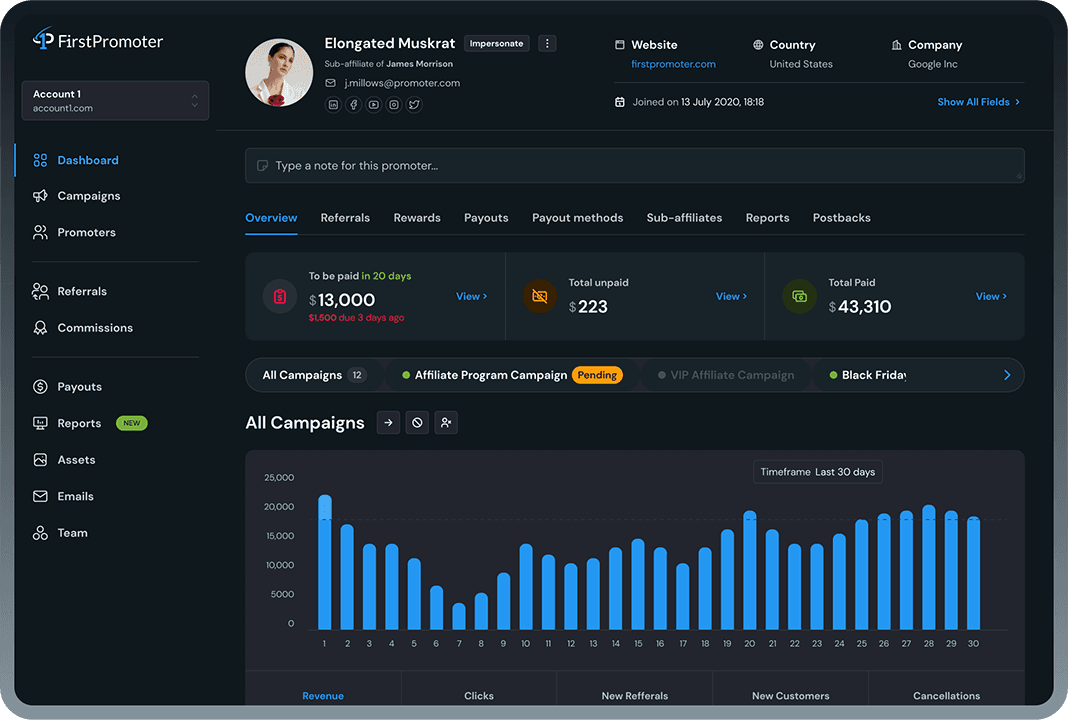
FirstPromoter is built for SaaS companies that need to launch a partner program quickly and keep it running cleanly as revenue grows. The difference from Tolt shows up later: when a customer upgrades, downgrades, pauses or churns, every billing event automatically updates the affiliate’s commission. Tolt doesn’t reliably capture those events. At scale, that gap becomes a systematic payout problem.
Five billing providers, not three. FirstPromoter natively integrates with Stripe, Recurly, Braintree, Paddle and Chargebee. No other tool in this comparison covers all five. Teams on Recurly or Braintree have no equivalent option elsewhere at FP’s price point. The alternative is a custom webhook build.
This is important because when a referred customer upgrades from your $49/mo plan to your $99/mo plan mid-cycle, FirstPromoter automatically adjusts the affiliate’s commission for that customer’s next renewal. Downgrades reduce it, cancellations stop it and refunds claw it back.

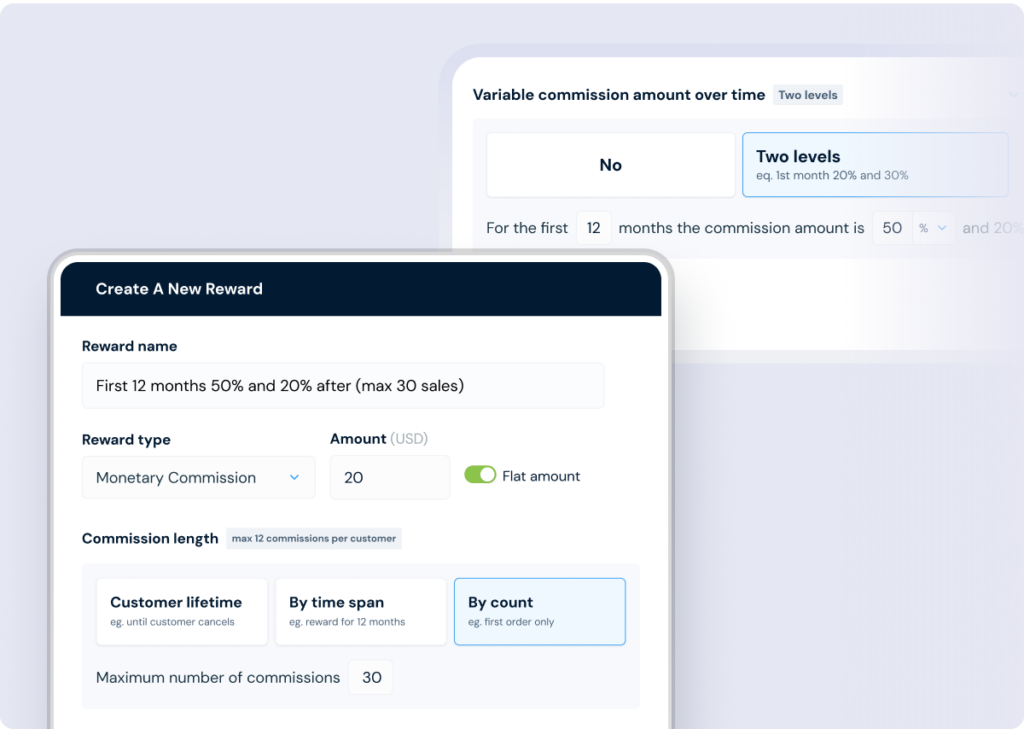
Programs that run partner networks need commission logic that runs across multiple levels. FirstPromoter supports up to three levels natively: a recruiting affiliate earns a share of every conversion their referred partners bring in
No revenue caps. The $49/mo Starter plan doesn’t limit the affiliate-driven monthly revenue your program can generate. Tolt caps this at $10K on Basic and $20K on Growth. FirstPromoter’s pricing is flat by feature tier, not by program performance.
At ten affiliates, the differences between this platform and Tolt are mostly cosmetic. At one hundred, three things start to matter. First, commission accuracy across plan changes. A customer who upgrades to a higher tier mid-cycle should generate a higher commission on renewal. If the platform misses that event, the affiliate gets underpaid and your commission records don’t reconcile. Second, multi-tier logic. A growing program often develops layers: top affiliates who recruit other affiliates, brand partners who bring in sub-networks. Flat commission tools no longer work for this. Third, payout operations. Paying 100 affiliates individually via manual exports isn’t a workflow anyone wants to own on a recurring basis.
Submagic generated over €1.6M in affiliate revenue through FirstPromoter, managing 9,000+ affiliates with coupon-code-first attribution. JustCall runs a $2.4M ARR affiliate program, producing $200K monthly through FP with 1,000 active promoters. Before choosing FirstPromoter, JustCall was quoted $50,000 a year plus 3% commission on every payment by a competing enterprise platform for the same features.
Passion.io acquired 2,000+ customers via 3,000+ affiliates before investing in a dedicated affiliate manager. These programs share a common profile: recurring revenue, multiple pricing tiers and commissions that must remain aligned with billing over time.
FirstPromoter doesn’t set up in fifteen minutes. Expect 45 to 60 minutes for the initial integration and commission configuration. That’s the cost of getting billing-event accuracy right from the start. For programs doing serious affiliate revenue, it’s the right trade.
See how it compares in the full FirstPromoter vs Tolt breakdown, or read more about referral marketing software built specifically for subscription businesses.
2. Rewardful
Rewardful is the answer to a specific question: what if the reason for leaving Tolt isn’t billing complexity, but something simpler: the revenue cap? For programs that are still early-stage, fully on Stripe and not yet running multi-tier structures, Rewardful removes the cap without adding complexity. The trade-off is that it doesn’t go deeper than Tolt on the billing side. It goes sideways.
As a Premier Stripe Partner, Rewardful’s Stripe integration is tight. Upgrades, downgrades, free trials, cancellations and refunds all affect commissions on Stripe’s side. It also supports Paddle Classic for teams on that billing stack.
The ceiling to know before committing. Paddle Billing, Paddle’s current API, is not supported. Only the older Paddle Classic integration works. Teams that have already migrated to Paddle Billing or plan to do so cannot use Rewardful unless they stay on the legacy stack. Beyond the billing scope, there are plan-level revenue caps: Starter covers up to $7,500/month in affiliate-driven revenue and Growth covers up to $15,000/month. These don’t affect commission rates. They determine which plan tier is required as the program grows.
One thing to verify before committing: Managed Payouts is labeled Beta in Rewardful’s own Help Center. Teams moving off Tolt specifically to get cleaner payout operations should confirm whether it’s production-ready for their volume before treating it as a solved problem.
Multi-tier commissions are not supported. Sub-affiliate structures need a different platform.
At $49/month with no transaction fees and a 14-day free trial, it’s a clean entry for programs that fit within its scope.
Compare FirstPromoter vs Rewardful.
3. Trackdesk
Trackdesk is the current top-ranked result for this keyword. Addressing it honestly means neither dismissing it nor elevating it beyond what it’s built for.
It’s a performance-marketing platform built for volume across verticals: ecommerce, trading, affiliate networks and SaaS programs. Unlimited affiliates, clicks and conversions on all plans with no caps. Real-time dashboard with funnel builder. ISO 27001 security certification. 295 G2 reviews averaging 4.8 stars. Users consistently highlight the automation, the UI improvement cadence and reliability.
Where the fit diverges for SaaS-specific programs: Trackdesk connects to Stripe Payment Links and Pricing Table, as well as PayPal Checkout. That’s not the same as a native Stripe billing webhook integration. Subscription lifecycle events such as upgrades, downgrades and dunning recovery are not verified in the platform’s documented behavior. MRR-from-affiliates and churn-adjusted reporting are not confirmed. For a multi-plan SaaS where commission logic needs to stay synced with subscription value changes over time, this gap is material.
Pricing is also a different category. The Business plan starts at around $329/month, so verify the current figures at trackdesk.com, as pricing has shifted recently. That’s a meaningful step up from $49/mo for a team primarily running a SaaS affiliate program.
Works for: high-volume performance-marketing programs that span multiple verticals and don’t need subscription-lifecycle-specific commission adjustments.
4. PartnerStack
PartnerStack is the right destination when a program has outgrown affiliate-only infrastructure. That means resellers, channel partners, co-sell motions and a dedicated partner operations function to run it. If you’re still primarily tracking affiliate conversions and paying recurring commissions, it’s more platform than you needd and priced to match.
The platform covers partner discovery through its B2B marketplace, LMS-based training and certification, co-sell tracking and standard affiliate referrals in one dashboard. Its fraud suite runs on Sift: self-referral detection, join-fraud monitoring, transaction fraud monitoring and automatic holds. The fraud logic is not configurable by the merchant. PartnerStack manages it centrally, which means strong defaults but no custom rules.
What to confirm before evaluating. There are no public plan prices. Every engagement starts with a demo, so budget accordingly. Platform fees apply but are not publicly disclosed. Confirm the complete fee structure during the sales process before comparing it to flat-rate alternatives. The payout cycle runs on monthly invoicing: commissions accumulate, generate a partner invoice, enter a company review window and are released after that window closes. 887 G2 reviews at 4.7 stars consistently praise the partner marketplace and commission transparency. Payout delays are the most frequently cited frustration across recent reviews.
Default attribution is 90-day last-click. Billing integration covers Stripe, Chargebee, Recurly and Paddle, but is classified as partial lifecycle tracking in analysis, not full SaaS lifecycle.
For a standard SaaS affiliate program at SMB scale, PartnerStack is more platform than you need and priced to match. For an enterprise B2B company building a channel with resellers and distribution partners, it covers that territory, though the lack of transparent pricing and a demo-required sales process add friction before you can even compare costs.
Compare FirstPromoter vs PartnerStack.
5. Reditus
Reditus is built specifically for B2B SaaS teams that want two things standard affiliate platforms don’t offer: a marketplace where affiliates can discover and apply to their program and an in-app referral widget that embeds directly inside the SaaS product.
The marketplace is a real differentiator. A Reditus listing exposes a program to partners already searching for B2B SaaS programs to join. For teams earlier in their affiliate journey without an established outreach motion, that distribution shortcut matters.
The structure to understand before signing. Pricing runs on ARR caps, not flat monthly fees. The Startup plan ($149/month, or $99/month billed annually) covers programs up to $60K ARR. Growth ($299/month, or $179/month annually) covers up to $120K ARR. As the business scales, plan upgrades are required. Factor this into cost modeling for a 12 to 24-month window. Automated payouts carry a 5% fee via credit card and 2% via invoice, on top of the monthly subscription.
Billing integration is Stripe-only. No Paddle, Recurly, Braintree, or Chargebee verified. Teams outside Stripe need custom integration work or a different platform. Tax form handling and Wise payout rails are not confirmed in the analysis.
For early B2B SaaS on Stripe that wants partner discovery infrastructure built in, it works well at program inception.
Compare FirstPromoter vs Reditus.
6. Tapfiliate
Tapfiliate’s differentiation is breadth: affiliate, referral and influencer programs in one platform, covering both SaaS subscriptions and one-time ecommerce purchases. For brands running both billing models, say a SaaS with a physical product line or a hybrid digital/physical subscription, consolidating under one affiliate tool has real operational value.
The trade-off is depth on the SaaS side. The Stripe integration covers order-based commissions, recurring commissions and refunds. Chargebee is listed as an integration, but the specific lifecycle event list is not fully confirmed in the analysis. Teams on Chargebee should verify which webhook events Tapfiliate actually receives before committing. That means upgrades, downgrades and dunning specifically. It’s not classified as a full subscription lifecycle tracker.
Pricing and caps to know. Launch at $89/month covers 50 affiliates, 5,000 clicks/month, 500 conversions/month, one program and one team member. These are hard caps, not soft limits. Overages cost $1.50 per 1,000 extra clicks and $15 per 1,000 extra conversions on Launch. Scale ($179/month) substantially increases the limits, but overages still apply. Model total cost at your actual program volume before using entry pricing as the comparison point.
Tapfiliate has an in-platform messenger for affiliate communication. Most platforms in this category require external email tools for affiliate outreach, which makes this a genuine differentiator. Multi-level commission structures are supported. No native tax forms.
G2 feedback flags limited data export options and management friction at larger affiliate counts as consistent themes. Support responsiveness has been noted across multiple reviews. Test it during the trial period before committing.
Compare FirstPromoter vs Tapfiliate.
Why Teams Look for Tolt Alternatives
Tolt built something genuinely useful for early-stage SaaS: a fast, clean platform with a modern interface that integrates with Stripe, Paddle and Chargebee. Most teams that started there made a reasonable call at the time. What changes is the program, not the tool.
There are three situations where Tolt’s limits cause operational friction. Knowing which one applies tells you what to evaluate next.
The first issue: the revenue-cap ceiling. Tolt’s plan structure limits how much affiliate-driven monthly revenue a program can generate. Basic ($69/month) caps affiliate payments at $10K/month. Growth ($99/month) caps at $20K/month. Pro ($199/month) caps at $50K/month.
A program generating $15K/month from affiliates is forced to jump to Growth. Growth carries a 2% processing fee on every automated payout. The free plan was removed and pricing has increased multiple times since 2023. As the program performs better, the cost structure compounds.
Second issue: billing-event accuracy. Tolt’s billing integration is partial. It tracks subscriptions, cancellations and refunds. What it does not track: upgrades, downgrades, trial-to-paid conversion distinctions, pause/resume events, or dunning recovery.
For a SaaS with multiple pricing tiers, commissions slowly drift from what billing actually processed. It’s invisible at 20 affiliates on a single-plan product. At 150 affiliates across multiple tiers, it becomes a reconciliation problem your top partners will notice before you do. Affiliates rarely tell you they’ve lost trust in the commission numbers. They simply stop putting effort in.
Third issue: program structural complexity. Multi-tier commission structures, reseller programs, B2B partner ecosystems and built-in affiliate marketplace discovery are all outside Tolt’s scope. When a program grows into these structures, Tolt’s architecture becomes an issue.
How to Evaluate the Best Tolt Alternatives
Before comparing feature tables, identify which of the three triggers applies to your program. The criteria below map to those triggers. A team primarily dealing with billing accuracy should weigh criteria two and three heavily. A team facing structural complexity should focus on criteria four and five.
Revenue accuracy and attribution quality
Commissions should tie to verified billing events. Not just clicks or form submissions. Referral links, coupon codes and direct URL tracking all matter, but the real test is what happens after the first payment. Does the commission adjust when the customer upgrades after three months? Does it stop on cancellation? Does the tool distinguish between a trial conversion and a paid renewal?
FirstPromoter tracks all of these events across five billing providers. That coverage is the foundation of attribution quality for multi-plan SaaS programs where affiliate relationships outlast the first charge.
Commission flexibility for recurring and one-time models
The range is wide: flat one-time payouts, percentage-of-each-renewal recurring commissions, time-limited windows, per-product rates and multi-tier structures where sub-affiliates earn a share of their recruits’ conversions. Match what you actually need to what the tool actually supports. Not what the marketing page claims.
“The most common mistake is setting commissions to recur forever. When promoters earn lifetime income from just one or two referrals, many stop promoting, because they already have a steady payout coming in. We usually suggest one of two approaches: limit recurring commissions to a set number of months or purchases to keep promoters motivated to bring in new customers, or use the Level Up feature, where the first few referrals earn a time-limited commission and every one after that earns a lifetime recurring one. Both setups reward continued activity rather than early momentum.” – Louis Anghel, Head of Customer Success at FirstPromoter
“The most common mistake is setting commissions to recur forever. When promoters earn lifetime income from just one or two referrals, many stop promoting, because they already have a steady payout coming in. We usually suggest one of two approaches: limit recurring commissions to a set number of months or purchases to keep promoters motivated to bring in new customers, or use the Level Up feature, where the first few referrals earn a time-limited commission and every one after that earns a lifetime recurring one. Both setups reward continued activity rather than early momentum.” – Louis Anghel, Head of Customer Success at FirstPromoter
Billing sync, lifecycle tracking and payout operations
This is where Trigger 2 lives as a technical requirement. Full subscription lifecycle tracking means that every billing event that affects revenue automatically updates the affiliate’s commission. That covers upgrades, downgrades, renewals, trial-to-paid conversions, failed payments, dunning recovery, cancellations and refunds. Without it, you’re manually reconciling commission records against billing reports on every payout cycle.
Payout operations are part of this evaluation too: automated payouts via PayPal and Wise, W-9/W-8BEN tax compliance for international affiliates, invoicing support and finance-exportable reports. Check whether payout automation is production-ready or labeled “beta.” The distinction matters for programs paying hundreds of affiliates monthly.
Partner experience and admin usability
A program with accurate backend tracking and a confusing affiliate portal will still underperform. Affiliates rarely tell you they’re disengaging and just stop promoting instead. Evaluate the signup flow, dashboard clarity, payout visibility for affiliates and how much self-service the portal enables.
FirstPromoter’s embeddable affiliate dashboard is a good example of something that works. It lets affiliates access their stats and payout details inside the merchant’s own app. No separate login, no redirect to a third-party subdomain.
One platform for affiliates, referrals and partner-led growth
Running separate tools for affiliate programs and referral programs creates attribution gaps, duplicated reporting and fragmented partner communication. A unified platform that handles affiliates, referrall and influencer tracking, with shared reporting, reduces overhead at every growth stage.
Use a practical feature checklist during evaluation
Verify these directly against each platform before deciding:
- Does it natively integrate with your billing provider?
- Which specific subscription lifecycle events does it receive? Not just “supports Stripe,” but which webhooks?
- Does it support multi-tier commissions with the number of tiers your program needs?
- Is automated payout processing production-ready, or in beta?
- Are W-9/W-8BEN tax forms handled natively?
- Is pricing flat per tier, or does it cap based on affiliate-driven revenue?
- Does the affiliate portal support custom domains and in-app embedding?
Start with the Stripe affiliate tracking integration documentation if Stripe is your billing provider. The event coverage list is the most direct test of lifecycle tracking depth for any platform.
Choose based on fit, setup effort and long-term accuracy
The fastest tool to set up is not always the right one for a serious affiliate program. Tolt takes fifteen minutes. FirstPromoter takes 45 to 60 minutes. PartnerStack takes weeks with a dedicated implementation team.
Setup time reflects depth, not quality. A tool that underpays affiliates by missing upgrade events slowly erodes program trust. Top affiliates notice when their commissions don’t reflect the customers they actually drove. That’s a retention problem with your best partners and it compounds.
Match the tool to the trigger, the team’s operational capacity and the long-term accuracy requirement. Those three inputs together, not the pricing table alone, should drive the decision.
Which Tolt Alternative Should You Pick?
For most SaaS teams reading this, the answer is FirstPromoter.
When a referred customer upgrades their plan, the commission increases automatically. When they cancel, it adjusts down. When a refund is issued, it’s reflected immediately. The number in your affiliate dashboard matches your billing data, not just at launch but as the program scales. That’s what billing-event accuracy means in practice and it’s the one thing Tolt was never built to deliver reliably.
Beyond the tracking mechanics, FirstPromoter handles the operational side of running a real program. Multi-tier commissions for programs with sub-affiliates. Mass PayPal payouts and Wise CSV exports. No transaction fees across any plan, starting at $49/month. JustCall’s affiliate program reached $2.4M in ARR and $200K in monthly revenue on FirstPromoter after being quoted $50,000 a year plus a 3% commission cut by a competing enterprise platform for the same outcome.
Rewardful is the right call for Stripe-only programs that are still small and simple. PartnerStack and Reditus serve programs that have grown into reseller and partner-ecosystem territory. But if you’re running a subscription business with a growing affiliate program and you need commissions to stay accurate as billing changes, FirstPromoter is built exactly for that.
Sign up and start your free trial.
Tolt Alternatives FAQs
What is the best Tolt alternative for SaaS companies?
FirstPromoter. It natively integrates with five billing providers (Stripe, Paddle, Recurly, Braintree, Chargebee) versus Tolt’s three, tracks upgrades and downgrades automatically, supports multi-tier commissions and starts at $49/month with no revenue caps. For SaaS programs where commission accuracy across the subscription lifecycle is the priority, it’s the strongest option in the category.
Why do businesses switch from Tolt to another platform?
Three distinct triggers. First, Tolt’s revenue-cap pricing: plans limit monthly affiliate-driven revenue to $10K, $20K, or $50K, with a 2% auto-payout fee on Growth+. Second, billing-event accuracy gaps: Tolt doesn’t track upgrades, downgrades, or trial-to-paid distinctions, which causes commissions to drift from actual billing as the program scales. Third, program structural complexity: multi-tier commissions, B2B partner marketplaces and reseller programs are entirely outside Tolt’s scope.
Which Tolt alternative is best for recurring commissions?
FirstPromoter. It tracks recurring commissions tied directly to billing events. Each renewal, upgrade, downgrade and cancellation updates the affiliate’s commission automatically across all five supported billing providers. Multi-tier recurring commission support is available on Business+ plans, where sub-affiliates earn a commission share on every customer they refer.
Does Tolt support Recurly or Braintree?
No. Tolt’s native billing integrations are Stripe, Paddle and Chargebee only. Teams on Recurly or Braintree need FirstPromoter, which natively integrates with both, or would need to build a custom webhook integration. No other tool on this list natively supports Recurly or Braintree.
Can I migrate my Tolt affiliates to another platform?
Yes. FirstPromoter supports the managed migration of existing affiliates, commission history and referral records. Confirm the specific migration scope and timeline with FirstPromoter’s customer success team before committing.
What features should I look for in a Tolt alternative?
Six criteria in priority order for SaaS programs: billing provider compatibility with your stack; subscription lifecycle tracking depth and specifically which webhook events the platform handles beyond cancellations; commission flexibility, including recurring, multi-tier and per-product rules; payout automation with tax form handling; affiliate portal quality and in-app embeddability; pricing structure without hidden revenue caps or per-transaction fees that scale with program performance.
Which Tolt alternative is best for Stripe-based affiliate programs?
Rewardful is the option if the program is Stripe-only, affiliate revenue stays under $15K/month and you don’t need multi-tier structures. It’s a stripe Partner and the entry price matches FirstPromoter’s at $49/month with no transaction fees. The ceiling to know: Rewardful supports Paddle Classic but not Paddle Billing, so teams on Paddle’s current API are out. For everything beyond that scope (full subscription lifecycle accuracy across upgrades, downgrades and renewals, multi-tier commissions, or billing stacks outside Stripe) FirstPromoter is the right call. Native integration with Stripe plus four other billing providers, 18-point reporting, and no revenue caps on any plan.

In this article
Newsletter