Influencer marketing grew into an estimated $32.55 billion industry in 2025, and brands aren’t easing off: 87.49% plan to spend more in 2026. With that much money moving to creators, it helps to know which numbers you can trust.
This roundup collects 50 statistics on market size, budgets, ROI, consumer trust and creator earnings. Most come from 2025 and 2026 research, and each one sits next to its publisher and year, so you can quote it without digging for the source.
These are the 2026 AI marketing statistics worth citing: adoption, budgets, AI search and zero-click, AI referral traffic, B2B buyer behavior and affiliate marketing. Each figure has a date and a link to its source.
Top influencer marketing statistics in 2026
- The global influencer marketing industry reached an estimated $32.55 billion in 2025, close to twice the $16.4 billion estimated for 2022 (Influencer Marketing Hub, 2026).
- US creator ad spend hit $37 billion in 2025, growing 26% in a year and roughly four times faster than total media (IAB’s 2025 Creator Economy Ad Spend & Strategy Report).
- Brands expecting a bigger influencer budget in 2026: 87.49% (Influencer Marketing Hub Benchmark Report, 2026).
- Average reported influencer budgets jumped 171% year over year, and nearly two-thirds of the 71% of organizations that increased them took the money from paid media (CreatorIQ, State of Creator Marketing report 2025).
- Sponsored influencer content converts better than organic brand content, according to 83% of marketers (Sprout Social, 2025).
- Promo codes are the most common way to measure influencer results, used by 45.9% of brands, ahead of affiliate links at 26.0% (Influencer Marketing Hub Benchmark Report, 2026).
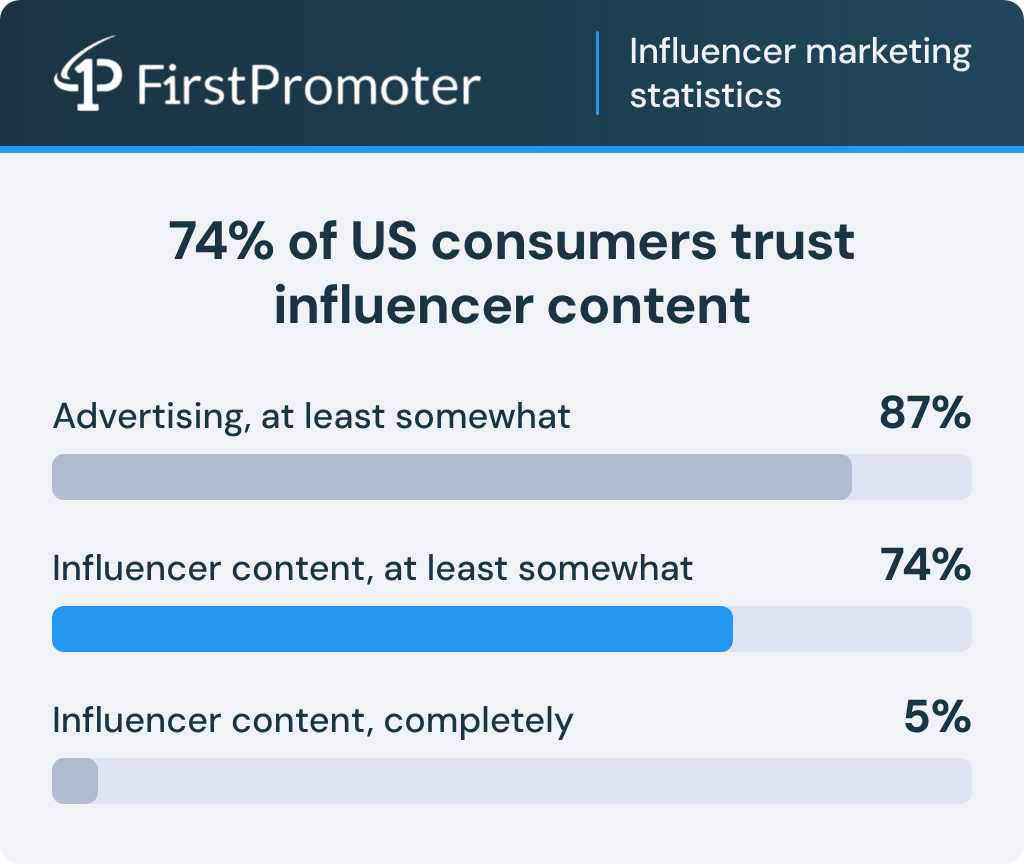
- US consumers trust influencer content less than advertising: 74% trust it at least somewhat, against 87% for ads, and just 5% trust it completely (The Influencer Trust Index: Consumer Insights 2025).
- Nearly one in five US social media users (19%) bought something on an influencer’s recommendation in the last six months, up from 14% in 2025 (CivicScience, 2026).
- Gen Z finds products through influencers (41%) almost as often as through search engines (42%). Across all US adults the figure is 27% (YouGov, 2026).
- Roughly half of Gen Z and millennials feel more personally connected to social media creators than to TV personalities or actors (Deloitte, 2025).
- Two in three creators (67%) make under $10,000 a year from content, and 4% make over $100,000 (CreatorIQ and Influencers.club, 2026, via Net Influencer).
- Performance-based pay, such as commission, was used by 61% of marketers working with influencers in 2025 (Modash, 2026).
Top influencer marketing statistics in 2026
- The global influencer marketing industry reached an estimated $32.55 billion in 2025, close to twice the $16.4 billion estimated for 2022 (Influencer Marketing Hub, 2026).
- US creator ad spend hit $37 billion in 2025, growing 26% in a year and roughly four times faster than total media (IAB’s 2025 Creator Economy Ad Spend & Strategy Report).
- Brands expecting a bigger influencer budget in 2026: 87.49% (Influencer Marketing Hub Benchmark Report, 2026).
- Average reported influencer budgets jumped 171% year over year, and nearly two-thirds of the 71% of organizations that increased them took the money from paid media (CreatorIQ, State of Creator Marketing report 2025).
- Sponsored influencer content converts better than organic brand content, according to 83% of marketers (Sprout Social, 2025).
- Promo codes are the most common way to measure influencer results, used by 45.9% of brands, ahead of affiliate links at 26.0% (Influencer Marketing Hub Benchmark Report, 2026).
- US consumers trust influencer content less than advertising: 74% trust it at least somewhat, against 87% for ads, and just 5% trust it completely (The Influencer Trust Index: Consumer Insights 2025).
- Nearly one in five US social media users (19%) bought something on an influencer’s recommendation in the last six months, up from 14% in 2025 (CivicScience, 2026).
- Gen Z finds products through influencers (41%) almost as often as through search engines (42%). Across all US adults the figure is 27% (YouGov, 2026).
- Roughly half of Gen Z and millennials feel more personally connected to social media creators than to TV personalities or actors (Deloitte, 2025).
- Two in three creators (67%) make under $10,000 a year from content, and 4% make over $100,000 (CreatorIQ and Influencers.club, 2026, via Net Influencer).
- Performance-based pay, such as commission, was used by 61% of marketers working with influencers in 2025 (Modash, 2026).
Influencer marketing market size and growth
Global influencer marketing was worth an estimated $32.55 billion in 2025, nearly double the $16.4 billion estimated for 2022.
[IMAGE PLACEHOLDER] Stat: Global influencer marketing industry estimated at $32.55B in 2025, nearly double the $16.4B estimated for 2022 (Influencer Marketing Hub, 2026) Suggested visual: two-bar comparison, 2022 vs 2025, with both values labeled and “estimate” noted under the axis Alt text: The influencer marketing industry reached an estimated 32.55 billion dollars in 2025, nearly double 2022’s 16.4 billion, per Influencer Marketing Hub File slug: influencer-marketing-market-size
Other sources report very different market sizes because each one measures something else. Here’s what the other big figures cover, so you quote the right one:
- US brands were forecast to pay creators $10.52 billion in 2025, crossing the $10 billion mark a year sooner than EMARKETER first expected. Paid media is excluded (EMARKETER, 2025).
- US creator ad spend, which adds paid amplification of creator content, reached $37 billion in 2025 (up 26%) and is forecast at about $44 billion for 2026.
- Influencer marketing software is a separate $34.2 billion market (2025), projected at $45.2 billion in 2026 and $116.2 billion by 2033, a 14.4% CAGR (Grand View Research, 2026).
- The wider creator economy is forecast to reach $480 billion by 2027, from about $250 billion, in a 2023 projection (Goldman Sachs Research, 2023).
How many companies use influencer marketing?
Nearly nine in ten brand marketers (88%) run influencer marketing, and two-thirds of them (66.33%) run it entirely in-house (Influencer Marketing Hub Benchmark Report, 2026). About 11% use a hybrid setup, about 11% hand it to an agency, and 12.24% don’t run it. The sample is 600+ practitioners, so it leans toward people already working in the channel.
- Specialist influencer agencies work with 49% of enterprise marketers (Linqia, 2026).
- 59% of marketers planned to work with more influencers in 2025 than the year before (Sprout Social, 2025).
- Always-on programs are run by 82% of the most successful B2B influencer marketers, compared with 39% of the rest (TopRank Marketing, 2025).
- In B2B, 43% of marketers say influencer programs deliver outstanding results, and in mature programs that share reaches 79% (TopRank Marketing, 2025).
How much do brands spend on influencer marketing?
Enterprises spend $5.6 million to $8.1 million a year on creators, and the industry leaders in CreatorIQ’s study put 54% of their whole marketing budget into creators. Single collaborations cost far less: about 80% cost under $300, and another 18% fall between $301 and $1,000 (Collabstr, 2026). Collabstr’s figure comes from 21,000 deals on its own marketplace, so it reflects smaller creators.
Budgets keep growing, with 87.49% of brands expecting to increase influencer spend in 2026 (Influencer Marketing Hub Benchmark Report, 2026).
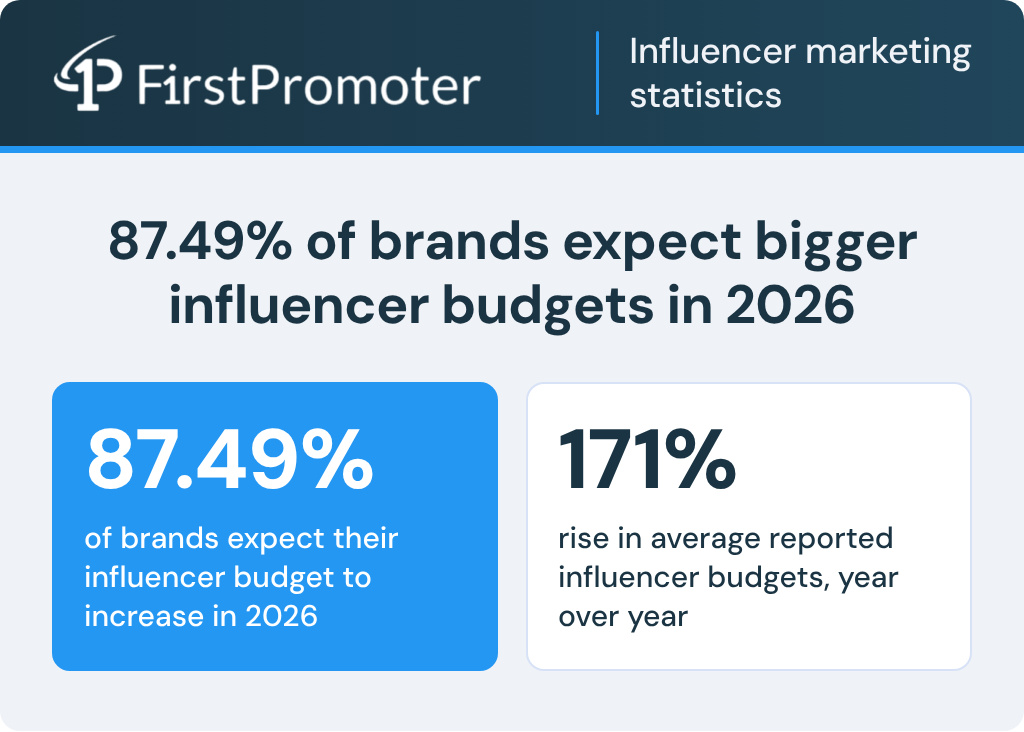
- Average reported budgets grew 171% in a year. 71% of organizations increased spend, and close to two-thirds of them funded it by cutting paid media (CreatorIQ, 2025).
- 74% of marketers plan bigger influencer budgets for 2026 (Aspire, 2026).
- Among enterprise marketers, 62% are raising influencer budgets in 2026, and 33% will spend more than $5 million (Linqia, 2026).
- Creator content ends up in paid ads at 77% of brands (Aspire, 2026).
What ROI does influencer marketing deliver?
86% of paid media leaders and marketing executives report at least 2x ROI from creator marketing, 42% report 3x, and 15% report 5x or more (CreatorIQ, 2026). These are self-reported results from 100 executives in the US and UK, and we found no independent per-dollar ROI benchmark published in 2025 or 2026.
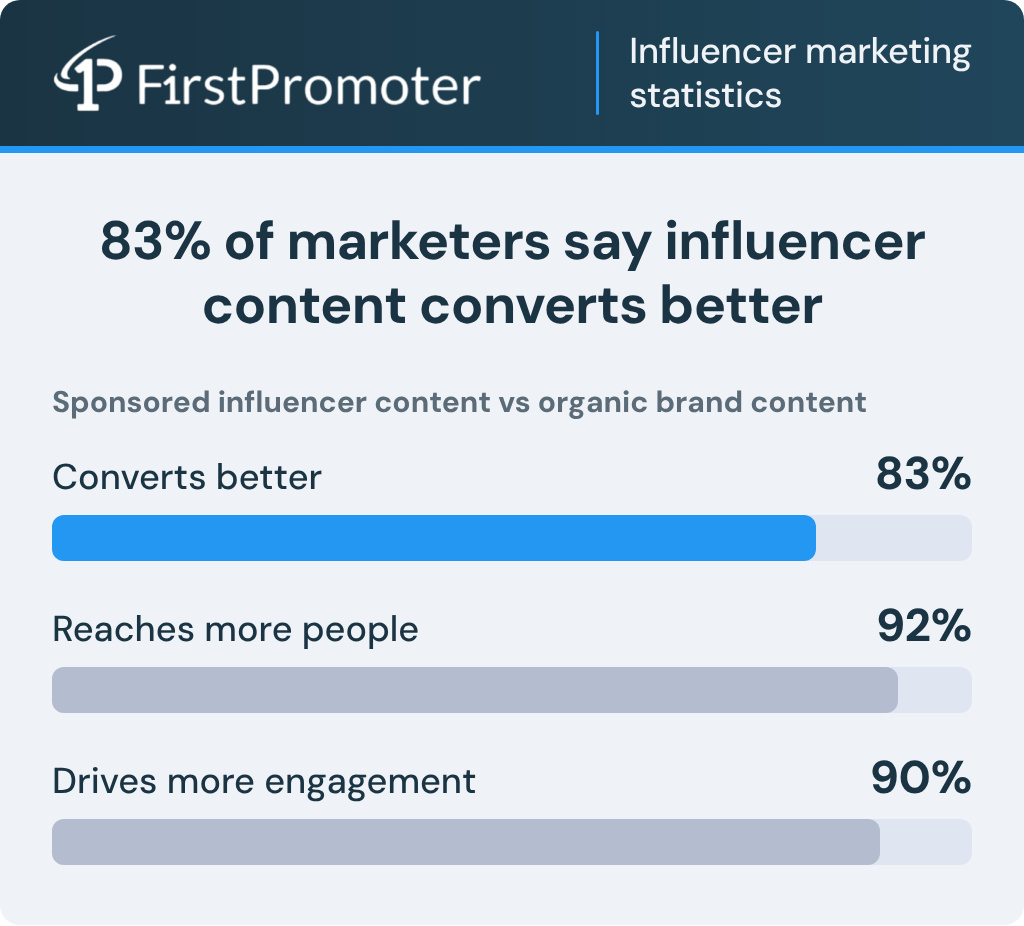
- Sponsored influencer content converts better than organic brand content for 83% of marketers. 92% say it reaches more people, and 90% say it gets more engagement (Sprout Social, 650 marketers in the US, UK and Australia, 2025).
- Measurement lags behind results: 81% of enterprise marketers say creator content beats brand-made assets, but 79% struggle to measure its ROI and 48% name attribution as their biggest gap (Linqia, 2026).
- 65% of marketers are very confident they can prove the business impact of influencer partnerships (Sprout Social, 2025).
- Promo codes are how 45.9% of brands measure influencer results, and 26.0% use affiliate links (Influencer Marketing Hub Benchmark Report, 2026).
- Creators on Aspire generated $52 million in attributed affiliate sales, 45% more than the year before (Aspire, 2026).
- Product gifting has fallen out of favor as an ROI driver: 20% of brands rank it at the top, against 71% in 2020 (CreatorIQ, 2025).
FirstPromoter tracks coupon codes and referral links in the same partner record, so a sale through either one is credited to the right creator. Codes and links are also how brands that pay creators on commission tie each sale to the person who made it.
Myth vs data: “$5.78 for every $1 spent”
The “$5.78 (or $6.50) for every $1 spent” figure is earned media value from surveys run between 2015 and 2019 and it doesn’t measure return on investment. Influencer Marketing Hub’s 2019 benchmark put average earned media value at $5.20 per dollar.
Do consumers trust influencers? Trust and purchase statistics
Partly. 74% of US consumers trust influencer content at least somewhat, below the 87% who trust advertising in general, and only 5% trust it completely (BBB National Programs, 3,700+ US consumers, 2025). Limited trust hasn’t stopped buying, and the share of people purchasing on influencer recommendations is rising.
- In the last six months, 19% of US social media users bought something an influencer recommended, up from 14% in 2025. Among under-45s it was 27% (CivicScience, 2026).
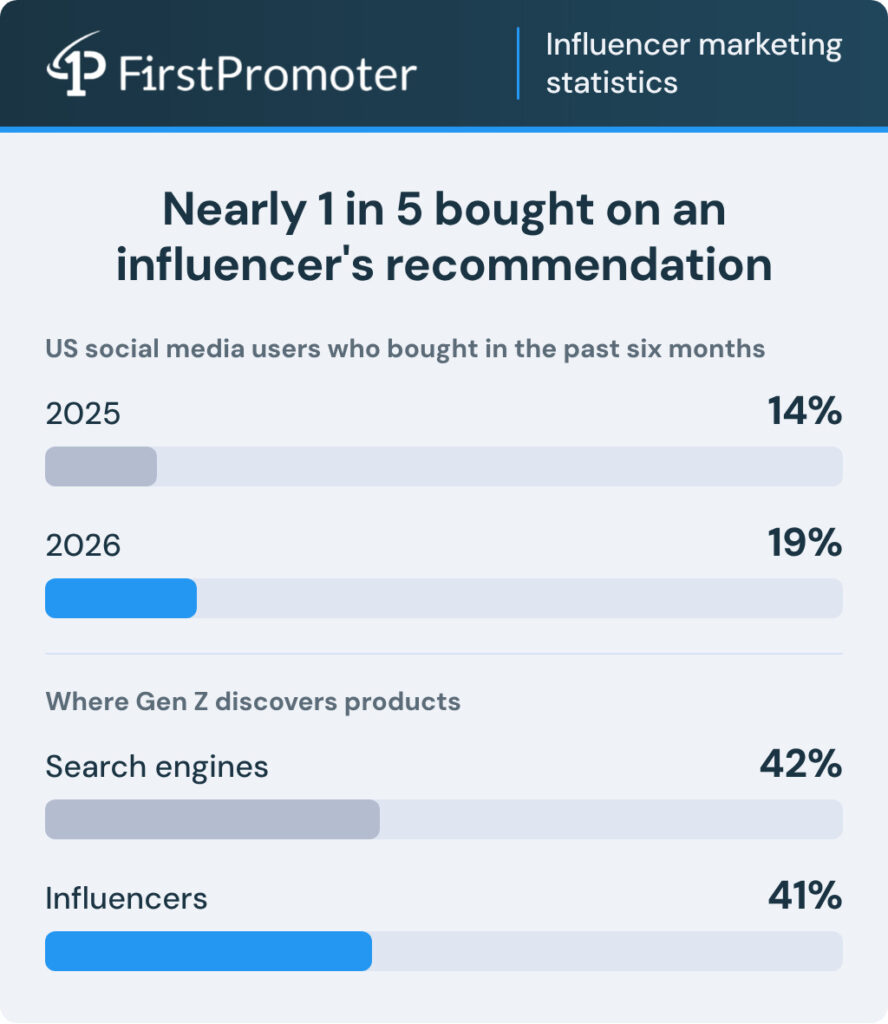
- Influencers are a discovery channel for 27% of US adults and 41% of Gen Z, which puts them level with search engines (42%) for Gen Z (YouGov, 2026).
- Trust in creators splits by age: 60% of Gen Z trust them, against 45% of millennials, 32% of Gen X and 34% of boomers. Across all US adults it is 40% (Modash, 2026).
- Among US adults who follow creators, 84% have bought something a creator recommended (Modash, 2026).
- About half of Gen Z and millennials feel closer to social media creators than to TV personalities or actors (Deloitte, 2025).
- Social media content feels more relevant than TV shows and movies to 56% of Gen Z and 43% of millennials (Deloitte, 2025).
- 86% of consumers buy something inspired by an influencer at least once a year, and 49% do it daily, weekly or monthly (Sprout Social, 2024).
- Brand partnerships with influencers make 87% of Gen Z consumers more willing to buy (Sprout Social, 2024).
Old trust statistics to stop quoting
Three trust figures still show up in a lot of influencer marketing articles, but each one says something different from the study it came from.
Myth: “49% of consumers depend on influencer recommendations.”
What’s wrong: the 2016 survey asked Twitter users only, not consumers in general.
Use instead: 19% of US social media users bought something on an influencer’s recommendation in the past six months (CivicScience, 2026).
Myth: “69% of consumers trust influencers.”
What’s wrong: the 2023 question grouped influencers with friends and family, so it doesn’t measure trust in influencers on their own (Matter Communications, 2023).
Use instead: 74% of US consumers trust influencer content at least somewhat, and 5% trust it completely (BBB National Programs, 2025).
Myth: “70% of teens trust influencers more than celebrities.”
What’s wrong: the 2015 study found that teens relate to creators more than to celebrities. It didn’t measure trust.
Use instead: about half of Gen Z and millennials feel more connected to social media creators than to TV personalities or actors (Deloitte, 2025).
How many influencers are there?
About 67 million people around the world see themselves as creators in 2025, and Goldman Sachs projects about 107 million by 2030 (Goldman Sachs Research, 2025). There is no official count, and totals change a lot with the definition of a creator.
- Nano-influencers, with 1,000 to 10,000 followers, make up 76% of Instagram influencers and 87% of TikTok influencers (HypeAuditor, 2025).
- Brazil leads all countries with 3.8 million Instagram influencers, 15.8% of the global total (HypeAuditor, 2025).
- In a 2023 survey, 57% of Gen Z said they would become an influencer if they had the chance (Morning Consult, 2023).
How much do influencers make?
Most make little: 67% of creators earn under $10,000 a year from content, only 4% earn over $100,000, and for 62% content isn’t the main source of income (CreatorIQ and Influencers.club, 5,055 creators, 2026, via Net Influencer).
[IMAGE PLACEHOLDER] Stat: 67% of creators earn under $10,000 a year from content; only 4% earn over $100,000 (CreatorIQ and Influencers.club, 2026) Suggested visual: stacked bar or income-band distribution, with the under-$10K and over-$100K bands highlighted Alt text: 67 percent of creators earn under 10,000 dollars a year from content and 4 percent earn over 100,000, per CreatorIQ and Influencers.club File slug: creator-earnings-distribution
- US creators split into three income bands: 48.7% under $10,000, 45.6% between $10,000 and $100,000, and 5.7% at $100,000 or more (The Influencer Marketing Factory Survey, 2026).
- The share of creators earning under $15,000 a year rose to more than half, from 48% in 2023 (Influencer Marketing Hub Creator Earnings Report, 2026).
- Per package, creators ask $398 on Twitch on average, $311 on YouTube, $214 on Instagram, $182 on TikTok and $180 for UGC (Collabstr, 2026).
- Affiliate marketing and product or merchandise sales together bring in 21.2% of creator income (The Influencer Marketing Factory, 2026).
Influencer engagement, platform and trend statistics
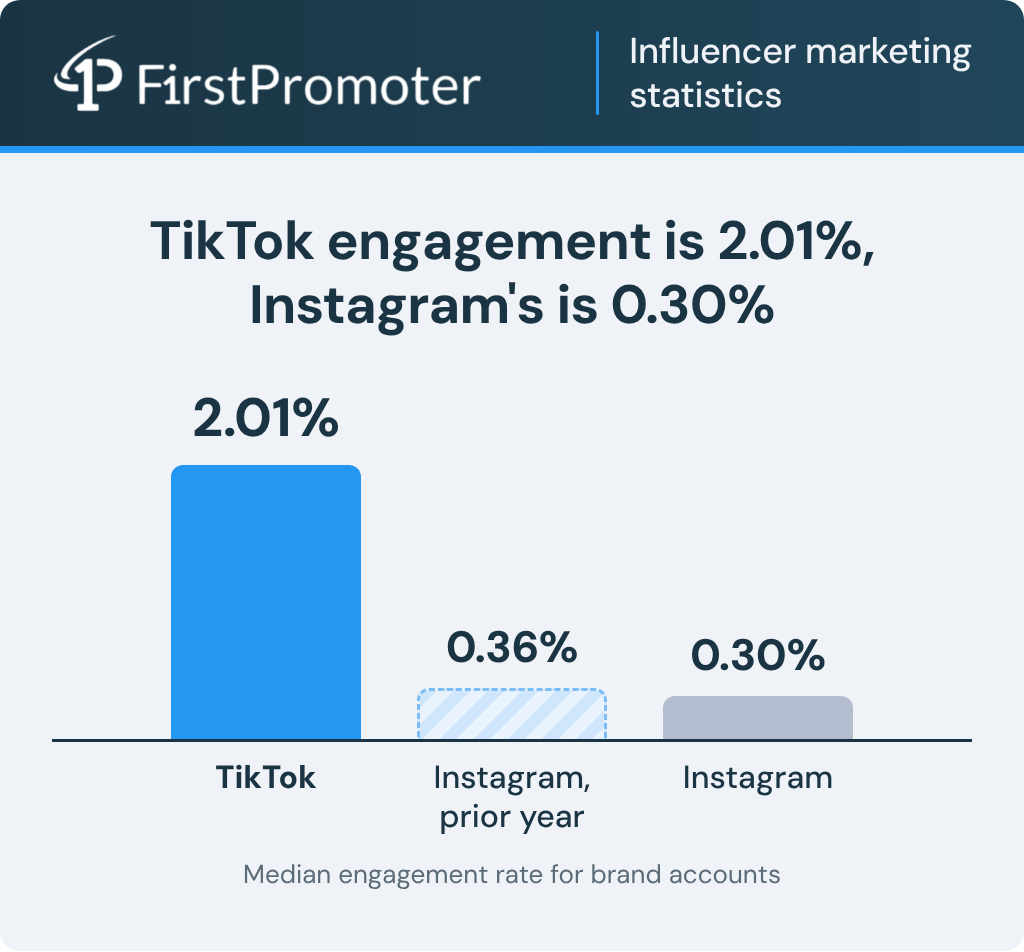
TikTok has the higher engagement rate: the median brand account gets 2.01% there and 0.30% on Instagram, where the rate fell from 0.36% in a year, about 17% lower (Quid, 2026).
- The highest engagement of any tier belongs to TikTok nano-influencers, at 11.9% (HypeAuditor, 2025).
- TikTok is in 31% of brands’ 2026 influencer plans, the most of any platform (Influencer Marketing Hub Benchmark Report, 2026).
- Instagram is still the platform brands use most for creators, named by 85% (CreatorIQ, 2025).
- 32% of brands already sell on TikTok Shop, close to double the year before (Aspire, 2026).
- 61% of marketers paid influencers on performance, such as commission, in 2025, while the share who said creators were open to an affiliate setup dropped from 63% to 26% (Modash, 50+ marketers, 2026).
- Long-term partnerships are preferred over one-off campaigns by 45% of creators (The Influencer Marketing Factory, 2026).
- Finding creators is the leading AI use case in influencer marketing (36.67% of brands), and just 10.56% use no AI at all (Influencer Marketing Hub Benchmark Report, 2026).
- 74% of enterprise marketers use AI for ideas, briefs and workflows, yet 89% stay away from virtual influencers (Linqia, 2026).
Commission pay and longer partnerships push creator programs toward an affiliate structure. FirstPromoter tracks creator partnerships the same way it tracks affiliates: each sale is credited to the creator through affiliate link tracking or a coupon code, and their commission is calculated from the brand’s real billing events.
Why is creator attribution harder for subscription businesses?
A creator’s customer keeps generating billing events after the first payment: renewals, upgrades, downgrades and refunds. A commission set on the first invoice alone drifts away from what the customer actually paid. Attribution is already the weak spot for enterprise teams: 79% of enterprise marketers struggle to measure creator ROI, and 48% call attribution their biggest gap (Linqia, 2026).
FirstPromoter reads those events from Stripe, Chargebee, Paddle, Recurly or Braintree and adjusts each creator’s commission to match. For benchmarks on affiliate and referral programs, see our affiliate marketing statistics for 2026. Connect your billing provider and try FirstPromoter free for 14 days, no card needed.

In this article
Newsletter