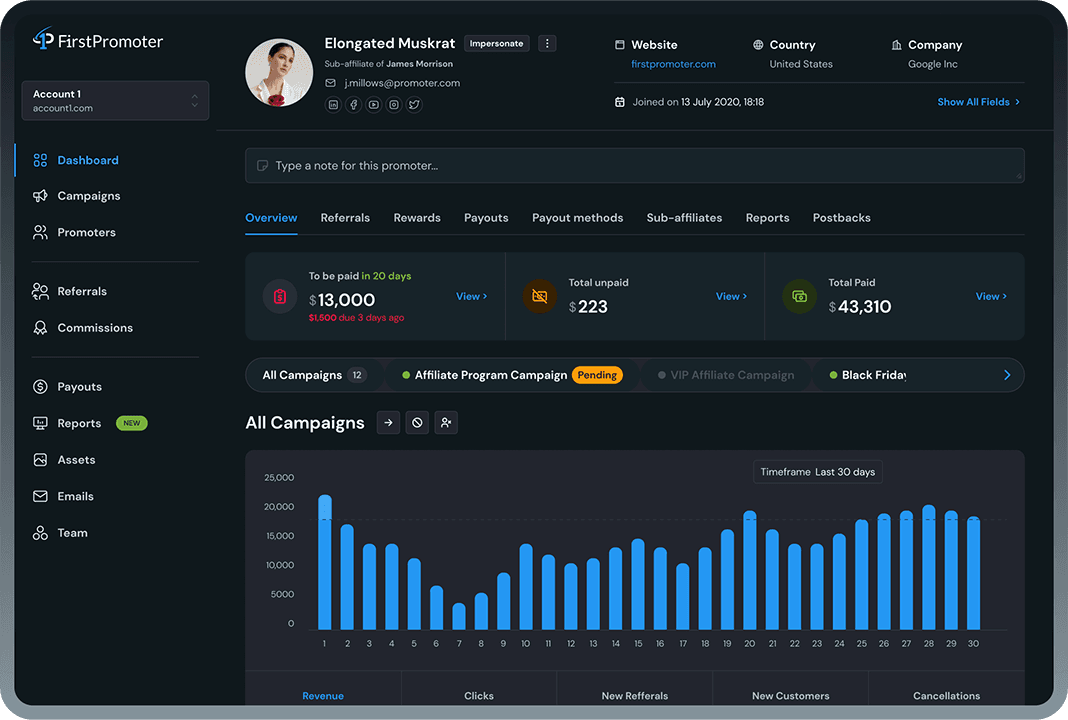
As an affiliate program manager, you must provide your affiliates a clear plan for reaching their first sale. To measure the success of this strategy, you can track how many new partners become active within 30 days and use affiliate onboarding to move them forward.
Affiliate onboarding is the process of guiding your partners to the next step when they join your program. You will provide them with resources on what to promote, who to promote it to, how much they will earn and when they’ll receive their first commission.
Spreading this information over a 90-day onboarding sequence creates a clear path to the first referral.
Key Takeaways
- 30-day activation rate is the metric, not signup count.
- Partners who promote mostly do it in the first 30 days.
- Vetting is part of onboarding, not a step before it.
- Subscription programs must explain when the commission fires, how long it pays and when the money lands.
- Clicks-no-sales and never-clicked need different fixes.
What affiliate onboarding is and how to tell if yours works
Affiliate onboarding is the process of helping new partners get started after they join your program. It begins where affiliate partner recruitment ends. That includes any information you offer between approving a new affiliate and their first tracked referral.
It’s common industry practice to complete affiliate partner onboarding with just a welcome email, but that’s not nearly enough. Even if the email is well-written or informative, abandoning your new affiliates to find their own way after the first check-in is exactly why the average activation rate is low.
The success of your affiliate onboarding process is measured by a metric called “30-day activation rate.” According to our research, only 15% of approved affiliates in the median program ever produce a referral and just 6.4% produce a paying customer (July 2026). In other words, 85% of approved affiliates never bring in a single referral.
Approve fewer partners and tell them the terms first
It can be tricky to find willing partners to join your affiliate program in the first place, but accepting everyone who applies isn’t a way forward either. Some partners were never going to promote your software, however well you onboard them.
To have fewer of these partners on your roster, the vetting process needs to be much more thorough. That starts with screening each applicant with a written approval standard. You can ask them about:
- Where they will promote the software
- The size of their audience
- Where their audience is based
- A verification of their platform/audience
- Proof of existing traffic
- Their affiliate experience
That will tell you about the affiliate partner’s potential experience and reach before they join your roster. It’s also a good opportunity to set the terms, so there’s no confusion on either end. You should relay details like
- The commission rate
- Whether the commission rate recurs
- The billing event that triggers it
- Cookie window
- Payout minimum
- Payout schedule
Commission is one of the main topics of confusion in an affiliate program. For example, an affiliate may join your program thinking they’ll earn a commission with every referral, when in reality, they only get paid when a customer makes their first subscription. If you don’t explain this upfront, they will feel misled.
Most importantly, you need to discuss your ad traffic and coupon policy, as these are the two disputes that cost the most later. For example, affiliates need to know:
- Can they pay for ads to promote your product or only do it organically?
- If they are allowed to pay for ads, where can they do it?
- Are they allowed to bid on your brand name in Google Ads?
- Can they use your brand name in ad copy?
The coupon policy is even more important. You don’t want your affiliate partners to offer any unauthorized discounts, because your business will have to either deal with customer complaints or lose money.
According to FirstPromoter’s ebook AI and the Affiliate Publisher Landscape, it has become much easier for bad actors to use AI to create very convincing fake proof of their online audience. If you receive a website, articles or social media posts as proof, make sure you ask for a second source like analytics screenshots.
The FirstPromoter platform allows you to create custom signup fields for your program’s approval standard and review applications in a manual approval queue.
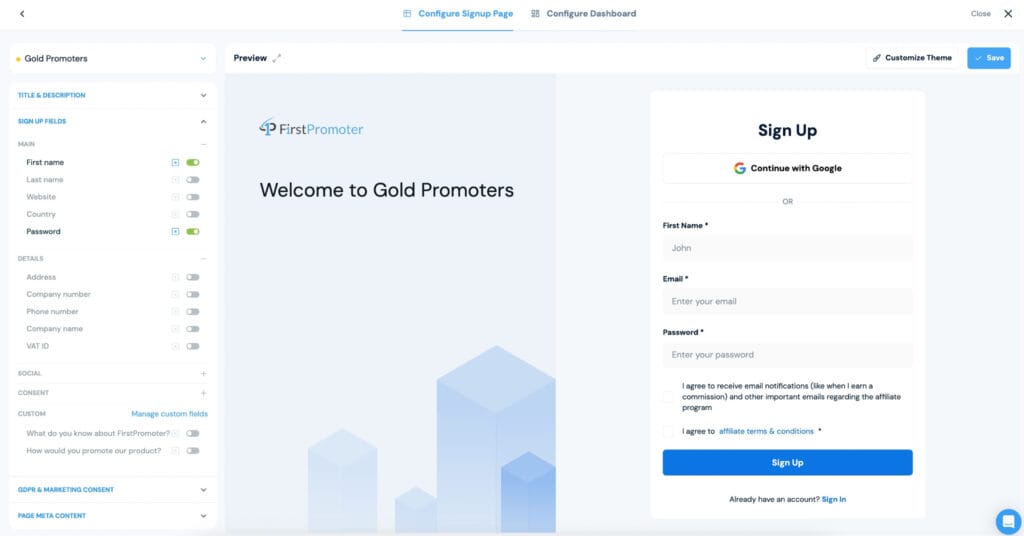
Users can also handle ad traffic differently for each campaign, as it allows you to configure how to track it, hold it as pending or block it. This is an affiliate program management tool, not a marketplace or discovery platform, so you’ll still need to recruit your own affiliate partners. FirstPromoter simply makes it easier for you to vet and manage your roster.
The first 90 days, touchpoint by touchpoint
Affiliate program onboarding does not end with recruiting enough partners or sending a welcome mail. Ideally, you should dedicate the first 90 days after recruitment to getting your partner situated, making sure each affiliate sends their first referral and earns a commission.
You can automate this sequence on whatever tool you already run for affiliate program management or even implement it manually.
A 90-day plan of action chart below describes a partner’s journey, including triggers and events that lead to success.
| Partner’s journey | Trigger | Contents | Success signal |
|---|---|---|---|
| Day 0 | Application approval | Custom welcome email containing the link, commission rate and first step. | Affiliates log in and copy their link. |
| Days 1 to 7 | First login, then day 7 | Informative check-in email. Then, a 7-day branched email based on affiliate behavior | Zero-click group: first click. Clicks-no-sales group: first sale |
| Days 14 to 30 | Two weeks in, clicks but no sale yet | Bonuses, temporary higher commission, contests, tiered commissions, better offers for customers, webinar or live sessions | Affiliates make their first sale. |
| Days 30 to 90 | 30-day review shows stalled affiliates (clicks but no sales) | Reassess the landing page, offer or placement and provide guidance to re-engage stalled affiliates. Send new assets or a fresh offer and invite them to a short 1:1 call | Stalled affiliates become active partners and boost their sales. |
| Day 90 | The first commission is approved. | Relationship-building with active affiliates and offering bigger placement opportunities. | Successful affiliates agree to further promotional activity and dormant affiliates are removed from the roster. |
Day 0: one link, one action
Once a suitable candidate has been approved to join your affiliate program, you should try to send the first welcome email within an hour. We recommend this, as it prevents any confusion on the affiliate’s end about what the next step is.
Keep the email short: the link, the commission rate and one first step. A long email full of guidelines usually goes unread. This could be something as simple as sharing the link in a relevant article or post.
The success signal in this case would be the new partner logging in to their affiliate account and copying their link.
You can make this even simpler by using FirstPromoter to automate the welcome email, triggered by every application approval. You can customize a welcoming affiliate dashboard to display the welcome message and other details like this.
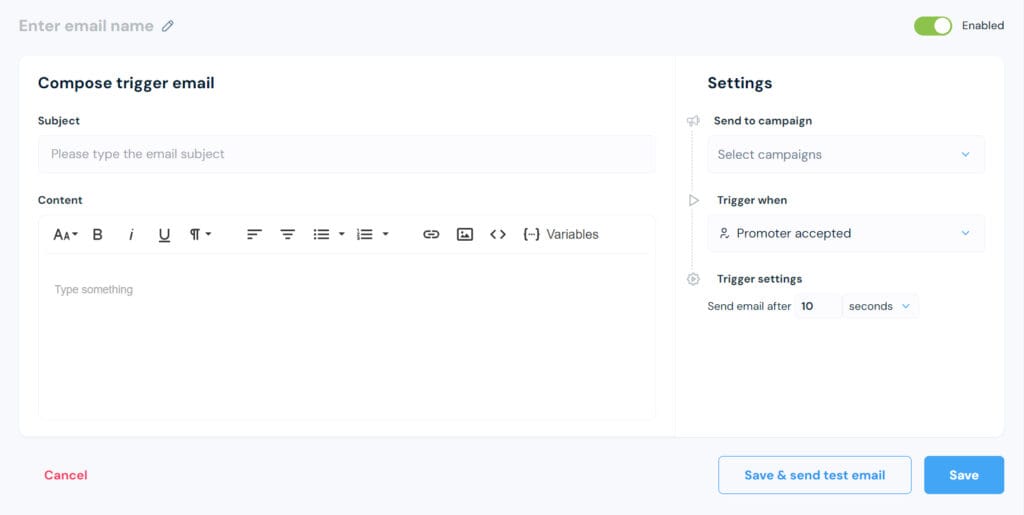
Here’s a template of the email you could send on day 0:
Subject Line: Welcome to (Program Name)! Your First Step
Body: Hi (affiliate name),
Welcome to the (program name) affiliate program! We’re happy to have you on board.
Your referral link: (insert link)
Your commission rate: (X%) on each paid subscription payment.
Your first step: Share your referral link in an article, blog post or social media post where your audience might benefit from (product name).
You can use your affiliate dashboard here to track your clicks, referrals and commissions: (insert link).
If you have any questions, just reply to this email.
Regards, (Team)
Days 1 to 7: assets, then a check-in split by behavior
The second trigger will usually occur within the first week when the affiliate logs in to their affiliate management program account. That means this event should be triggered immediately after the success signal from the first event.
At this point, affiliates need to know two things: what your product does and what angle they should take to convert their audience for you. A common mistake is to answer neither and, instead, bombard affiliates with logos, banners and product images.
A smarter choice would be to provide these four details:
- A simple product explanation
- Common customer concerns and how to address them
- An example of successful promotion that has generated sales in the past
- Which plan, product, discount or feature should the affiliate lead with
Let’s see the example of a fake SaaS called TaskFlow to help you understand what such an email would look like:
Subject Line: Your TaskFlow Affiliate Quick-Start Guide
Body: Hi (affiliate name),
Here’s what you should know before promoting TaskFlow, our project management tool for freelancers. TaskFlow helps freelancers manage client projects, deadlines and tasks in one place.
If your audience worries about cost or ease of use, promote our free plan and explain that no technical skills are needed to get started.
In the past, the most successful placement has been in a blog post comparing project management tools for freelancers. It generated sales by showing how TaskFlow simplifies client work. Use this angle as inspiration for your own content.
First, lead with the free plan to attract new users, then highlight the Pro plan’s automated reminders for freelancers managing multiple clients.
You can find your referral link and promotional resources here: (insert link)
Best, The TaskFlow Team
The next step you take will depend on what the affiliate chooses to do with this information, meaning it will be “branched.” You can expect to see two scenarios at this point.
- Zero clicks: There will be affiliates who have not decided on the right placement for your link yet, hence the lack of clicks.
- Clicks Without Conversions: This type of affiliate may be getting plenty of clicks but not actually generating any sales. This could mean that there is something lacking in your landing page, pricing, offer and checkout process.
For the zero-clicks group, the correct action is to offer a specific placement for the link, whether that’s a different newsletter or relevant blog post. For instance, if the affiliate is promoting a business software to freelancers, you can point them to an existing blog post on their website, such as “How to Manage Multiple Freelance Clients.” This placement will connect the product to the affiliate’s exact audience type.
You’ll know your action was successful when the affiliate gets their first click. Here’s a template of the 7-day check-in email for the zero-clicks affiliate:
Subject Line: Let’s Get Your First Referral Link Out There
Body: Hi (affiliate name),
You’ve been part of the (program name) affiliate program for a week, so we wanted to check in and help you get started.
If you haven’t found the right place for your link yet, try (post title), in the section about (topic). It reaches exactly the readers (product) is built for.
Here’s a quick reminder of what you can promote: (list product features and benefits).
You can find your referral link here: (insert link).
Have a specific channel or content idea in mind? Reply to this email and we can suggest a suitable placement.
Best, (Team)
For the second group, start by checking your side of the funnel. If they’re getting tons of clicks but no conversions, it means the customers aren’t finding anything worth buying. Take this opportunity to revamp your landing page, pricing and checkout process as needed.
Subject Line: Let’s Turn Your Referrals Into Sales
Body: Hi (affiliate name),
Your referral link is bringing visitors to (product), but we haven’t seen a sale come through yet. Let’s look at how we can improve that.
Here are some tips you can try in your next promotion:
- Lead with how (product) solves a specific problem for your audience.
- Use (FAQ resource) to answer questions about pricing, features or signing up.
- Direct visitors to (specific plan, feature or discount) so they can quickly see what suits their needs.
You can find our promotional resources here: (insert link)
We’ll also review the landing page experience visitors have after clicking your link to identify any improvements we can make on our end.
If there are any questions coming up repeatedly with your audience, reply and let us know. That feedback can help us improve the offer and give you better resources to promote it.
Best, (Team)
The success signal here is when the affiliate converts their first customer.
This is what we mean by “branching” your triggers, actions and success signals. If you send the same 7-day check-in email to all your affiliates, it’s bound to get ignored.
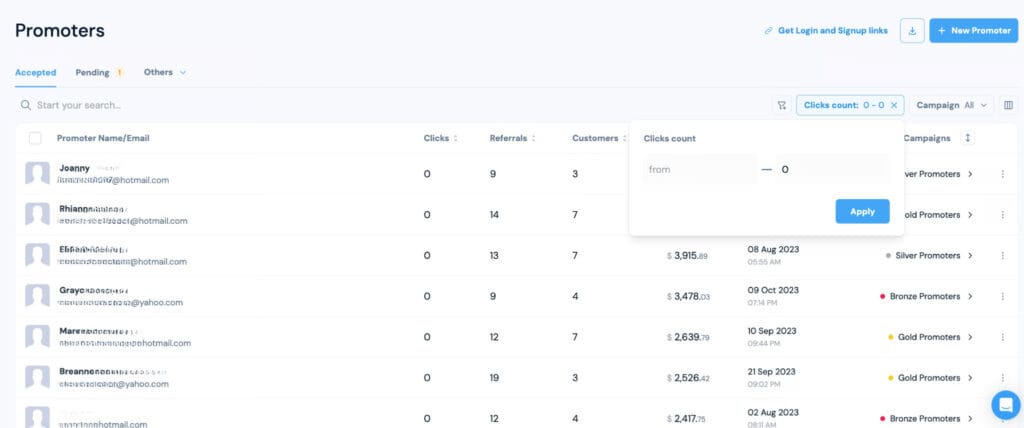
You can trigger this sequence based on the click activity of each affiliate using FirstPromoter’s affiliate tracking software. The partner list can be filtered by click activity, which means you can set a trigger email for all affiliates who have not gained any clicks yet. The platform also contains a marketing assets library and custom content panel so your affiliates can access all the relevant information in one hub.
Days 14 to 30: incentivize affiliates to make a sale in the first month
It’s time to change your approach if the affiliate has not generated a single sale even two weeks after their joining. This is your next trigger. Another educational email at this point may not be enough to motivate your affiliates, who are instead looking for a specific reason to push harder in the next month.
You have a few different ways to motivate your affiliate roster at this point.
First, you could offer a first-sale or performance bonus, which is triggered once the affiliate crosses a revenue or customer threshold. There is also the option of a temporary commission rate increase for the first month.
You can also launch a contest with a visible leaderboard on the affiliate program management dashboard. These time-limited leaderboards have different prizes based on the position, on top of existing commissions. Here’s what a contest leaderboard would look like on FirstPromoter. You can choose to hide the affiliate’s details for an anonymous contest.
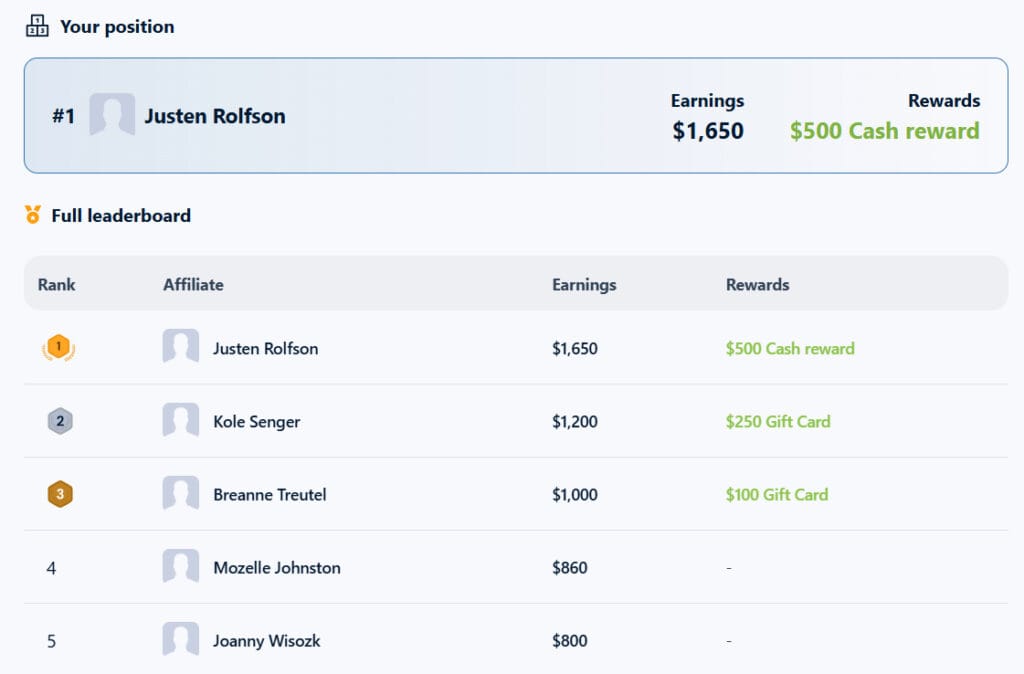
These are not to be confused with tiered commissions. Tiered commissions move a partner into a higher-commission campaign on their own volume. For instance, an affiliate’s commission rate may increase from 20% to 25% once they cross a customer or revenue threshold.
Finally, you can provide an approved discount or another compelling offer for affiliates to share with their customers, incentivizing them to convert. You will know this strategy was successful when your zero-sales affiliates make their first sale, boosting your 30-day activation rate.
Another way to increase momentum and give your affiliates some more tips is with a webinar or live session.
Days 30 to 90: re-engage stalled partners
With these efforts, many of your affiliates should have finally earned their first commission. They have just proved to you that they can generate revenue. This is your next trigger to review their clicks, referral traffic and conversion data to check the progress of your partners.
Some of your partners may have generated sales in the first month, but their activity has now become stagnant. Others may still be generating clicks without converting them into sales. These “stalled” partners are the ones you need to re-engage, as they may be starting to lose motivation.
Since the problem isn’t with their audience, you need to reassess the landing page, offer or placement. You can also send them new assets or a fresh offer on a short 1:1 call.
The success signal here would be your stalled partners becoming active again and generating sales.
Day 90: mark the first commission, then sort the roster
The 90-day point is your final trigger, as it’s time for another review. You’ll notice that three groups of affiliates have formed:
- Active affiliates with clicks and sales
- Stalled affiliates with clicks but no sales
- Dormant affiliates with no clicks or sales
Since it’s already been three months, you can stop emailing the dormant group and even remove them from your roster. For the stalled affiliates, you can repeat the third phase by offering more incentives, but only if they have enough monthly clicks to justify it.
The active affiliates are the ones you should be focusing most on. This is a perfect time to engage the active affiliates in a long-term partnership. For instance, you could encourage them to post a dedicated newsletter feature or a more noticeable blog placement. It will give your active affiliates the assurance that this is a commitment where everyone could be a winner.
Build a relationship with them, offer bigger promotional opportunities, create incentives and help them grow their audience.
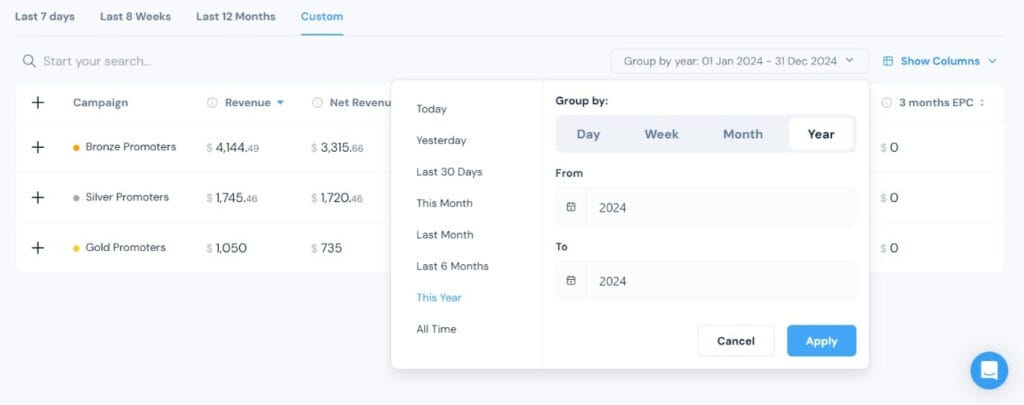
Since you’ll be making special arrangements with certain affiliates, internal notes on commission records will really come in handy at this point. The FirstPromoter tool keeps track of 20+ reporting data points at the account and campaign level. The data is also exportable to CSV.
Now, you’ve successfully created an efficient roster by building a relationship with the active affiliates, re-engaging your stalled affiliates and dropping the dormant affiliates.
What subscription programs have to explain
It’s possible that not all referrals sign up or start paying immediately. Some may cancel during the trial and some may ask for a refund. A refund claws the commission back from the affiliate’s next unpaid payout.
If the affiliate isn’t aware of these terms, it could break the trust in your partnership. During the 90-day affiliate onboarding process, you need to clarify three things for your partners.
First, they should know exactly when they’ll receive their commission. It won’t be when the customer clicks on their link or even signs up, but only when the customer actually gets billed for a subscription. This means the length between their first referral and first earning would be the length of your SaaS product’s free trial.
If the customer decides to cancel the subscription before the free trial is over, the affiliate will not receive a commission.
Secondly, they must know how long each referral will pay them. It could be a one-time commission when the customer first subscribes to the software. It could also be a recurring one for each subscription renewal for a set period. It could also be a lifetime commission, meaning the affiliate will receive a percentage for every payment.
For a 20% commission on a $50 subscription, the affiliate would receive a total of $120 over the course of a year. But this assumes that the customer continues the subscription for all 12 months and there are no refunds or no cancellation. Show the affiliate these calculations so they’re aware that one commission type isn’t necessarily better than the other:
| Commission type | Example rate | Year-one earnings |
|---|---|---|
| One-time | 20% of the first $50 payment | $10 |
| Recurring | 20% of each monthly $50 payment | $120 |
| Lifetime | 20% of every $50 monthly payment for as long as the customer subscribes | $120 in year-one |
Finally, your affiliate needs to know when the money actually ends up in their bank account. Let them know the limitations, like a payout minimum, pay schedule, tax forms and payment method verification. Make sure you collect the W-9, W-8BEN and the preferred payout method during onboarding and not when the payment is actually due.
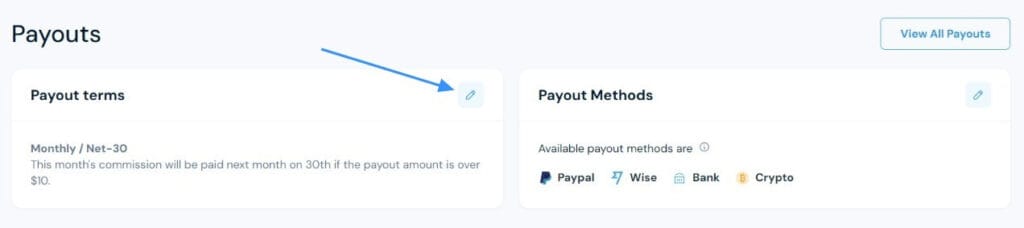
On FirstPromoter, you can set custom payout terms and pay affiliates through PayPal, Stripe or CSV export (see payout options by plan).
You will also need to make your affiliates aware of the minimum paying customers threshold they need to cross before they get paid. This minimum is strictly for preventing affiliate fraud and is not the same as a minimum payout threshold.
Five affiliate types, five different first weeks
While the 90-day flow is a good bet for most affiliate types, a good affiliate program manager knows that the same method can’t work for every partner on their roster. You’ll most likely be working with five types of affiliates, so you will need to adjust your approach on their first week accordingly.
| Affiliate type | What to provide on their first week |
|---|---|
| Content and review sites | Product depth, comparison material and a long cookie window |
| Coupon and deal sites | Coupon codes and confirmation on whether coupon promotion is allowed for your company |
| Agencies and consultants | Flat fees or recurring terms, a named contact and flexible deadlines |
| Existing customers who refer others | Easy-to-find referral link inside the product |
| Influencers | Manual onboarding, personal invitations, coupon codes, vanity links and individually negotiated deals |
Start with the first 30 days
One email alone is not enough to welcome your partners during affiliate onboarding, but what it contains can make a big difference. It can’t contain too many rules and terms to overwhelm the new partner, just enough to show them the first easy step.
Then, as their partnership with your affiliate program progresses, you can offer them better promotional opportunities or better placement advice if they’re falling behind. The 90-day flow is a helpful template to follow, but we place a huge emphasis on branching your actions based on the affiliate’s behavior. Identical treatment for every partner could cause you to lose stalling affiliates who had the potential to become fully active.
Another mistake is waiting until payday to figure out the tax and payout setup details of your affiliate, as it can lead to unnecessary delays. If you follow these affiliate program management practices, you have a better chance of increasing your 30-day activation rate, which is what you should be measuring rather than signups or clicks.
When you reach the 90-day check-in, you’ll have weeded out the dormant affiliates from the active ones. Chasing them would be a waste of time and resources. Instead, you should re-engage the stalled ones and build a long-term relationship with the active ones.
The crux of this affiliate onboarding guide is the 7th day check-in. The check-in email should be branched based on the behavior of the affiliate. Affiliates with no clicks or sales need a nudge in the right direction, while affiliates with clicks but no sales could benefit from a revamped landing page or offer.
Remember that this entire affiliate onboarding process only starts after recruitment. As an operator, it’s still your job to recruit partners in the first place. Platforms like FirstPromoter simply make the vetting and managing process simpler and more efficient.
Help more affiliates reach their first sale with FirstPromoter’s partner management features.
FAQs
What is affiliate onboarding?
Affiliate onboarding is the process of helping new affiliate partners get started when they first join your affiliate program. That includes any information you offer between approving a new affiliate and their first tracked referral.
How long does affiliate onboarding take?
The affiliate onboarding sequence runs for 90 days. The operator’s own setup work gets done within the same day, while the first 30 days determine the activation rate of your affiliate program. The remaining 60 days help filter out dormant affiliates and create better promotional opportunities for active ones.
What is a good affiliate activation rate?
A good 30-day activation rate for an affiliate program is at least 10% or higher. However, top-performing or specialized programs can reach 40 to 50%.
Should you approve every affiliate application?
No, you should not approve every affiliate application because it will lower your average activation rate. You can vet your affiliate applications with the help of an approval standard, detailing their affiliate strategy, audience size, affiliate experience and other relevant information. This will ensure that you’re only approving affiliates that will actually benefit your roster.
When do affiliates get paid on a recurring commission?
Affiliates on a recurring commission get paid on each charge within the terms, whether that’s the first charge, the first X charges, the first X months or lifetime. Then, they are paid on the payout schedule once the minimum threshold is met.
In this article
Newsletter