Reditus built its model around one idea: charge nothing until affiliates generate revenue. For programs that have not launched yet, that logic is sound. For programs that are actually working, that same architecture creates three specific problems. This article covers six tools that come up when SaaS teams start comparing.
FirstPromoter is the primary recommendation for subscription businesses that need billing-aware tracking and full program ownership without marketplace dependency.
Quick answer: what is the best Reditus alternative?
The answer usually comes down to one of three constraints: the billing stack, the commission ceiling or portal ownership. Which billing providers the platform supports natively, how far the commission logic goes beyond flat recurring percentages and whether the partner portal can carry the program’s own brand rather than the marketplace’s. The table below covers all six options side by side.
Ready to launch or switch? Start your 14-day free trial, no credit card required.
| Tool | Good fit for | Starting price (2026) | Standout features | Ideal use case |
|---|---|---|---|---|
| FirstPromoter | SaaS and subscription businesses wanting billing-aware, full-control affiliate management | $49/month | 5 native billing integrations; multi-tier and per-plan commissions; full CSS and JavaScript portal branding; 22-point reporting; built-in W-9/W-8BEN; no transaction fee | Programs that have hit any of the three Reditus constraints |
| Rewardful | Simple Stripe or Paddle Classic affiliate programs | $49/month | Clean Stripe and Paddle Classic lifecycle tracking; first and last-touch attribution; 0% transaction fee; white-label on Growth+ | Early-stage SaaS fully on Stripe or Paddle Classic, wanting fast launch without marketplace overhead |
| PartnerStack | B2B SaaS needing affiliate, referral, and reseller in one ecosystem | Custom (demo required) | Multi-motion partner management; 90-day last-click S2S attribution; Sift fraud detection; Airwallex payouts | Teams building a full B2B partner ecosystem, not just a direct affiliate program |
| Tolt | SaaS startups wanting an affordable, simple direct affiliate program | $69/month | Stripe, Paddle, Chargebee; branded portal; auto-payouts on Growth with 2% fee; W-9/W-8BEN and 1099 on Growth | Early-stage programs with straightforward commission needs and tight budgets |
| Tapfiliate | SaaS brands needing multi-tier commissions and flexible white-labeling | $89/month | Tiered and MLM commission structures; 45-day cookie window up to 365 days; Stripe, Chargebee, and Memberful; Trolley payout automation | Teams hitting the commission ceiling, on Stripe or Chargebee, who can manage payouts externally |
| Trackdesk | Established programs needing tracking depth, multi-tier logic, and compliance infrastructure | $329/month | Multi-tier and MLM payouts; country-specific rates; Tipalti integration; ISO 27001; real-time dashboard; S2S postbacks | Programs that have scaled beyond lightweight tools and need enterprise-grade tracking |
Best Reditus alternatives
Reditus creates three specific problems for growing programs. It only connects to Stripe. Commission logic tops out at flat recurring percentages. The partner portal is tied to the Reditus marketplace brand rather than the buyer’s own. Each tool below solves at least one of those problems. Some solve two. FirstPromoter solves all three. The right choice depends on which constraint shows up first.
1. FirstPromoter
Start with the billing stack. Reditus connects to Stripe. That is the whole list. FirstPromoter integrates natively with Stripe, Paddle, Chargebee, Braintree, and Recurly. If the billing provider changes, if two providers run in parallel, or if a migration to Paddle Billing is on the roadmap, the difference becomes clear fast: one platform tracks commission logic accurately, and the other requires someone to reconcile a spreadsheet every time a subscription event fires.

Consider a concrete scenario. A subscriber upgrades from a $49 plan to a $99 plan. In FirstPromoter, the recurring commission recalculates automatically. No one touches a spreadsheet. The affiliate dashboard reflects the new amount on the next billing cycle. When that subscriber cancels in month seven, the recurring commission stops. When a refund is processed, the commission logged in the third month reverses. All of it happens because FirstPromoter reads directly from the billing provider’s event stream, not from a periodic export.
Now the commission logic. Reditus supports flat recurring commissions and multiple affiliate tiers. It does not support per-plan-ID commission rates. It does not verify commission logic tied to upgrade or downgrade events. FirstPromoter does both. If the goal is to pay 20% on annual plan conversions and 15% on monthly ones, that is a standard settings configuration.
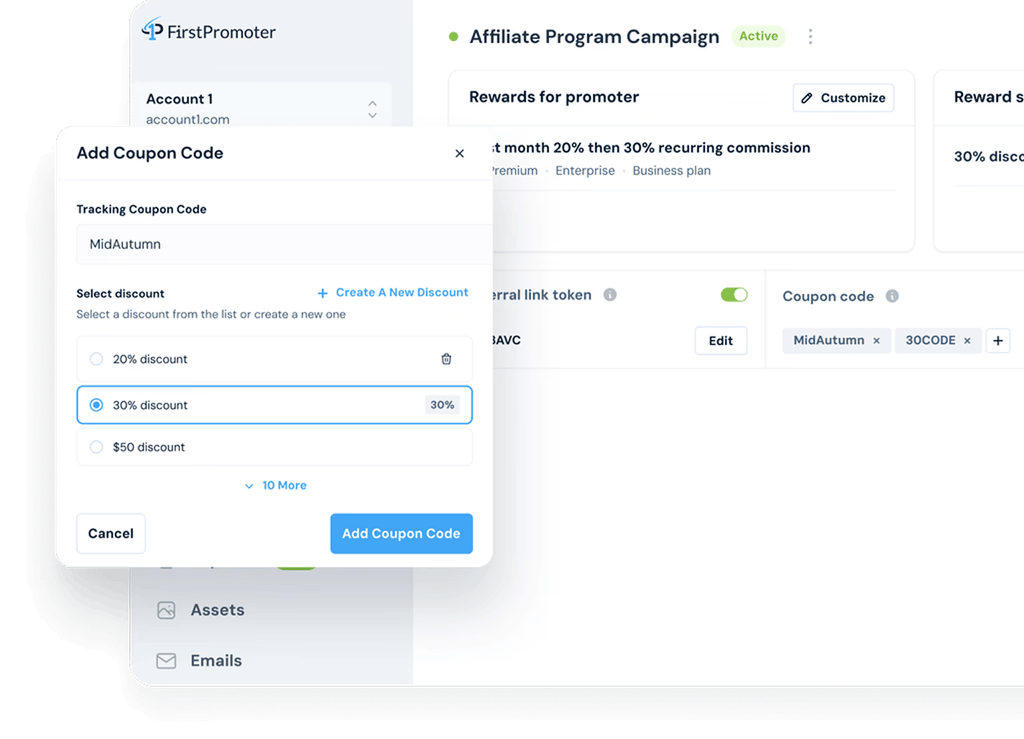
A strategic partner on a custom rate separate from the standard program is also a standard configuration. Time-limited commissions that run for the first 12 months of a subscription and stop after that are also standard. A non-technical team member can set all of this up and adjust it later without involving an engineer.
The portal question is worth taking seriously. An affiliate who lands on a partner.yourcompany.com page that looks like the product they promote is getting a different signal than one who lands on a Reditus marketplace listing. The first signal reads: this company runs a serious program worth committing to. FirstPromoter supports a fully branded portal with a custom domain, CSS, and JavaScript control. The dashboard can be embedded directly inside the product. Affiliates see one brand throughout.
On the operational side: PayPal and Wise bulk payouts, auto-managed payouts, EU invoicing, and W-9 and W-8BEN tax form collection built into the platform. Reporting covers 22 data points with multiple breakdowns. Unlimited team members with custom roles, so the program scales without paying per seat. Pricing starts at $49 per month, with no transaction fees and no cuts from partner commissions. FirstPromoter runs a 14-day free trial with no credit card required. Start your free trial
The honest trade-off: FirstPromoter does not include a built-in affiliate marketplace. Teams whose primary acquisition strategy is passive inbound discovery will find more reach with Reditus or PartnerStack. For teams that recruit partners directly or already have an existing partner list, that absence is not a constraint.
For a full comparison, see FirstPromoter vs Reditus.
2. Rewardful
Rewardful is the closest thing to a simpler Reditus for teams that already know their billing stack is Stripe or Paddle Classic and do not need a marketplace. Setup is fast. The Stripe integration is solid: it captures customer creation, invoice payments, free-trial conversions, upgrades, downgrades, cancellations, and refunds, and adjusts commissions at each step.
Paddle Billing is not supported. Only Paddle Classic. Teams that have moved to Paddle Billing or are planning to will find that the integration does not follow them.
The Starter plan at $49 per month caps team member access at two people and includes one campaign only. There is no custom domain and no branded portal on Starter. Those features require Growth at $99 per month.
Managed Payouts is officially labeled Beta in Rewardful’s own Help Center. That is not a finished feature. Teams that need reliable automated payouts from day one should treat it as a work in progress and plan around PayPal mass payouts or Wise bulk transfers instead.
Full pricing: Starter $49 per month (up to $7,500 per month from affiliates, 1 campaign, 2 team members). Growth $99 per month (up to $15,000 per month, unlimited team members, white-label portal, custom domain). Enterprise $149 or more per month above $15,000 per month. No transaction fee. 14-day free trial, annual billing gives 2 months free. Tax form collection is not included natively.
Rewardful is the right call when Stripe or Paddle Classic is the only billing provider, commission logic is straightforward, and the main reason for leaving Reditus is wanting a simpler, direct program rather than more billing depth or commission complexity.
See the full comparisons: Rewardful vs Reditus and FirstPromoter vs Rewardful
3. PartnerStack
PartnerStack is not a like-for-like Reditus replacement. It is a broader partner ecosystem platform. Affiliates, referrals, resellers, and co-sell programs run from the same dashboard. There is a B2B partner marketplace, so companies can be found and applied to through the network rather than relying entirely on outbound recruitment.
The billing stack is covered. PartnerStack connects natively to Stripe, Chargebee, Recurly, and Maxio/Chargify, with Paddle via documentation. Lifecycle tracking covers payments, refunds, failures, voids, and some subscription events, depending on the provider. It is partial lifecycle tracking, not the full SaaS billing lifecycle.
Commission flexibility is high: percentage, flat fee, recurring, usage-based, drip installment, product-specific, volume-based, customer-lifecycle-based, and transaction-count-based structures are all available. The commission ceiling is lifted.
Getting a cost estimate requires a demo. No monthly prices are published. The percentage fee applied to partner payout invoices is not disclosed publicly. For a team modeling whether moving off Reditus makes financial sense before signing anything, the inability to calculate the platform cost upfront is a real friction point.
Payout methods are PayPal, Stripe, and direct deposit via Airwallex. The fraud suite is the strongest in this comparison, Sift-powered with joint fraud monitoring, transaction fraud controls, automatic holds, and dispute workflows.
PartnerStack makes sense when the program is genuinely multi-motion, the team has a dedicated partner manager, and the goal is ecosystem growth. For a lean team that needs a direct affiliate program at a predictable monthly cost, it brings more infrastructure than the program requires.
4. Tolt
Tolt is lightweight and affordable. For a program in its first six to twelve months, those two qualities matter more than they will later. Stripe, Paddle, and Chargebee are supported. Braintree and Recurly are not. Lifecycle tracking covers subscriptions, cancellations, and refunds on Stripe.
Multi-tier and multi-level commission structures are not available. Commission logic covers percentage rates, fixed amounts, paid sign-up bonuses, custom affiliate rates, double-sided rewards, and partner groups. At 20 affiliates, that covers most program needs. At 100, teams with more complex structures will find the ceiling.
The Basic plan at $69 per month includes manual payouts only. At 15 affiliates, running individual payments monthly is a manageable task. With 60 affiliates across different payment methods, it becomes a process that takes half a day. Auto-payouts require the Growth plan at $99 per month and carry a 2% processing fee on top.
Full pricing: Basic $69 per month (up to $10k per month from affiliates, manual payouts). Growth $99 per month (up to $20k per month, auto-payouts with 2% fee, W-9/W-8BEN collection, 1099 filing). Pro $199 per month (up to $50k per month, custom payout methods, unlimited programs and team members, no Tolt branding). Enterprise custom. 14-day free trial, no card required, 30-day refund policy.
Programs that anticipate commission complexity in the next 12 months will hit Tolt’s ceiling before they outgrow the price point. Migrating mid-program is harder than choosing the right tool before the program has traction.
5. Tapfiliate
Tapfiliate is the alternative to reach for when the commission ceiling is the specific problem. The commission model supports percentage, fixed, recurring, lifetime, group, per-product, tiered, and MLM structures, both standard and advanced multi-level. For SaaS teams that need to differentiate commission rates by affiliate group, performance tier, or product category, this is the most flexible commission setup on this list, aside from FirstPromoter.
Stripe is the strongest verified integration, picking up payments, subscriptions, refunds, and billing event changes. Memberful is also integrated. Chargebee, Paddle and Braintree aren’t among Tapfiliate’s current integrations.
The cookie window is configurable from 45 to 365 days. For a SaaS product with a longer evaluation cycle, that range matters. A fixed 30-day cookie on an enterprise SaaS sale that closes in week six would misattribute the commission entirely.
There is one flag worth knowing before signing up. Native internal payouts are described as planned or coming soon. Today, automated payouts depend on PayPal MassPay exports or a Trolley integration. Teams that need platform-managed payouts as a day-one feature should account for that external dependency while they wait.
Pricing: Launch $89 per month (50 affiliates, 5,000 clicks per month, 500 conversions per month, 1 program, 1 team member, 7-day trial). Scale $179 per month (unlimited programs and affiliates, 100,000 clicks per month, 10,000 conversions per month, 5 team members, 14-day trial). Enterprise custom with a 30-day trial. Overage fees apply to both standard plans: $1.50 per 1,000 clicks and $15 per 1,000 conversions on Launch, $1 per 1,000 clicks and $10 per 1,000 conversions on Scale. Tax forms are not handled natively.
Tapfiliate works when the commission ceiling is the constraint, the billing stack is Stripe or Chargebee, and the team can run payouts externally while native automation catches up.
6. Trackdesk
Trackdesk is not a starter tool, and it does not present itself as one. The Business plan at $329 per month costs more than Reditus’s Scale Up plan and more than FirstPromoter’s top published tier. That price is accurate for what the platform is: a performance-marketing tracking infrastructure that larger programs with high conversion volumes can actually fill.
The commission ceiling is addressed: fixed, percentage, recurring, first-versus-recurring payout splits, multi-tier and MLM structures, country-specific rates, and dynamic payout rules are all available. The tracking model is built around CID-based attribution, S2S postbacks, coupon tracking, and recurrence limits.
The billing wall is partially lowered. Trackdesk has a native Stripe app that tracks subscription payments, refunds and cancellations, plus support for Stripe Payment Links, Pricing Table and PayPal. It doesn’t document how it handles upgrades, downgrades or dunning. Trackdesk was built as a performance-marketing infrastructure, not subscription billing management.
Full pricing: Business $329 per month (up to $30k per month in program revenue, 5 seats, 10 offers, 100 coupon codes). Enterprise $499 per month (unlimited seats, offers, and coupons, full API, white-label, custom domain). Enterprise Plus from $1,199 per month with custom integrations and private infrastructure. 14-day assisted trial, annual plan gives 2 months free.
The question to ask before evaluating Trackdesk: is the move away from Reditus driven by tracking depth and compliance requirements, or by billing stack limitations, commission complexity, or portal branding? If the latter, the price jump does not match the problem being solved.
Why teams look for a Reditus alternative
Reditus built something specific: a B2B SaaS affiliate platform oriented around marketplace-driven partner discovery. The pricing model removes the upfront cost barrier by tying fees to affiliate-generated ARR. For programs that have not launched yet, that combination is genuinely useful. The marketplace delivers partner access that most early-stage teams would otherwise have to build manually.
Three problems appear once the program starts working.
First, Reditus connects to Stripe and nothing else. Consider the following scenario: a SaaS team moves payment processing from Stripe to Paddle Billing to comply with EU tax requirements. The Reditus integration cannot follow. Commission tracking for every affiliate goes dark until someone manually reconciles the difference. The same problem appears for any company running Chargebee, Recurly, or Braintree. And it is not a gap that a Zapier connection can bridge. Zapier does not replicate the real-time billing event stream that commission accuracy depends on.
The second issue is related to commissions. Say the goal is to pay 20% for annual plan conversions and 15% for monthly ones. Reditus doesn’t document a way to set rates per plan. It does support public and private commission tiers with time-limited or lifetime commission windows, but not sub-affiliate or multi-level commissions. Programs with one recurring rate per tier never hit this ceiling. Programs that want commissions to reflect the actual value of what a subscriber is paying will.
Then, there is ownership. Reditus’s product is oriented around its marketplace ecosystem. A new affiliate discovers the program via the Reditus network and signs up through a Reditus-branded portal. That is useful when the marketplace is the primary acquisition channel. It is a constraint when the goal is a branded program that feels like an extension of the product. Reditus isn’t available as white label. It offers a customised embed, but no documented CSS or JavaScript control.
On cost: Reditus pricing runs by affiliate-generated ARR. Startup is $149 per month or $99 per month annually for programs up to $60k ARR. Growth is $299 per month or $179 per month annually for programs up to $120k ARR. Scale Up is $399 per month, annual only, up to $360k ARR. Automated payouts add a 5% fee on credit card transactions or 2% on invoices, on top of the plan fee. As the program generates more affiliate revenue, the platform cost rises alongside it.
How to evaluate and choose between these platforms
The right tool depends on your partner model, your revenue model, and how much operational overhead your team can realistically sustain. Below are the criteria to consider first when choosing a new provider.
Match the platform to your partner model
Before comparing pricing, identify what the program is actually running. Affiliate programs, referral programs, influencer programs, and reseller programs have structurally different requirements, even when tools claim to support all of them.
Reditus is built for B2B SaaS affiliate and in-app referral programs. PartnerStack extends to reseller and co-sell motions. Tapfiliate covers affiliate, referral, influencer, and ambassador programs across SaaS and ecommerce.
FirstPromoter handles affiliate, referral, and influencer in one platform with subscription-native billing logic. Choosing the wrong category of tool creates a configuration problem that no amount of additional setup can fix.
Decide how much marketplace access you actually need
Reditus’s marketplace is the feature none of the other tools in this list replicate. If passive inbound partner discovery is the core acquisition strategy, that is a genuine selling point worth weighing against other factors.
If the team recruits affiliates directly, has an existing user base to activate, or runs outbound partner acquisition, then the marketplace is a paid-for feature not being used. It sounds appealing in a demo. The question is whether it matches how the program actually acquires partners.
Recurring revenue and billing sync matter more than surface simplicity for SaaS
The billing provider in use today is usually the first filter. Run through who covers what before anything else: FirstPromoter covers Stripe, Paddle, Chargebee, Braintree and Recurly with full subscription lifecycle events. Rewardful covers Stripe and Paddle Classic only. Tolt covers Stripe, Paddle and Chargebee with verified cancellation and refund handling. Tapfiliate covers Stripe with partial Chargebee support. Trackdesk handles Stripe Payment Links.
The second question is what each integration actually does. Connecting to Stripe is not the same as reading the full billing event stream. The distinction matters when a subscriber upgrades mid-cycle, when a payment fails and retries, or when a refund fires three months in. A platform that logs the first conversion and treats every subsequent billing event as background noise will drift from the actual commission liability over time. Check specifically: does the platform adjust commissions on upgrades, downgrades and refunds automatically, or does reconciling those events involve a manual step?
Louis Anghel, Head of Customer Success at FirstPromoter: Most of the problems I see come down to the same thing: the affiliate tool doesn’t know a subscription was upgraded, downgraded or cancelled. You’re tracking clicks, but not what actually happened to the revenue. If your commission logic doesn’t react to subscription changes, you’re not running an affiliate program, you’re running a spreadsheet.
Attribution and reporting should connect to real revenue
Ask each vendor for a screenshot of what a program manager actually sees six months in, not the new-signup dashboard. The useful reporting view is per-affiliate lifetime revenue: what each partner generated, what cancelled, what refunded, and what net revenue remains. That number is what determines whether a commission rate is sustainable.
Referral link tracking, coupon-based attribution, and per-affiliate revenue reporting are the three capabilities to verify. FirstPromoter covers all three across 22 reporting data points. For the others, check whether coupon-based attribution is included at the plan level you would be on, and whether reporting shows revenue after churn rather than just conversion count.
Commission flexibility matters for recurring and one-time models
Programs start simple, but most grow more complex. Annual plan conversions should earn more than monthly ones. Strategic partners should earn at different rates than standard affiliates. Programs running separate campaigns for different partner tiers need those to map to distinct commission rules.
When those requirements show up mid-program, the tools that handle them without custom development work are FirstPromoter, Tapfiliate, and PartnerStack. Rewardful and Tolt handle flat recurring commissions well. Trackdesk handles multi-tier and geographic payout logic from a performance-tracking perspective.
Partner onboarding and partner UX shape daily performance
The affiliate portal is where partners check their commissions, find their links, and decide whether a program is worth continuing to promote. Partners do not usually announce when they stop. They simply stop. The minimum to look for is a custom domain, a clear payout history, and asset access without having to email the program manager.
Beyond that: CSS and JavaScript control, embeddable dashboard, and onboarding automation for new partners. FirstPromoter supports all of those. Rewardful supports custom domain and CSS on Growth and above. Tolt supports a custom domain only. Tapfiliate covers full white-labeling at Enterprise; CSS support on standard plans isn’t documented. Trackdesk supports a custom domain, white-label and Google SSO (custom SSO on Enterprise PLUS), but doesn’t document custom CSS.
Use a practical feature checklist during evaluation
Bring these questions to every demo. They map directly to the three constraints. For a full overview of what to look for in a partner management platform, see our blog post dedicated to affiliate program management software.
- Does it integrate natively with your billing provider, or only Stripe?
- Does commission logic support per-plan rates, or only flat percentages?
- Are renewals, upgrades, downgrades, and refunds handled automatically without manual steps?
- Can the partner portal be fully branded with a custom domain, your own CSS, and no third-party branding?
- Is marketplace access something the program will actually use, or a feature it will pay for without needing?
- Are payouts automated or manual, and what fees apply to each method?
- Are W-9 and W-8BEN tax forms handled natively or by a third-party integration?
- Does reporting show partner-driven revenue at a lifecycle level, not just first conversion?
- What does the admin overhead look like once the program has 100 or more active affiliates?
Choose based on fit, setup effort, and long-term manageability
The billing wall, the commission ceiling, and the ownership ceiling each point to a different shortlist. If the billing wall is the constraint, FirstPromoter removes it as completely as possible. If the commission ceiling is the issue, FirstPromoter and Tapfiliate both address it. PartnerStack does as well, at higher complexity and cost.
If the ownership ceiling is the priority, FirstPromoter and Rewardful on Growth and above give the most back. If cost is the primary driver, Tolt is the entry point. If tracking depth and compliance infrastructure are priorities for a scaled program, Trackdesk is the right direction. The constraint that has already shown up is the fastest path to the right decision.
Which Reditus alternative should you pick?
Reditus is a reasonable starting point for B2B SaaS programs that want marketplace-driven partner discovery at low upfront cost. The same architecture that makes it accessible early on creates the billing wall, the commission ceiling, and the ownership ceiling once the program is generating real revenue.
For SaaS and subscription businesses that have hit any of those constraints, FirstPromoter is the strongest option: five billing integrations, multi-tier and per-plan commission logic, full portal ownership with CSS and JavaScript, 22-point reporting, and pricing from $49 per month with no transaction fee.
For teams fully on Stripe or Paddle Classic that want the simplest setup, Rewardful. For a full B2B partner ecosystem, PartnerStack. For early-stage programs where budget is the constraint, Tolt. For multi-tier commission complexity on Stripe or Chargebee, Tapfiliate. For established programs that need tracking depth and compliance, Trackdesk.
Running a subscription business and ready to move? Sign up for FirstPromoter
FAQs
What are the best Reditus alternatives for SaaS companies?
FirstPromoter, Rewardful, PartnerStack, Tolt, Tapfiliate, and Trackdesk are the main options. FirstPromoter is the primary recommendation for subscription businesses that need billing-aware tracking across multiple payment providers, flexible recurring commission logic, and full program ownership. The right choice depends on which constraint is most urgent: billing stack compatibility, commission complexity, portal branding, or cost.
Which Reditus alternative is best for recurring commissions?
FirstPromoter handles recurring commissions across five billing providers, Stripe, Paddle, Chargebee, Braintree, and Recurly, with full lifecycle event handling for upgrades, downgrades, cancellations, and refunds. Rewardful handles recurring commissions on Stripe and Paddle Classic. Tapfiliate supports recurring and lifetime commission structures on Stripe with partial Chargebee support. Tolt covers recurring commissions on Stripe, Paddle, and Chargebee. The key differentiator is whether per-plan commission rates or multi-tier structures are also required. Only FirstPromoter and Tapfiliate handle both alongside recurring commission support.
Is FirstPromoter one of the best Reditus alternatives for subscription businesses?
The trade-off to know first: FirstPromoter has no built-in affiliate marketplace, so teams whose primary acquisition is passive inbound discovery through a partner network will find more reach with Reditus or PartnerStack. For subscription businesses that recruit partners directly or have an existing partner list, the case is five native billing integrations, per-plan-ID commission logic, full CSS and JavaScript portal control with no third-party branding, built-in W-9 and W-8BEN collection, and no transaction fee from $49 per month. Reditus offers none of those: it has one native billing integration, isn’t available as white label and doesn’t handle US tax forms. That is where the fit comes from.
Why do SaaS teams look for Reditus alternatives?
The billing wall comes up first. Stripe is Reditus’s only native billing integration. A team on Paddle, Chargebee or Recurly has to connect through the Reditus Payments API, which takes developer work. The commission structure is the second issue. Reditus supports public and private commission tiers, but not sub-affiliate or multi-level commissions, and per-plan rates or upgrade-triggered adjustments aren’t documented. The third is portal ownership: Reditus isn’t available as white label, and affiliates see one dashboard for all the programs they join through its marketplace. On cost, pricing escalates with affiliate-generated ARR. Growth is $149 per month (or $99 annual) up to $60k ARR. Scale Up is $399 annual only up to $360k ARR, and Enterprise starts at $799 per month. Automated payouts add a 5% fee on credit card transactions or 2% on invoices on top of the plan.
What features should I compare when switching from Reditus?
Start with billing provider compatibility. Not every tool supports providers beyond Stripe. Then check commission lifecycle accuracy: does the platform adjust commissions automatically on renewals, upgrades, downgrades, and refunds? Verify portal ownership: custom domain, CSS control, and no third-party branding. Assess payout workflows: automated or manual, and what fees apply. Finally, check reporting depth. Lifecycle-level partner revenue reporting is what separates a tool built for subscription businesses from one that handles first conversion and leaves the rest to a spreadsheet.
Are Reditus competitors better for direct affiliate programs or partner marketplaces?
Reditus sits at the intersection: a direct affiliate program tool combined with a B2B SaaS marketplace for partner discovery. The alternatives in this article are better for direct programs, with more billing depth, stronger commission logic, and better portal ownership. PartnerStack also offers ecosystem-level partner discovery through its own network and is the right call when that scope is genuinely needed. For teams whose goal is a tightly controlled direct affiliate program with full billing lifecycle support and a branded partner experience, FirstPromoter, Rewardful, Tolt, Tapfiliate, and Trackdesk all serve that use case better than Reditus.

In this article
Newsletter