Businesses that choose PartnerStack often underestimate what they’re actually buying. It isn’t just one product. In fact, PartnerStack is both an affiliate tracking engine and a PRM platform. While it may sound good on paper, many teams are now looking for PartnerStack alternatives because they’ve realized they’re paying for a full partner ecosystem when they only use half of it.
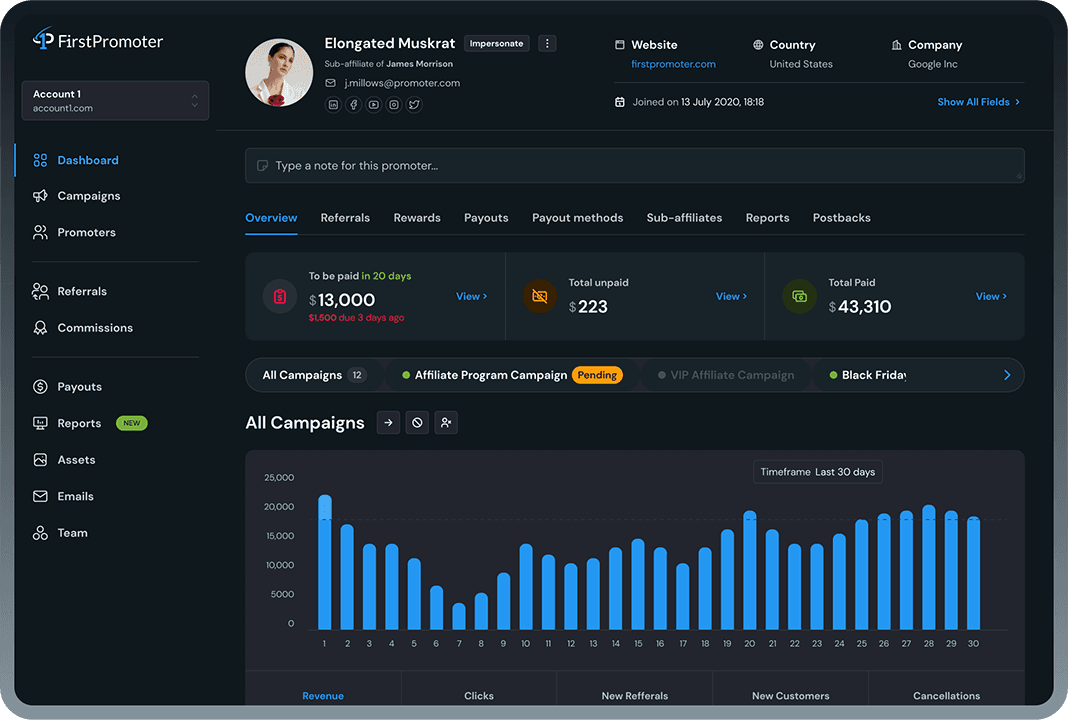
The question worth answering before you evaluate alternatives: are you using PartnerStack to track conversions and pay affiliates, or to manage resellers inside your sales pipeline? If you’re on the affiliate side, FirstPromoter is the strongest fit. Built for SaaS businesses, this affiliate management software for SaaS provides billing-aware tracking and recurring-revenue support. Teams switch from PartnerStack to FirstPromoter when they want less operational overhead, a simpler setup, more control over recurring commissions, or a platform that fits their actual partner model.
However, if you’re on the PRM side, this guide also covers options for enterprise channel management.
Quick answer: What ss the best PartnerStack alternative?
FirstPromoter is the top alternative for SaaS and subscription companies seeking precise recurring-commission tracking without the complexity of a large partner platform like PartnerStack.
If your focus is clear, FirstPromoter is the go-to tool for billing-event-native commission accuracy across Stripe, Paddle, Chargebee, Recurly, Braintree and other payment providers. It doesn’t take a cut of your commission payouts and it offers transparent pricing. Start a 14-day free trial and test this PartnerStack competitor yourself.
Here is a fast-scan comparison table of all providers in this guide:
| Tool | Best for | Pricing | Standout features | Good fit for |
|---|---|---|---|---|
| FirstPromoter | SaaS recurring commissions | $49 / $99 / $149+ /mo | Billing sync (Stripe/Paddle/Chargebee), recurring payouts, customizable portals | Subscription businesses on Stripe |
| PartnerStack | All-in-one partner ecosystem | Custom + payout fees | Affiliate + reseller management, partner marketplace | SaaS teams wanting a full ecosystem in one platform |
| Partnero | Simple affiliate/referral | $49 / $149 / $479 /mo | Automated payouts, recurring commissions, white-label portals | Smaller teams needing quick setup |
| Impact | Enterprise & consumer partnerships | $30/ $500 / $2,500 + payout fees | Cross-channel attribution, broad ecosystem management | Large retail/B2C/publisher partnerships |
| Introw | CRM-integrated PRM | Free (1 partner) / $329 / $579+ /mo | Native HubSpot/Salesforce, deal registration, Crossbeam | B2B sales teams using existing CRMs |
| Channelscaler (previously Allbound) | Partner enablement | Custom (historically ~$600/mo) | Onboarding, training, content distribution, deal registration | Mid-market channel programs |
| Impartner | Enterprise PRM | $25,000–$75,000 /year | Partner lifecycle, governance, MDF, hyperscaler co-sell | Large channel and reseller ecosystems |
Best PartnerStack alternatives
Under its hood, PartnerStack combines two different partner models: affiliate/referral and reseller/channel. It also wraps a partner marketplace around them, where partners can find programs to join. This breadth brings in a lot of users, but many teams are turning away from the platform. Why? The answer is ROI. When businesses realize that they are paying premium pricing for features they don’t use, the cost invested in the platform becomes difficult to justify.
When writing this article, we wanted to make sure to find a tool suitable for your specific use case. Thus, the first three providers are the best PartnerStack competitors for teams running an affiliate or referral program. The rest are more suited for resellers and channel partner programs.
Each entry covers what the provider does best, pricing, standout features, ideal use case and what users find limited.
1. FirstPromoter
If you’re running a SaaS and subscription business that wants partner-led growth, FirstPromoter is the best choice. What makes it better than PartnerStack? There are three main reasons.
First, it’s a much lighter platform. FirstPromoter tracks conversions and pays affiliates accurately across the full subscription lifecycle. When a customer upgrades, downgrades, requests a refund in week two, churns in month four, or fails a payment and recovers a week later, the platform tracks each event and calculates the commission accordingly.
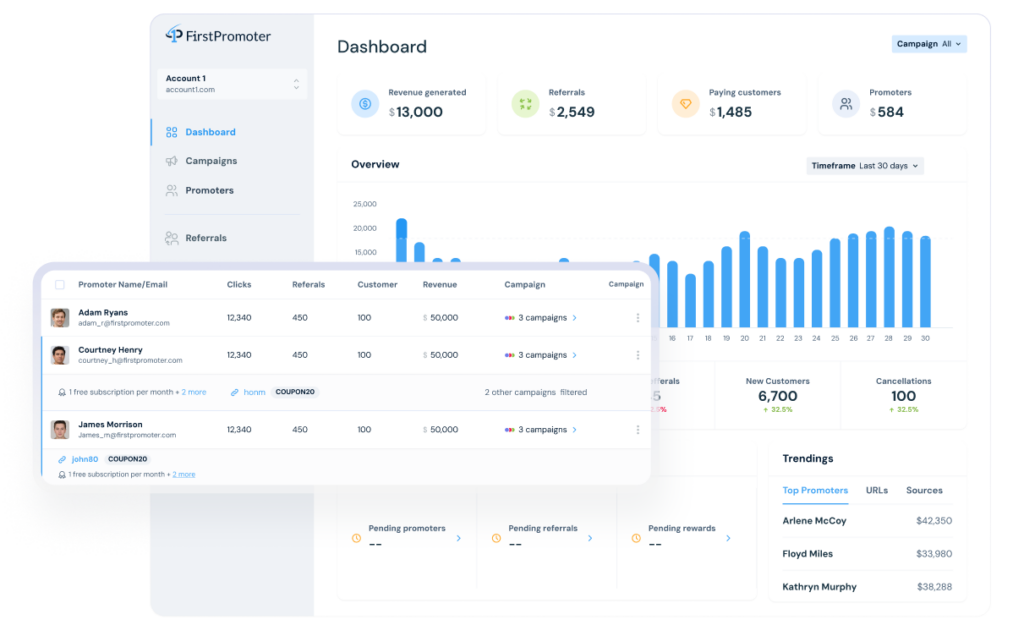
All of this is done automatically, across billing providers such as Stripe, Paddle, Chargebee, Recurly, Braintree and others. This billing-event accuracy sets FirstPromoter apart from generic partner platforms.
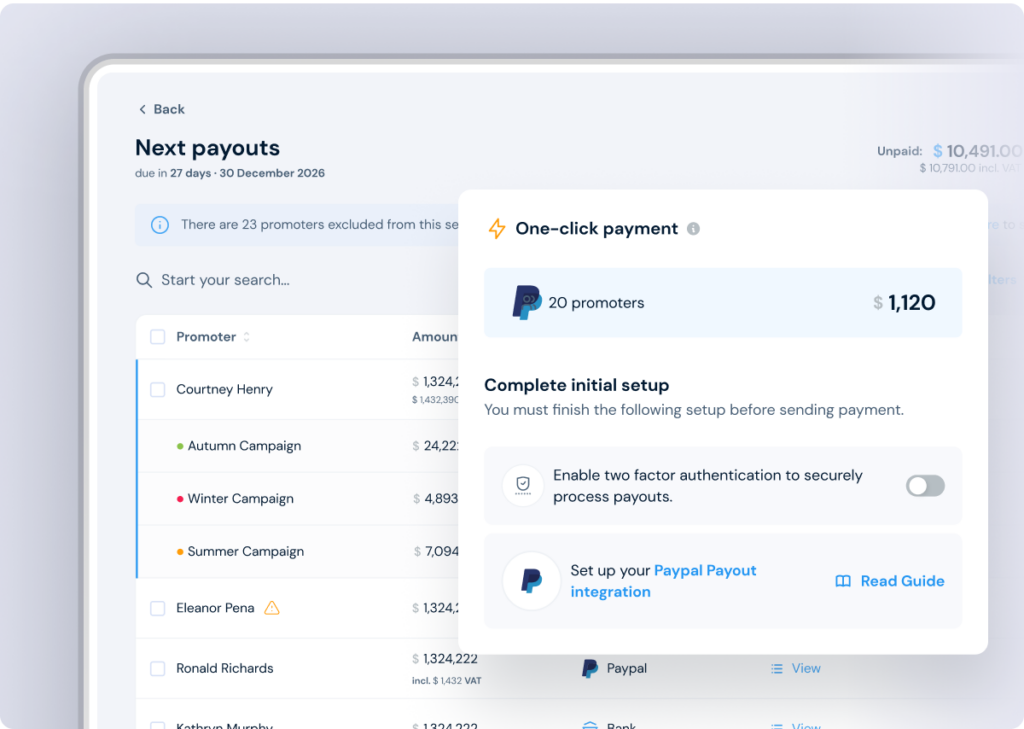
On top of that, the commission and tracking depth hold up as a program grows. You get one-time, recurring and tiered commissions, with custom rewards by plan or product. Payouts run through PayPal and Wise, either one by one or in bulk. Enterprise accounts on the managed plan go further: you pay a single invoice to FirstPromoter and the platform handles all affiliate payouts through Dots, including W-9 and W-8BEN compliance, removing the accounting burden from your team entirely.
Fraud controls sit inside the same layer. The platform flags self-referrals by email and IP, tracks referrals originating from paid ad channels, and automatically applies negative commissions when a refund or chargeback is recorded on your billing provider. You can set approval thresholds, configure ad traffic rules per campaign or per promoter, and require email verification before any affiliate updates their payout method.
Meanwhile, PartnerStack manages affiliates, resellers and co-sellers, and provides a partner marketplace on top of that. For an enterprise, this platform would make good use of a large team’s time and allow them to manage partner ecosystems at an organizational level. However, for an SMB, this means a heavier implementation process. There’s more to configure, more to learn and more to pay, even if you don’t use all of the features.
The second reason is support. FirstPromoter focuses on its clients’ experience by ensuring proper onboarding to the tool. Reviewers praise the agents for quick responses and helpfulness. They mention how eager they are to solve their issues and actually help set things up.
PartnerStack, on the other hand, reportedly has slow onboarding and slow customer support response times. This is a serious drawback for a complex platform that requires guidance.
Louis Anghel, Head of Customer Success: The most common mistake is bracing for complexity. Teams come off an enterprise platform expecting a big setup project, when a tool built for their model usually launches faster than they expect. Two things trip people up: not adding assets – affiliates sell better when they understand your product, and copying every old setting without checking what the new platform can do. The programs that grow keep things simple. The ones that stall overcomplicate from day one
The third reason is transparent and clear pricing. FirstPromoter’s monthly tiers run at $49, $99 and $149+. The service doesn’t take a cut of your partner payouts, either. You can also test the platform with a 14-day trial. With PartnerStack, things get a lot more complex. It hides the pricing behind a book-a-demo call and takes a percentage of what you pay your partners on top of the subscription. Based on reviews, the pricing could be in the thousands per month with additional platform and payout fees.
That’s why founders always run the math before choosing a provider. Take JustCall as an example. Before choosing FirstPromoter, they were quoted $50,000 a year plus 3% commission on every payment by a competing enterprise platform for the same features. Not only did FirstPromoter help save on operational costs, but it also helped JustCall’s affiliate program reach $2.4M in ARR and $200K in monthly affiliate revenue across 1,000 promoters.
These benefits make FirstPromoter a strong foundation for a new affiliate program and it can scale as your program matures and grows. However, it lacks a built-in partner marketplace to recruit affiliates. Instead, it’s built for the affiliate and referral motion.
FirstPromoter works best for SMB-to-mid-market subscription businesses on Stripe, Paddle, or a similar billing tool. If the commission math staying correct as you scale is the priority, this is the right fit.
One thing worth addressing before you sign up: straightforward setup doesn’t mean you’ll outgrow it. As programs scale, the platform adds depth: custom team roles, granular permissions, and activity logs for operational oversight. You don’t pay for that complexity until you need it. Starting a trial takes about fifteen minutes.
One thing worth addressing if you’re evaluating long-term fit: FirstPromoter is straightforward to set up, but that doesn’t mean it’s a starter tool you’ll outgrow. As programs scale, the platform adds depth: custom team roles, granular permissions, and activity logs for operational oversight. You don’t pay for that complexity until you need it.
2. Partnero
Another contender for affiliate and referral software is Partnero. It’s a second practical option for smaller teams that need low setup friction. Unlike PartnerStack, you can launch it without a sales call and configure it the same day.
The platform covers recurring and one-time commissions, affiliate and referral management, coupon support, automated payouts through PayPal and Wise, an AI-assisted program builder and white-label portals.
The pricing is transparent and comes with three tiers: $49, $149 and $479 per month. The platform also doesn’t take a cut of payouts.
Even though Partnero is cheaper, you can’t get FirstPromoter’s depth at that price. The main reason is that FirstPromoter integrates directly into the billing provider to track subscription events. Meanwhile, Partnero is a SaaS-and-e-commerce generalist, so it’s less specialized in the recurring-billing lifecycle that drives commission accuracy. For a subscription business, this difference alone can determine which tool to pick.
Another limit to point out is that support responsiveness comes up repeatedly in reviews. Users point out slow replies and occasional tracking issues. That being said, Partnero is a credible lower-complexity option if PartnerStack’s depth and pricing are too much.
3. Impact
Impact is a broad partnerships platform that covers affiliates, influencers and referrals with deep cross-channel attribution and access to a large partner network. It’s wider than PartnerStack, as it goes beyond affiliate/referral tracking into full partnership lifecycle management (discovery, contracting, attribution, payments) at a scale PartnerStack doesn’t reach.
Whether that scale helps you depends on your team’s goals. For the right organization, Impact can handle complexities that smaller tools can’t. But, like PartnerStack, it’s overbuilt for a typical SaaS team.
This platform leans toward specific industries, such as retail, B2C and publisher partnerships. In other words, it’s targeting a wider scope of clients than just subscription SaaS. This means a small subscription team pays for and operates a scope of features it won’t use.
When it comes to pricing, Impact’s Starter tier runs about $30/month or 3% of monthly revenue, whichever is higher; Essential is roughly $500/month; Pro is around $2,500/month; Enterprise is custom. On top of the plan, there’s a 2.5% fee on every commission the platform generates and enterprise contracts commonly land at $50,000+ a year.
While Impact is a capable platform, it lacks a native SaaS billing integration. Unlike FirstPromoter, which reads billing events natively from Stripe, Paddle, Chargebee, Recurly and Braintree, Impact requires custom development to ensure it’s connected to recurring-revenue logic.
4. Introw
Introw opens the PRM part of this guide. This platform builds partner portals, onboarding and deal registration directly on top of Salesforce or HubSpot. It ensures that partner-sourced leads and deals sync into the pipeline your sales team already works in. PartnerStack, on the other hand, tends to sit more as a separate platform alongside the CRM.
Introw positions itself as a newer and lighter PRM. It offers off-portal updates through Slack and email and a native Crossbeam connection for account mapping. Additionally, its no-code portal building serves as an alternative to PartnerStack’s long enterprise onboarding.
Pricing runs free for a single partner, then $329 per month at the entry tier and $579+ for Pro, with enterprise pricing on request. No sales call is needed to get started.
The catch is that Introw isn’t trying to be an affiliate platform. Its value lives in deal collaboration and CRM-synced pipeline, not in revenue-share automation or recurring-commission accuracy. If your partner program is resellers and co-sellers working deals inside your CRM, Introw works well. But if you’re tracking affiliates earning recurring commissions, this is the wrong option.
5. Channelscaler (previously Allbound)
After a recent merger with Channel Mechanics, Allbound is now known as Channelscaler. It’s a partner relationship platform built around enablement. The platform focuses on education. Thus, the product centers on content libraries, training and certification, onboarding journeys, deal registration, lead distribution and channel incentives. So if you run an organized reseller or channel program where collaboration and training matter as much as tracking, Channelscaler is a good starting point.
That also means more setup and operational overhead. It is designed around a dedicated channel or partnerships manager whose only job is running partners. Setting up workflows, such as building enablement journeys, maintaining a content library and distributing leads, is a project that requires a full-time commitment. So, if you’re a founder or a lean team, you may not have the time to run this platform properly.
Before the merger, the pricing started at around $600/month, clearly aimed at mid-market and enterprise rather than SMB. However, it’s no longer transparent. Now, it sits in enterprise modular territory, hidden behind a sales call.
Overall, Channelscaler is a good fit for companies needing structured partner enablement, but those teams must be ready to absorb the cost and commit the setup resources.
6. Impartner
Impartner is another heavyweight platform. It’s an enterprise-grade PRM for organizations that need formal channel infrastructure.
Impartner handles partner lifecycle management, governance, onboarding and certification, performance management, marketing automation, MDF and hyperscaler co-sell across AWS, Azure, and Google Cloud.
If your company runs a large reseller, distributor, or ISV ecosystem, this is a solid toolkit. However, if you’re a smaller SaaS running an affiliate program, you’ll be paying for an arsenal of features you simply don’t use. Chances are, this is why you’re already leaving PartnerStack.
Based on pricing alone, you can tell that Impartner is aimed at enterprises. Expect annual fees of $25,000 to $75,000. Reviews mention extensive implementation alongside add-on or professional services fees that add up beyond the base license. If you pick Impartner as your PRM platform, treat it as a project requiring a dedicated team, rather than a one-day task.
Impartner is a promising PRM alternative to PartnerStack, but it’s also a heavy platform that may not be suitable for lean teams.
Why teams look for a PartnerStack alternative
Teams that leave PartnerStack often do it for similar reasons. Naming them can help you pick the right tool and avoid making costly mistakes.
One of the most common reasons is pricing. If you’re running a lean team that needs to kick-start an affiliate program today, you need to know how much the platform costs upfront. You also need to consider other fees and calculate the ROI of your program.
However, PartnerStack makes the process difficult. It doesn’t publish pricing upfront. Instead, you need to book a demo to get a quote. The contracts that come back are built for enterprise budgets and tend to scale with partner count as your program grows. On top of the platform fee, PartnerStack takes a percentage of every partner payout, which can erode margin exactly as your best partners succeed.
Pricing aside, the complexity of the platform is another issue to note. PartnerStack is an ecosystem platform built around affiliates, referrals, resellers and a marketplace. Even if you’re using only one of these motions, you’re still paying for and operating around all of them.
The marketplace is often seen as a solid selling point. But there’s a catch. It can bring in new partners, but being listed also means sharing affiliate exposure with competitors, which is not what every company wants.
Another important reason teams often mention is buying the wrong partner model. After gaining experience, founders often realize that what they needed all along was billing-aware recurring-commission tracking, not a broad partner ecosystem. This is where FirstPromoter is a much better fit. If you want the head-to-head comparison, see FirstPromoter vs PartnerStack.
That’s why, before you pick a platform, figure out whether you need an affiliate engine or a reseller PRM.
How to evaluate the best PartnerStack alternatives
Picking the right alternative is less about which platform has the longest feature list and more about which one holds up once your program is live. Plenty of tools look complete in a demo and still leave you reconciling commissions by hand three months later. The criteria below are the practical tests that tell the difference.
Match the platform to your partner model
What does your program actually involve? Affiliate and referral programs need conversion tracking and commission accuracy. Reseller and channel programs need deal registration and partner enablement: a PRM, not a tracking tool. Getting this wrong is the most common reason teams end up switching platforms within a year.
FirstPromoter is built for the affiliate and referral side. If you’re running a subscription-led program, it fits better than Introw, Channelscaler, or Impartner by design.
Revenue accuracy and attribution quality
Once you have a correct partner model pinned down, make sure the platform provides accurate revenue reports.
A good alternative ties commissions and reporting to verified conversions and real revenue, not just clicks, leads, or partner activity.
That’s why you should look for referral links, coupon tracking, and direct attribution methods, plus lifecycle-aware reporting that shows true revenue contribution rather than top-of-funnel noise.
For affiliate and referral programs, a tool that meets this criterion is FirstPromoter. It ensures accuracy through billing-event attribution and per-affiliate revenue tracking with traffic-source identification across 18 data points, so you can see which partners drive revenue that actually sticks.
Commission flexibility for recurring and one-time models
Your incentive logic has to match how you sell. Say a customer signs up through an affiliate in January, upgrades in March and churns in June. Does the platform recalculate the commission at each stage, or does it lock in the payout at signup? For subscription businesses, that distinction matters more than the number of commission types on a feature list.
Make sure any tool you evaluate handles the full billing lifecycle – renewals, upgrades, downgrades, refunds – not just the initial conversion. FirstPromoter covers one-time, recurring and tiered commissions with automatic adjustments at each billing event and custom rewards by plan or product.
Onboarding, portals and daily partner operations
No matter how promising the feature list of a platform sounds, the daily experience matters more. Look at the signup flow, approval rules, the partner portal and self-service access, training resources, in-app communication and how much admin load lands on your team.
Communication with affiliates runs through a built-in email layer. Trigger emails fire automatically on specific events: acceptance, reward creation, payout confirmation, inactivity reminders, and can be set up as drip sequences with delays. Broadcast emails let you reach your full affiliate base or a specific campaign with announcements, offers, or updates, without needing an external email tool.
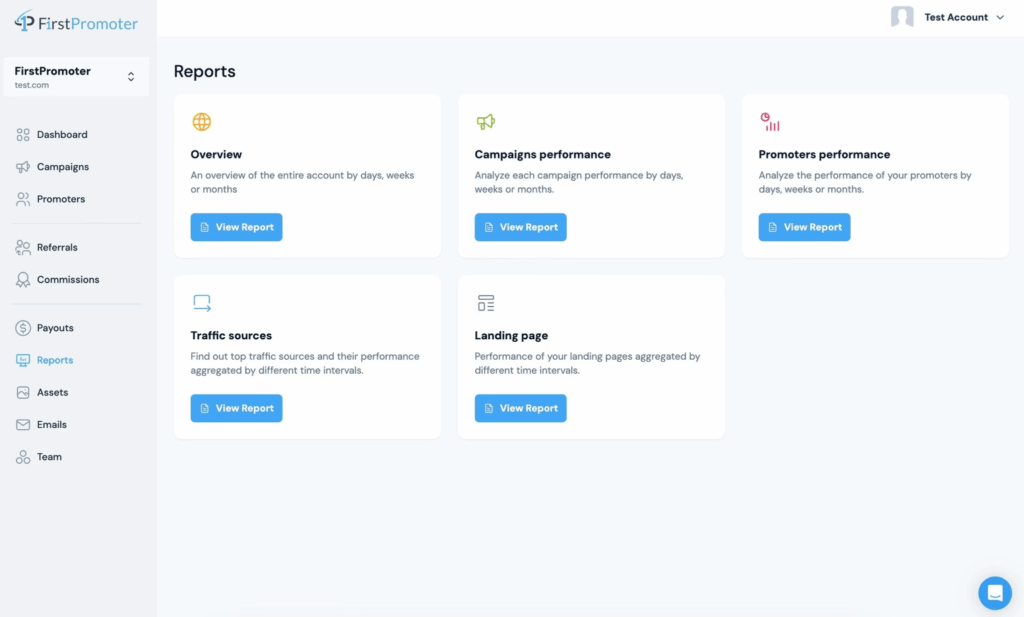
FirstPromoter is a good example of a clean partner portal that keeps good partners active and engaged. It offers branded, custom-domain portals, built-in email automation and broadcasts and unlimited team members with custom roles, so adding a colleague doesn’t mean buying another seat.
Billing sync, lifecycle tracking and payout operations
If you’re paying a hefty fee for a platform, you shouldn’t need to manually reconcile commissions every month. However, if the platform doesn’t automatically account for common events such as renewals, upgrades, downgrades, refunds, failed payments and cancellations, you won’t get an accurate view.
That’s why we put FirstPromoter at the top of this list. It ensures native integrations with billing providers and makes automatic lifecycle adjustments. The platform also offers bulk and auto-managed payouts via PayPal and Wise, as well as built-in VAT and non-VAT invoicing.
You can wire it up through the Stripe affiliate tracking integration and let billing events drive the commission math.
One platform for affiliates, referrals and partner-led growth
Running affiliates in one tool and referrals in another means two attribution engines, two reporting dashboards and no clean way to see how both programs interact. For most SaaS teams, that’s not a complexity worth adding.
If you expect to run both motions, verify that the platform handles them under one reporting layer before you commit. FirstPromoter manages affiliates and referrals in the same account, so the numbers reconcile against each other.
Use a practical feature checklist during evaluation
When you compare alternatives side by side, run each one through the same checklist:
- Conversion-verified attribution and which methods it supports (links, coupons, direct)
- Recurring vs one-time commission logic and tiered or campaign-level commission structures
- Coupon tracking, including auto-generation and multiple codes per partner
- Billing integrations and automatic lifecycle handling for subscriptions
- Payout automation, including bulk payouts and invoicing
- Partner portal quality, onboarding flow, and built-in affiliate communication (trigger and broadcast emails)
- Reporting depth and revenue-level visibility
- Fraud controls: self-referral detection, paid ad traffic filtering, refund/chargeback negative commissions, reCAPTCHA on signup, payout method verification
- Team roles and seat limits
Keep the list next to each tool and mark what’s native, what’s a workaround and what’s missing. The gaps you find can tell you more than the feature counts.
Choose based on fit, setup effort and long-term manageability
The final evaluation step is matching the shortlisted providers to what matters most: your revenue model, your partner strategy, your technical resources, the implementation effort you can afford and the admin load you can sustain.
Even if a platform looks impressive during the demo, the long setup and dedicated staff can cost more than it returns. Also, factor in whether the platform takes a cut of payouts.
Don’t focus merely on features or how the platform looks. Instead, test whether the tool stays reliable and accurate as the program grows. The commission math should hold and the reporting should reconcile as your program grows from ten to 10,000 partners.
Conclusion: Which PartnerStack Aalternative ahould you pick?
Let’s come back to the question we asked at the start of this article. Are you using PartnerStack to track conversions and pay affiliates, or to manage resellers inside your sales pipeline? Your answer can determine what kind of alternative you need.
If you run affiliates and referrals on recurring revenue, FirstPromoter is the top pick. It offers simpler, more accurate recurring-commission tracking, transparent pricing and no cut of your payouts. This platform is built for small-to-mid-market subscription businesses. Sign up and have a program live the same day.
If you run reseller or co-sell motions inside a CRM, Introw, Allbound (Channelscaler), or Impartner will serve you better.
Name your use case, match the tool and don’t pay for the half of PartnerStack you weren’t using.
PartnerStack alternative FAQs
What is the best PartnerStack alternative for SaaS companies?
For SaaS companies running affiliate or referral programs, the answer usually comes down to billing integration. Most tools track clicks and leads; fewer track what happens after signup: renewals, upgrades, cancellations. FirstPromoter connects directly to Stripe, Paddle and similar billing tools, so commissions stay accurate as subscriptions change. Channel-led businesses need a CRM-first PRM instead.
Why do businesses look for a PartnerStack alternative?
Most want lower or more transparent costs, since PartnerStack hides pricing behind a demo and takes a cut of partner payouts. Others find it more platform than they need, especially when they only use the affiliate side and not the reseller or marketplace features. The common thread is paying for a full partner ecosystem when only half of it gets used.
Which PartnerStack alternative is best for recurring commissions?
FirstPromoter stands out here because it ties commissions directly to billing events. When a customer renews, upgrades, downgrades, or cancels, the commission adjusts automatically instead of needing manual correction. That billing-event accuracy is hard to match with tools built around clicks or one-time conversions.
Is there a simpler alternative to PartnerStack for smaller teams?
Yes. FirstPromoter is lighter and faster to set up than PartnerStack, with no sales call or long onboarding required to launch a program. Its lower plans start at $49 a month, so a small team can run an affiliate program without enterprise pricing or overhead. For subscription businesses, it keeps commission tracking accurate as you scale without adding complexity.
What features should I look for in a PartnerStack alternative?
Prioritize billing sync, flexible recurring commissions, branded partner portals, automated payout and clear revenue-level reporting. Match those against your partner model: an affiliate program and a reseller program need very different things. The fastest way to over- or under-buy is to compare feature counts instead of fit.
Are PartnerStack alternatives better for affiliate programs or channel partnerships?
It depends on the tool and that distinction is the most important one to get right. FirstPromoter and Partnero lean toward affiliate and referral programs, where the job is tracking conversions and paying partners. Introw, Allbound (Channelscaler) and Impartner focus on structured channel partnerships with deal registration and partner enablement.
Is FirstPromoter a better PartnerStack alternative for subscription businesses?
For most subscription businesses running affiliate or referral programs, yes. It sets up faster, tracks recurring revenue more accurately and carries lower long-term overhead because it isn’t built around reseller or marketplace features you won’t use. It is not a reseller PRM, so channel-led businesses are a better match for a CRM-first tool.

In this article
Newsletter