LeadDyno alternative roundups tend to miss the question that actually decides everything for a subscription business: does the platform read billing events, or does it just track clicks?
That distinction is why teams leave LeadDyno. Clicks and signups work fine. Renewals, upgrades, downgrades, and refunds, the events that actually move commission math, do not adjust automatically. As a result, teams need manually reconcile against Stripe or Chargebee, to avoid a growing gap between what affiliates were paid and what they earned (source: G2).
This guide ranks six LeadDyno alternatives by how well they handle subscription billing. FirstPromoter is the top recommendation for SaaS teams. It integrates natively with Stripe, Paddle, Recurly, Chargebee, and Braintree, and adjusts commissions automatically when billing events fire. The rest of the list covers comparable alternatines and explain who they fit best.
Quick comparison: LeadDyno alternatives at a glance
For SaaS subscription businesses, FirstPromoter is the strongest alternative on this list. It covers the widest set of billing providers, handles the full subscription lifecycle, and runs affiliate, referral, and influencer programs from one system. If accurate billing event tracking is your priority, start your 14-day free trial of FirstPromoter.
If your main focus is on clicks and conversions, then a platform like Tolt or Tapfiliate might be just what you need. However, if you’re searching for a solution that’s specifically designed for CPA networks, multi-channel attribution, or managing large B2B partner ecosystems, you’ll want to consider options like Everflow or PartnerStack.
| Tool | Architecture | Good fit for | Pricing from | Billing providers |
|---|---|---|---|---|
| FirstPromoter | Billing-event-native | SaaS / subscription, SMB to mid-market | From $49/mo | Stripe, Paddle, Recurly, Chargebee, Braintree |
| Rewardful | Billing-event-native (narrow) | Stripe / Paddle Classic SaaS | $49/mo | Stripe, Paddle Classic |
| Tolt | Billing-aware | SaaS startups, early-stage programs | $69/mo | Stripe, Paddle, Chargebee |
| Tapfiliate | Billing-aware | Multi-vertical affiliate programs | $89/mo | Stripe; partial Chargebee/Memberful |
| PartnerStack | Enterprise PRM | B2B SaaS with large partner ecosystems | Quote only | Stripe, Chargebee, Recurly, Maxio, Paddle (partial) |
| Everflow | Performance marketing | Networks, agencies, media buyers | Quote only | Event/postback tracking, not lifecycle-native |
Best LeadDyno alternatives
Each review below addresses several key questions. First, we evaluate whether the platform can adjust commissions based on accurate billing events, such as upgrades or refunds.
Next, we examine the flexibility and structure of the commission system and inquire about the payout workflows they offer.
Finally, we assess the pricing structure and identify the most suitable use case for each platform.
1. FirstPromoter
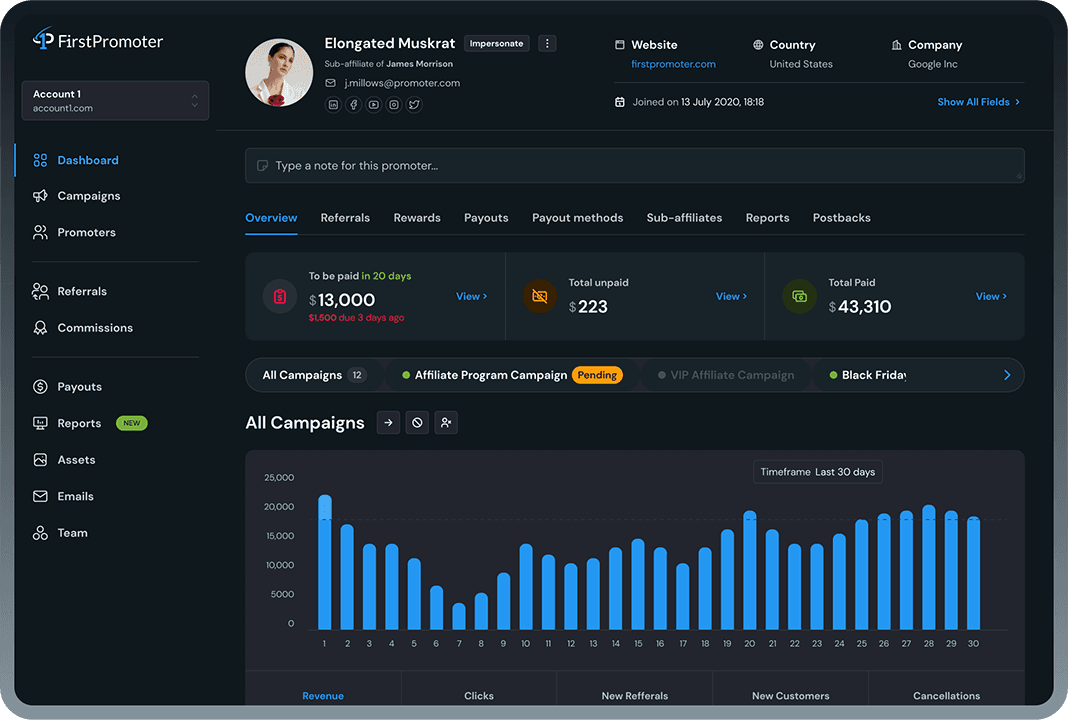
FirstPromoter is built for the use case LeadDyno covers only partially. Subscription-native affiliate, influencer, and referral programs for SaaS businesses.
The difference comes from how attribution works underneath. LeadDyno tracks conversions and runs into trouble at every billing event after the first sale. FirstPromoter connects directly to the billing provider’s webhook stream and follows the subscription through its lifecycle. When a customer upgrades from a $49 plan to a $99 plan mid-month, the commission recalculates on the next renewal. When a refund clears, the commission reverses. When churn happens, the recurring commission stops. No spreadsheet.
FirstPromoter integrates natively with Stripe, Paddle, Recurly, Chargebee, and Braintree. This is the widest coverage on this list. LeadDyno’s documented support is Stripe and Chargebee. The five-provider coverage is what matters if your billing stack isn’t pure Stripe, or if you’re planning a migration to Paddle Billing.
The integration depth matters too. FirstPromoter reads upgrades, downgrades, refunds, cancellations, failed charges, and trial conversions as separate events, and the commission engine applies different logic to each. That’s the difference between billing-event-native and billing-aware. LeadDyno is the second kind, and that limitation shows up at month-end.
LeadDyno’s product structure separates affiliate programs and customer referral programs into different setups. FirstPromoter unifies the three motions, affiliates, influencers, and referral partners, under one attribution engine with shared payout automation. For a subscription company running creator partnerships alongside an affiliate channel, that’s one tool instead of two.
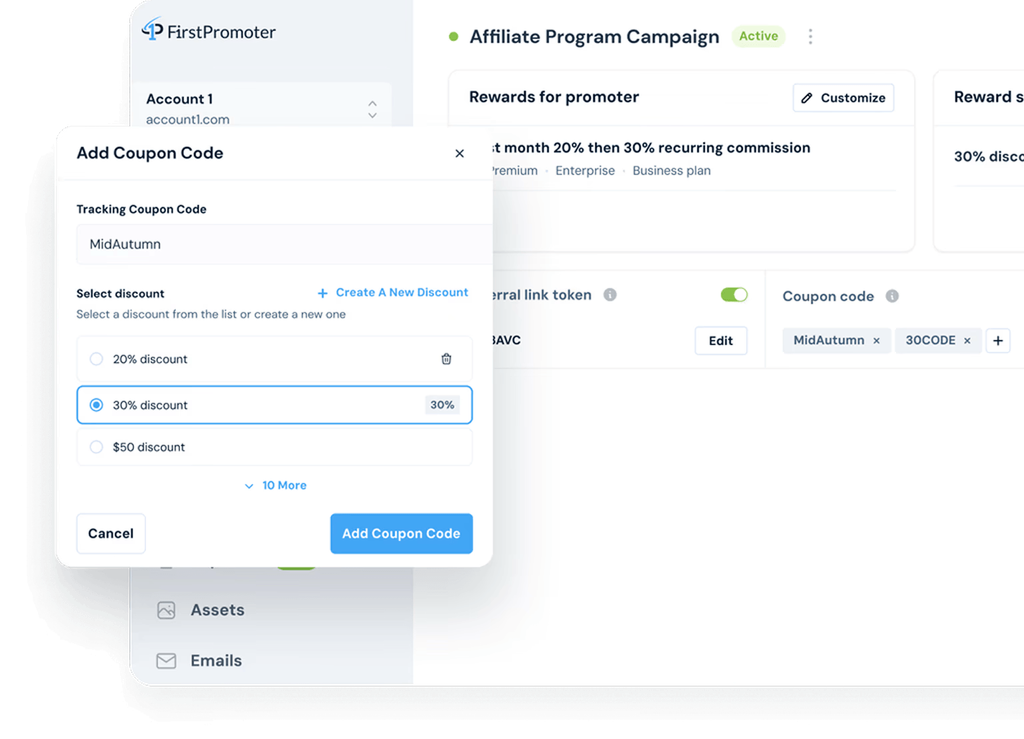
Commission flexibility runs deeper, too. The platform supports recurring commissions, time-limited campaigns, dual-sided referral rewards, and commission rates that escalate as affiliates hit volume milestones. Coupon tracking runs alongside link tracking, which matters for influencer programs where creators share discount codes rather than URLs. Self-referrals and ad traffic fraud are flagged automatically before a commission fires.
LeadDyno’s verified payout method is PayPal Payouts or PayPal MassPay CSV. For a US-only program with PayPal-friendly affiliates, that works. For programs with affiliates in markets where PayPal is expensive, restricted, or slow, it doesn’t.
FirstPromoter processes payouts through PayPal, Wise, and bank transfer, with bulk automation and built-in invoicing support. On the Enterprise plan, Managed Auto Payouts lets FP pay affiliates on your behalf via a single invoice. he platform handles per-affiliate transfers and tax form collection (W-9/W-8BEN). EU invoicing is also supported.
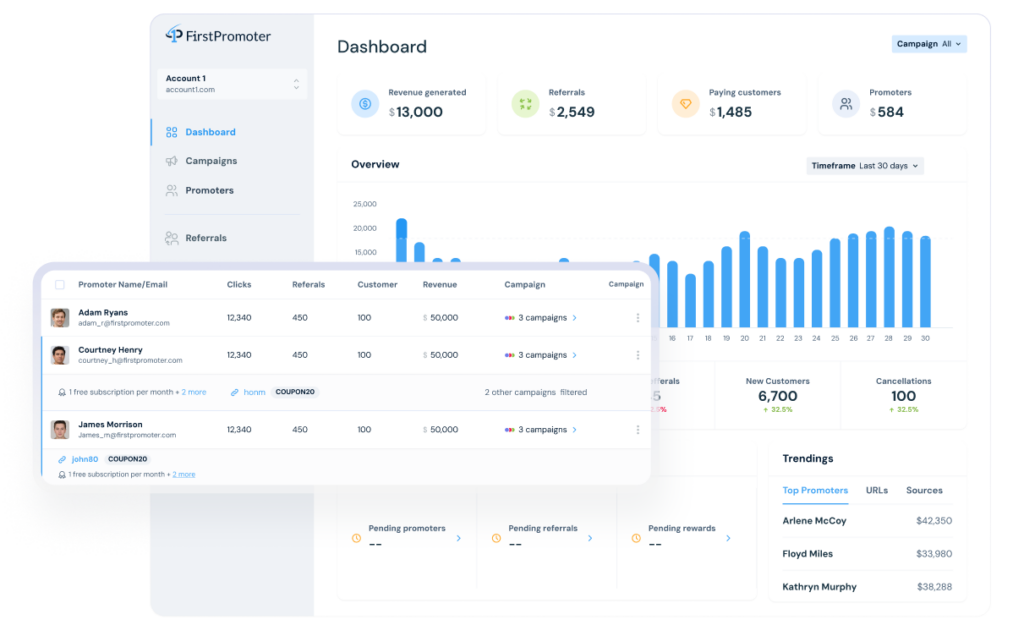
This platform reports across 18 data points with campaign, promoter, traffic-source, and landing-page breakdowns. The metrics that matter for a subscription business are first-class. EPC, churn rate of referred customers, MRR from affiliates, conversion rate from referral to paying customer, and lifetime commission value per affiliate.
For a finance or operations reviewer evaluating the platform, the reporting depth is what makes the month-end clean. Commissions match billing data because the commissions are calculated from billing data.
FirstPromoter has tracked over $2 billion in affiliate revenue across customer programs
Customer outcomes back the platform up:
- Submagic: built a program to €85K+/month in affiliate revenue, 9,000+ promoters, €1.6M+ total tracked.
- Passion.io: $2M+ total affiliate revenue, 3,012 promoters.
- JustCall: $2.4M ARR from the affiliate channel, $200K/month at peak, 1,000+ active promoters.
JustCall specifically chooses FirstPromoter after evaluating the value-to-price ratio. A competing platform quoted them $50K/year plus 3% of every payment processed. Meanwhile, FirstPromoter pricing starts $49/per month and charges no percentage on transactions.
For SMB to mid-market subscription businesses on Stripe, Paddle, Recurly, Chargebee, or Braintree, building a partner-led growth channel and tired of reconciling commissions against billing data, FirstPromoter is the top recommendation.
However, it’s not the right call for e-commerce-first brands (the billing model doesn’t fit) or for performance marketing networks that need media-buyer features and high-volume click attribution. For those, see the Everflow and PartnerStack sections below.
For a feature-by-feature breakdown, see FirstPromoter vs LeadDyno.
2. Rewardful
Rewardful is the closest billing-event-native alternative to FirstPromoter, with a deliberately narrower scope. The Stripe integration is deep. Customer creation, invoice payments, upgrades, downgrades, trial conversions, cancellations, and refunds all adjust commissions automatically. For a team whose entire billing stack runs through Stripe, the setup is worth the attention.
The billing coverage, though, is narrow by design. Rewardful supports Stripe and Paddle Classic only. Paddle Billing, Paddle’s current platform, is not supported. Teams on Recurly, Chargebee, or Braintree are outside Rewardful’s scope. As a result, a migration to Paddle Billing means a migration off Rewardful.
Pricing tiers are capped by affiliate-driven revenue, not affiliate count. Starter is $49/month up to $7,500/month in affiliate-generated revenue. Growth is $99/month up to $15,000/month. Enterprise is $149+/month above that. Zero transaction fees keep costs predictable within each tier.
The branded affiliate portal, custom domain, and white-label features sit behind the Growth+ plan. Starter at $49/month does not include them. Managed Payouts is currently in Beta. The team that needs production-ready payout automation should double-check if the workflows are available.
This platform works for Stripe-first SaaS businesses running simple affiliate programs that don’t need multi-tier commissions, in-platform email automation, or coverage beyond two billing providers.
3. Tolt
Tolt covers Stripe, Paddle, and Chargebee with a two-way Stripe sync that detects when a customer subscribes, cancels, or is refunded. For an early-stage program that handles the events that matter most.
Tolt is billing-aware rather than billing-event-native. Trial-started events, upgrade and downgrade handling, subscription pause and resume, dunning sequences, and payment-failed events are not in scope. For a SaaS program where mid-cycle upgrades drive a meaningful share of commission math, that’s a coverage gap that grows with program size.
Pricing tiers are capped by affiliate revenue. Basic at $69/month, up to $10,000/month with manual payouts. Growth at $99/month up to $20,000 with auto payouts and a 2% processing fee. Pro at $199/month up to $50,000 with custom payouts. Enterprise above that. The 2% auto-payout fee on Growth stacks on top of the monthly plan cost.
A program generating $20,000/month in affiliate commissions pays $400/month in processing fees on top of $99 in platform fees.
Payout methods on the Growth plan include PayPal, Wise, local bank transfer, crypto, and wire. The branded affiliate portal supports a custom domain, logo, colors, and magic-link login. CSS/JS customization and partner SSO are not verified.
It’s a suitable solution for SaaS startups on Stripe, Paddle, or Chargebee that want a fast launch with lean configuration and moderate affiliate volume. The 2% payout fee is worth modeling before the program crosses the Growth tier.
At mid-market scale, FirstPromoter’s broader lifecycle coverage and zero-percent payout structure become more economical.
4. Tapfiliate
Tapfiliate covers a wide range of affiliate use cases. Ecommerce, SaaS, B2B, B2C, hybrid programs. The commission engine and partner portal handle multiple program types under one account, which is useful for teams running affiliate marketing across product categories.
The Stripe integration handles conversion tracking, recurring and lifetime commissions, refunds, disputes, and coupon conversions. Upgrade and downgrade events are not covered. Dunning, pause/resume, and payment-failed events are not available. If you’re running a subscription business, this is worth considering before onboarding.
Pricing: Launch at $89/month covers 50 affiliates, 5,000 clicks, 500 conversions. Scale at $179/month covers unlimited affiliates, 100,000 clicks, and 10,000 conversions. Overage fees apply. $1.50 per 1,000 clicks on Launch, $1 per 1,000 clicks on Scale.
This solution is for teams running multi-vertical affiliate programs (e-commerce and SaaS in one) where full subscription lifecycle commission automation isn’t a hard requirement.
5. PartnerStack
PartnerStack is an enterprise B2B partner ecosystem platform. The buyer evaluating PartnerStack alongside LeadDyno is usually asking a different question than the one that led them to LeadDyno originally. Affiliate tracking versus partner ecosystem management.
PartnerStack covers Stripe, Chargebee, Recurly, Maxio/Chargify, and Paddle, but with partial lifecycle tracking rather than full SaaS lifecycle coverage. Expect data on customer creation, updates, payments, refunds, payment failures, and some subscription events, depending on the billing provider.
Pricing is quote-based and requires a demo. There are no verified public monthly prices, overage rates, or transaction fee percentages. User-reported pricing puts the starting cost at approximately $1,500/month for annual contracts plus a percentage of all partner payouts. Published transaction fees aren’t disclosed, but typically fall in the 3–15% range based on customer reports.
Payouts run on a monthly review cycle before release, through PayPal, Stripe, and direct deposit via Airwallex.
Consider this platform if you’re B2B SaaS company with substantial ARR that want affiliates, resellers, co-sell motions, and partner marketplace discovery in one system. It may not be the right tool for replacing a lean affiliate program with manageable monthly costs.
6. Everflow
Everflow is a performance marketing platform built for affiliate network management, multi-channel attribution, media buying, lead generation, and high-volume traffic analytics across ecommerce, mobile, gaming, and B2B verticals.
SaaS subscription affiliate tracking is not Everflow’s native use case. The platform handles clicks, impressions, conversions, custom events, sales amounts, coupon codes, app installs, and leads, with first-touch, multi-touch, and view-through attribution.
Subscription lifecycle events are handled through generic postback configuration, not native billing webhooks. Setup requires developer assistance, particularly for postback configuration and changes to tracking rules. If you’re a SaaS team without these resources, you’ll run into a problem.
Pricing is quote-based with no public plans. The quote form asks about program status, monthly affiliate payout volume, and business type.
This is an option for performance marketing teams, affiliate networks, agencies, and media buyers who need cross-channel attribution and high-volume traffic analytics. It’s not designed as a SaaS subscription affiliate tool.
How to evaluate your options
The six tools on this list cover different categories of buyers, and the wrong fit shows up months after onboarding, when it’s expensive to undo. The criteria below are the ones that actually separate platforms once a SaaS program scales past its first hundred affiliates. Work through them in order, since each filter narrows the shortlist before the next.
Start with your revenue model
Picture a $49 subscriber who upgrades to $99 three months in, then cancels at month seven. How many tools on a typical comparison list can trace that subscription arc and adjust the affiliate’s commission at each step without a manual entry?
Start there. Which billing providers you use and which events your commission logic actually depends on narrows the shortlist faster than any feature matrix. An ecommerce affiliate tool handles the click-to-purchase moment well. A subscription tool needs to follow the customer past the first payment. Those are different architectures, and the wrong fit shows up at month-end.
Recurring commission accuracy matters more than basic link tracking
FirstPromoter and Rewardful both handle commission updates at the billing event level, which means upgrades, downgrades, refunds and cancellations adjust commissions automatically. Tolt and Tapfiliate track subscription events but don’t have verified coverage for mid-cycle plan changes. That gap is invisible when a program is small. At 150 affiliates with active subscriber bases, it surfaces as a reconciliation problem every month.
When evaluating any platform’s billing integration, ask which specific events trigger a commission change, not just which billing providers are listed. The answer tells you whether accuracy is built in or bolted on.
Check affiliate limits and pricing structure early
Model the total cost before shortlisting, because the headline monthly price rarely reflects what you’ll pay at scale. LeadDyno’s tier structure caps affiliates per plan and requires jumping from $129 to $349 to reach 500 affiliates. Tolt caps by affiliate-earned revenue ($10K, $20K, $50K monthly tiers) and adds a 2% processing fee on auto payouts from the Growth tier.
Tapfiliate, on the other hand, charges overage fees on clicks and conversions beyond plan limits. That works out to $1.50 per 1,000 clicks on Launch, $1 per 1,000 clicks on Scale. Rewardful caps by affiliate-driven revenue rather than affiliate count.
Model what the actual cost looks like at your expected affiliate volume and revenue before making a final decision.
Attribution should connect to verified revenue
Ask every vendor this in the demo: “If a creator shares a discount code and their referral upgrades six weeks after signup, does that upgrade show as attributed revenue in my affiliate report?”
The answer tells you whether attribution connects to verified revenue or just to the first conversion event. Link tracking and coupon tracking need to work in parallel, since influencers and content affiliates use different methods. Attribution window length matters too: Tapfiliate defaults to a 45-day last-click window, PartnerStack to 90 days. FirstPromoter and Rewardful both support link and coupon tracking with configurable attribution.
Partner portals shape activation and retention
The affiliate portal is what partners actually use. A confusing or generic dashboard lowers activation rates and increases support requests. Check whether the branded portal requires an upgraded plan.
Rewardful requires Growth for a custom domain, Tapfiliate requires Enterprise for full white-label, and Tolt removes its own branding only at the Pro tier.
Also, check whether magic-link or SSO login is available. There should be an option for affiliates to access their own payout history without contacting support.
Payout workflows become critical as programs grow
The payout workflow is easy to overlook during evaluation and painful to discover at scale. Before committing, verify two things: whether automated payouts are production-ready (Rewardful’s Managed Payouts is currently Beta; Tapfiliate’s internal payout functionality is listed as coming soon), and whether the platform’s payout fee structure is modeled at your expected affiliate revenue volume.
Tolt charges 2% on Growth-tier auto-payouts. On a $20,000/month affiliate commission total, that is $400/month in processing fees on top of the platform cost. Geography matters too: LeadDyno’s confirmed payout method is PayPal only, and Everflow covers ACH and wire but not PayPal or Wise.
Louis Anghel, Head of Customer Success at FirstPromoter: “The biggest ongoing pain is paying everyone. Most affiliate programs support PayPal and maybe a bank transfer, which works until your program goes global. Then you find PayPal isn’t practical for affiliates in more than 20 countries, bank transfers eat fees and take a week and some affiliates want other payout methods. The operator ends up running payouts manually across four or five methods every month. And that’s when payments get missed and the wrong people get paid the wrong amounts.”
Decide if you need a simple affiliate tool or a broader partner platform
Most SaaS teams switching from LeadDyno need billing-native affiliate tracking with clean recurring commission logic. Some need more: reseller management, co-sell workflows, partner marketplace access.
PartnerStack is built for the second category. Everflow is built for performance marketing programs with media buyers and high-volume traffic analytics. Placing yourself in the correct product category before the demo is worth doing. Feature comparisons across different categories produce no useful signal.
Use a practical feature checklist during evaluation
When evaluating any of these tools, bring a checklist to the demo:
- Partner types supported: affiliate, referral, reseller, co-sell, influencer
- Billing provider integrations available, and which subscription events trigger commission changes
- Which billing events adjust commissions automatically without manual steps: renewal, upgrade, downgrade, cancellation, refund
- Commission types: one-time, recurring, multi-tier, coupon, product-specific
- Payout automation: one-click payouts, PayPal and Wise support, tax form handling
- Portal: custom domain, branding, partner self-service access
- Attribution method: first-touch, last-click, or configurable
- Reporting: affiliate-level MRR visibility, churn-adjusted commissions, coupon tracking
- Integrations: billing provider, CRM, payout platform
- Admin load: estimated time to launch, engineering required, ongoing maintenance
For a full breakdown of what to look for, see FirstPromoter’s affiliate program management features.
Choose based on fit, setup effort and long-term manageability
The right platform stays accurate as the program grows. Commission drift from untracked billing events compounds over time. It’s a minor annoyance at 30 affiliates and an operational problem at 300.
Match the platform to your billing stack, your partner types, your payout complexity, and the program scale you’re planning for in 12 months, not the program you have today.
Which LeadDyno alternative should you pick?
For SaaS and subscription businesses, FirstPromoter is the strongest alternative on this list. It covers five billing providers natively, adjusts commissions automatically across the full subscription lifecycle, and runs affiliate, referral, and influencer programs from one system with automated payouts via PayPal, Wise and bank transfer.
Rewardful could also be a good call if your billing stack is exclusively Stripe or Paddle Classic and you want the simplest possible setup. Verify Paddle Billing isn’t on your roadmap before committing and note that Managed Payouts is currently in Beta.
Tolt works for SaaS startups that want a fast, low-cost launch on Stripe, Paddle or Chargebee. Model the 2% auto-payout fee at your expected affiliate revenue before crossing into the Growth tier.
Tapfiliate fits multi-vertical affiliate programs where full subscription lifecycle depth isn’t the primary requirement. In-platform payouts are still in development.
PartnerStack belongs in evaluations where the program is part of a larger B2B partner motion (affiliates, resellers, co-sell, marketplace) and the budget supports it.
Everflow fits performance marketing teams and affiliate networks. It is not designed as a SaaS subscription affiliate tool.
If you’re running a subscription business and want commissions that stay aligned with billing data as your program scales, set up your FirstPromoter account and see how it handles your specific billing setup.
LeadDyno alternative FAQs
What is the best LeadDyno alternative for SaaS companies?
FirstPromoter is the strongest LeadDyno alternative for SaaS and subscription businesses. It connects natively to Stripe, Paddle, Recurly, Chargebee, and Braintree, the widest billing-provider coverage on this list, and adjusts commissions automatically when billing events fire, including upgrades, downgrades, cancellations, and refunds.
Which alternative handles recurring commissions most reliably?
The short answer is FirstPromoter, but the “why” is worth understanding. Most platforms track subscription events. Fewer adjust commissions when a mid-cycle upgrade or downgrade fires. FirstPromoter is built around billing webhooks, so upgrades, downgrades, cancellations and refunds all trigger commission recalculation without a manual step. It covers Stripe, Paddle, Recurly, Chargebee and Braintree.
Is there a simpler LeadDyno alternative for early-stage SaaS teams?
Depends on what “simpler” means. If it means faster to launch with less configuration, Tolt is worth a look for programs on Stripe, Paddle, or Chargebee that are comfortable with some coverage gaps on mid-cycle billing events.
If it means launching lean without having to migrate later, FirstPromoter is the better call. The native billing integrations mean commissions are accurate from the first referral, and the plan structure doesn’t force a tier jump as the affiliate list grows. Free trial, no credit card required.
What should SaaS teams check before switching from LeadDyno?
Start with billing-provider coverage and which specific events the platform receives. Not just “Stripe integration” but whether upgrades, downgrades, refunds, and cancellations actually adjust commissions. Then check affiliate caps and pricing structure at scale, payout automation maturity (in production or Beta?), partner portal quality without requiring an enterprise plan and whether migration support is available for moving an existing affiliate list.
Is FirstPromoter better than LeadDyno for subscription businesses?
For subscription businesses specifically, yes. FirstPromoter covers more billing providers, handles the full subscription lifecycle (upgrades, downgrades, refunds, churn all adjust commissions automatically), and manages affiliates, referrals, and influencers in one system. LeadDyno remains a reasonable choice for e-commerce-focused businesses or hybrid programs where wide marketing-tool integration matters more than subscription billing depth.

In this article
Newsletter